
[Paper Review] Perception Test: A Diagnostic Benchmark for Multimodal Video Models
This paper introduces Perception Test, a real-world multimodal video benchmark that evaluates memory, abstraction, physics, and semantics across video, audio, and text, with descriptive, explanatory, predictive, and counterfactual reasoning, plus dense annotations and a held-out test server.
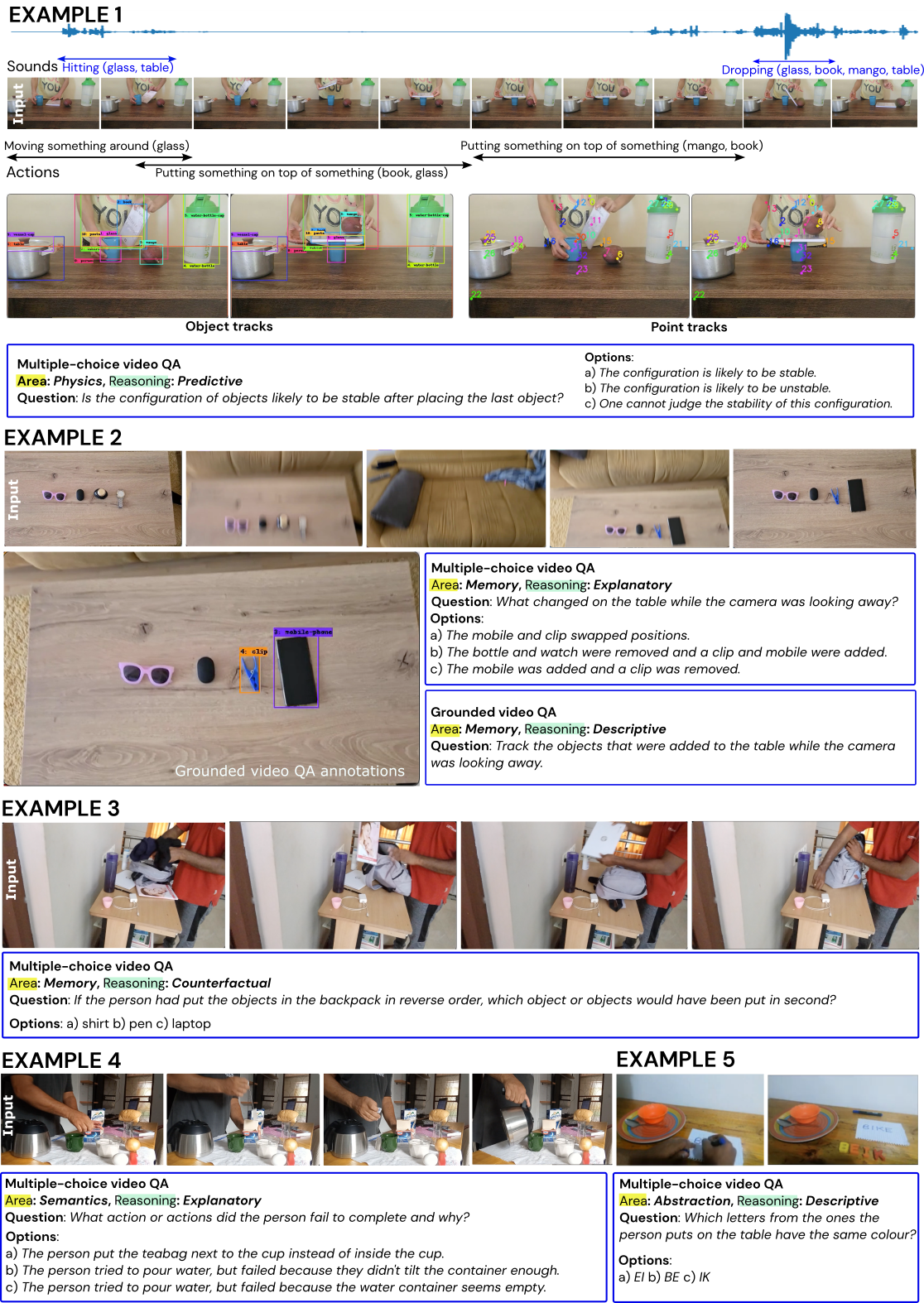
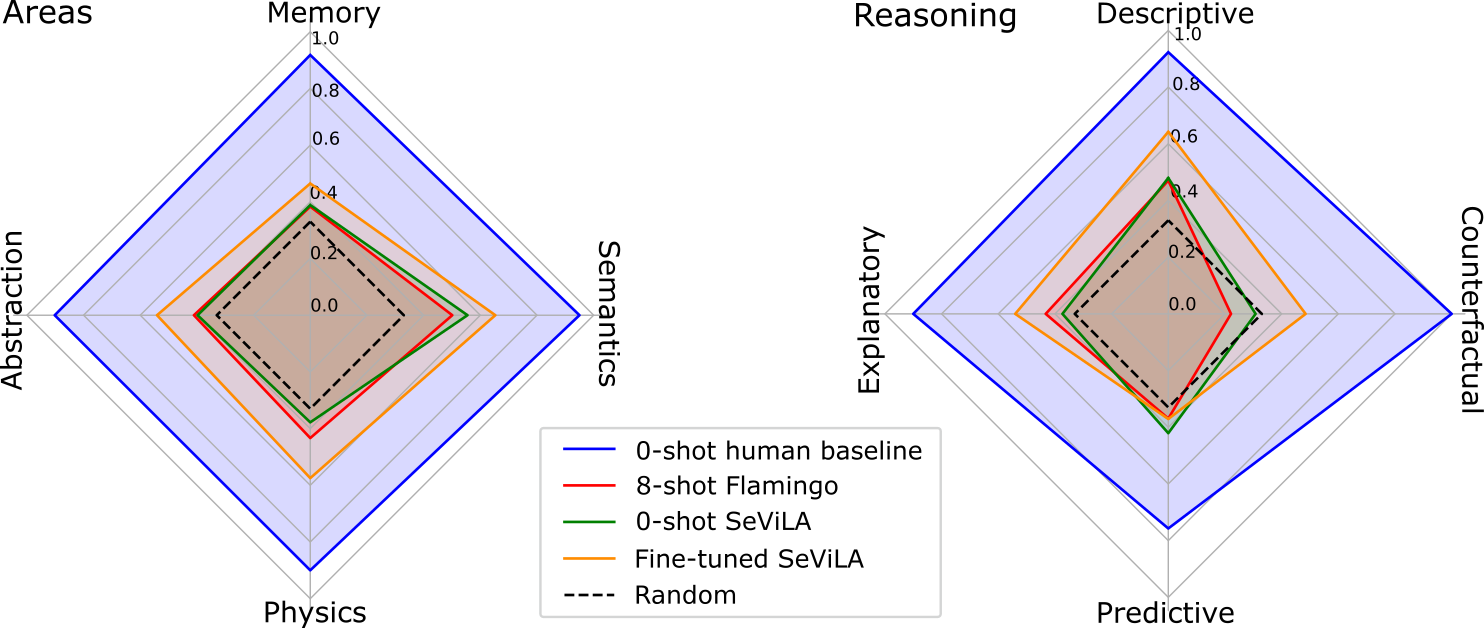
We propose a novel multimodal video benchmark - the Perception Test - to evaluate the perception and reasoning skills of pre-trained multimodal models (e.g. Flamingo, SeViLA, or GPT-4). Compared to existing benchmarks that focus on computational tasks (e.g. classification, detection or tracking), the Perception Test focuses on skills (Memory, Abstraction, Physics, Semantics) and types of reasoning (descriptive, explanatory, predictive, counterfactual) across video, audio, and text modalities, to provide a comprehensive and efficient evaluation tool. The benchmark probes pre-trained models for their transfer capabilities, in a zero-shot / few-shot or limited finetuning regime. For these purposes, the Perception Test introduces 11.6k real-world videos, 23s average length, designed to show perceptually interesting situations, filmed by around 100 participants worldwide. The videos are densely annotated with six types of labels (multiple-choice and grounded video question-answers, object and point tracks, temporal action and sound segments), enabling both language and non-language evaluations. The fine-tuning and validation splits of the benchmark are publicly available (CC-BY license), in addition to a challenge server with a held-out test split. Human baseline results compared to state-of-the-art video QA models show a substantial gap in performance (91.4% vs 46.2%), suggesting that there is significant room for improvement in multimodal video understanding. Dataset, baseline code, and challenge server are available at https://github.com/deepmind/perception_test
Motivation & Objective
- Evaluate transfer performance of pre-trained multimodal models (zero-shot, few-shot, or limited finetuning) on diverse perception skills.
- Provide a densely annotated, real-world video dataset to probe memory, abstraction, physics, and semantics.
- Offer a public training/validation split and a held-out test server to enable robust generalisation assessments.
- Enable analysis of model biases and cross-task correlations through multiple annotation types (tracking, segments, Q&A).
Proposed method
- Design 37 scripted real-world videos with variations to probe different skills and avoid language bias.
- Annotate videos with six types of labels: object tracks, point tracks, temporal action segments, temporal sound segments, mc-vQA, and grounded vQA.
- Define six computational tasks (tracking, localisation, and video QA) with task-specific evaluation metrics.
- Provide per-task baselines using zero-shot or few-shot settings to assess generalisation.
- Open-source videos, annotations, and a challenge server to facilitate reproducible evaluation.
- Include a human baseline on mc-vQA to contextualize model performance against human capability.
Experimental results
Research questions
- RQ1Can pre-trained multimodal video models generalise to memory, abstraction, physics, and semantics tasks in a zero-shot, few-shot, or limited finetuning regime?
- RQ2How do multimodal models perform across different types of reasoning (descriptive, explanatory, predictive, counterfactual) and modalities (video, audio, text)?
- RQ3What are the gaps between human performance and state-of-the-art models on a comprehensive, real-world diagnostic benchmark?
- RQ4What insights do combined annotations (tracking, segments, QA) provide about model biases and failure modes?
Key findings
- 11.6k real-world videos (23s average) with dense, multi-type annotations enable thorough multimodal evaluation.
- Humans achieve 91.4% on mc-vQA, while state-of-the-art models lag at 46.2% in zero-shot/few-shot settings, indicating substantial room for improvement.
- Perception Test reveals model weaknesses across memory, physics, and abstraction areas, often underperforming simple baselines in some tasks.
- Baseline results show task-specific bests: object tracking IoU of 0.67, point tracking Jaccard 0.401, action localisation mAP 15.56, sound localisation mAP 15.46, mc-vQA accuracy 46.2, grounded vQA IoU 0.1.
- The dataset supports generalisation-focused evaluation, with train/validation splits and a held-out test server to probe transfer capabilities across tasks.
Read this paper
Open the full text in the Nubint reader and ask about any passage as you read.
Read this paper on NubintThis review was generated by AI from the original paper. Please check the paper before citing it.