
[Paper Review] Perceptive Locomotion through Whole-Body MPC and Optimal Region Selection
The paper presents a perceptive locomotion framework that decouples surface selection from whole-body MPC, enabling online re-planning at 50–100 Hz and improved robustness to perception errors and slips.
Real-time synthesis of legged locomotion maneuvers in challenging industrial settings is still an open problem, requiring simultaneous determination of footsteps locations several steps ahead while generating whole-body motions close to the robot's limits. State estimation and perception errors impose the practical constraint of fast re-planning motions in a model predictive control (MPC) framework. We first observe that the computational limitation of perceptive locomotion pipelines lies in the combinatorics of contact surface selection. Re-planning contact locations on selected surfaces can be accomplished at MPC frequencies (50-100 Hz). Then, whole-body motion generation typically follows a reference trajectory for the robot base to facilitate convergence. We propose removing this constraint to robustly address unforeseen events such as contact slipping, by leveraging a state-of-the-art whole-body MPC (Croccodyl). Our contributions are integrated into a complete framework for perceptive locomotion, validated under diverse terrain conditions, and demonstrated in challenging trials that push the robot's actuation limits, as well as in the ICRA 2023 quadruped challenge simulation.
Motivation & Objective
- Motivate real-time, robust legged locomotion in uncertain industrial environments.
- Decouple contact planning from full-body control to enable fast online re-planning.
- Integrate terrain perception, convex surface segmentation, and surface selection with WB-MPC.
- Demonstrate the approach on challenging terrains and in ICRA 2023 quadruped simulations.
Proposed method
- Decouple contact planning from whole-body MPC while updating contact positions synchronously with MPC output at 50 Hz.
- Use a surface selection MIP to choose convex contact surfaces for the next steps (6–8 steps horizon).
- Represent surfaces as unions of convex planes extracted from a terrain elevation map and refine them with margins and convex decomposition.
- Employ a Bezier-trajectory based foot trajectory generation and a collision-free QP to adapt foot placements online.
- Integrate a state estimator with IMU, wheel odometry, LIDAR corrections, and depth camera to build the elevation map at ~1 Hz.
- Use a Riccati gain controller with WB-MPC to synthesize motions under torque limits.
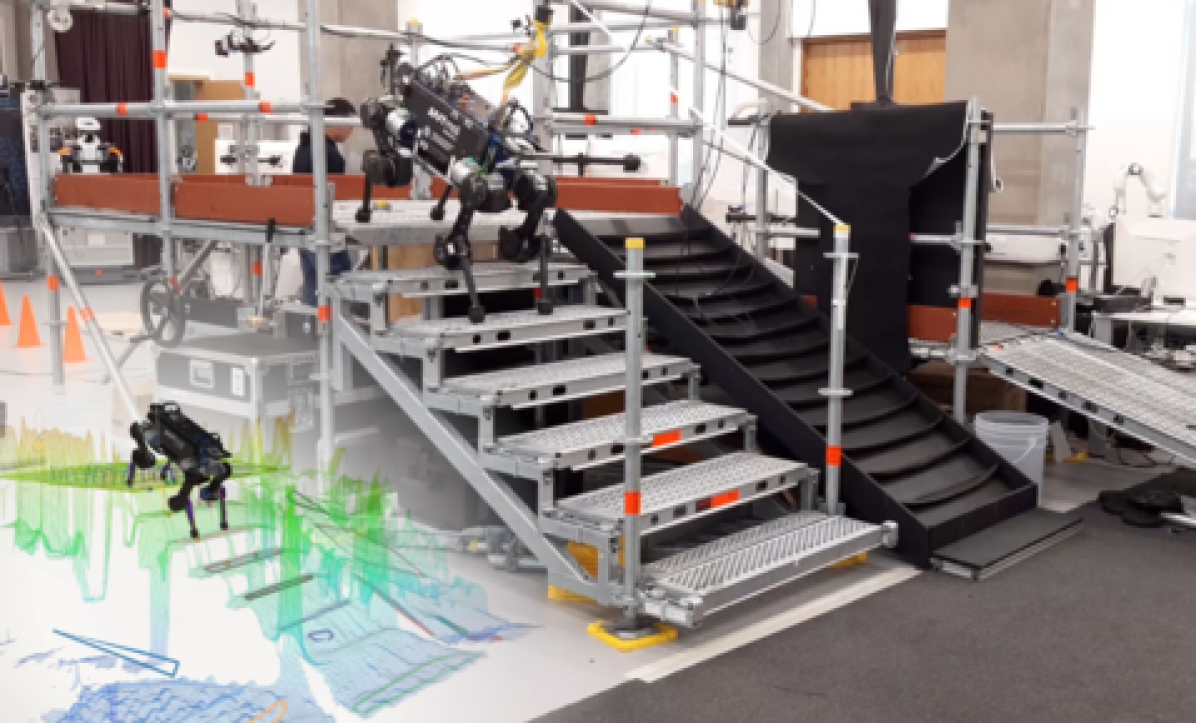
Experimental results
Research questions
- RQ1Can decoupling surface selection from WB-MPC enable higher-frequency re-planning without compromising feasibility?
- RQ2How does online surface selection at 3–5 Hz and MPC at 50 Hz affect robustness to perception errors and contact slips?
- RQ3What role do convex surface processing and margins play in reliable footstep placement on challenging terrains?
- RQ4Does incorporating WB-MPC feedback improve perceptive locomotion performance compared to reduced-dynamics approaches?
Key findings
- The surface repositioning module updated at 50 Hz provides robustness to perception errors and slips.
- The surface planner at 3–5 Hz effectively selects feasible convex surfaces for multiple upcoming steps.
- The full framework demonstrates state-of-the-art locomotion on challenging terrains and in ICRA 2023 simulations.
- Convex decomposition and safety margins reduce planning complexity and improve safety of foot placements.
- WB-MPC with torque limits and end-effector tracking enhances perturbation rejection compared to baseline approaches.
Read this paper
Open the full text in the Nubint reader and ask about any passage as you read.
Read this paper on NubintThis review was generated by AI from the original paper. Please check the paper before citing it.