
[Paper Review] Persistent hyperdigraph homology and persistent hyperdigraph Laplacians
This paper introduces persistent hyperdigraph homology and persistent hyperdigraph Laplacians to enable multiscale topological analysis of directed, structured data. By extending hyperdigraph homology and leveraging filtration-based persistent spectral methods, the approach captures both topological invariants (via Betti numbers) and quantitative structural changes (via non-harmonic spectra), demonstrating superior sensitivity to molecular interactions compared to persistent homology alone.
Hypergraphs are useful mathematical models for describing complex relationships among members of a structured graph, while hyperdigraphs serve as a generalization that can encode asymmetric relationships in the data. However, obtaining topological information directly from hyperdigraphs remains a challenge. To address this issue, we introduce hyperdigraph homology in this work. We also propose topological hyperdigraph Laplacians, which can extract both harmonic spectra and non-harmonic spectra from directed and internally organized data. Moreover, we introduce persistent hyperdigraph homology and persistent hyperdigraph Laplacians through filtration, enabling the capture of topological persistence and homotopic shape evolution of directed and structured data across multiple scales. The proposed methods offer new multiscale algebraic topology tools for topological data analysis.
Motivation & Objective
- To address the lack of topological tools for directed, asymmetric relationships in complex networks.
- To generalize hypergraph homology to hyperdigraphs by incorporating vertex order and directionality.
- To develop topological hyperdigraph Laplacians that extract both harmonic (Betti numbers) and non-harmonic spectral information.
- To introduce persistent hyperdigraph homology and Laplacians via volume- and distance-based filtrations for scale-robust shape analysis.
- To demonstrate the method’s superiority in capturing subtle structural changes in biological systems, such as protein-ligand interactions.
Proposed method
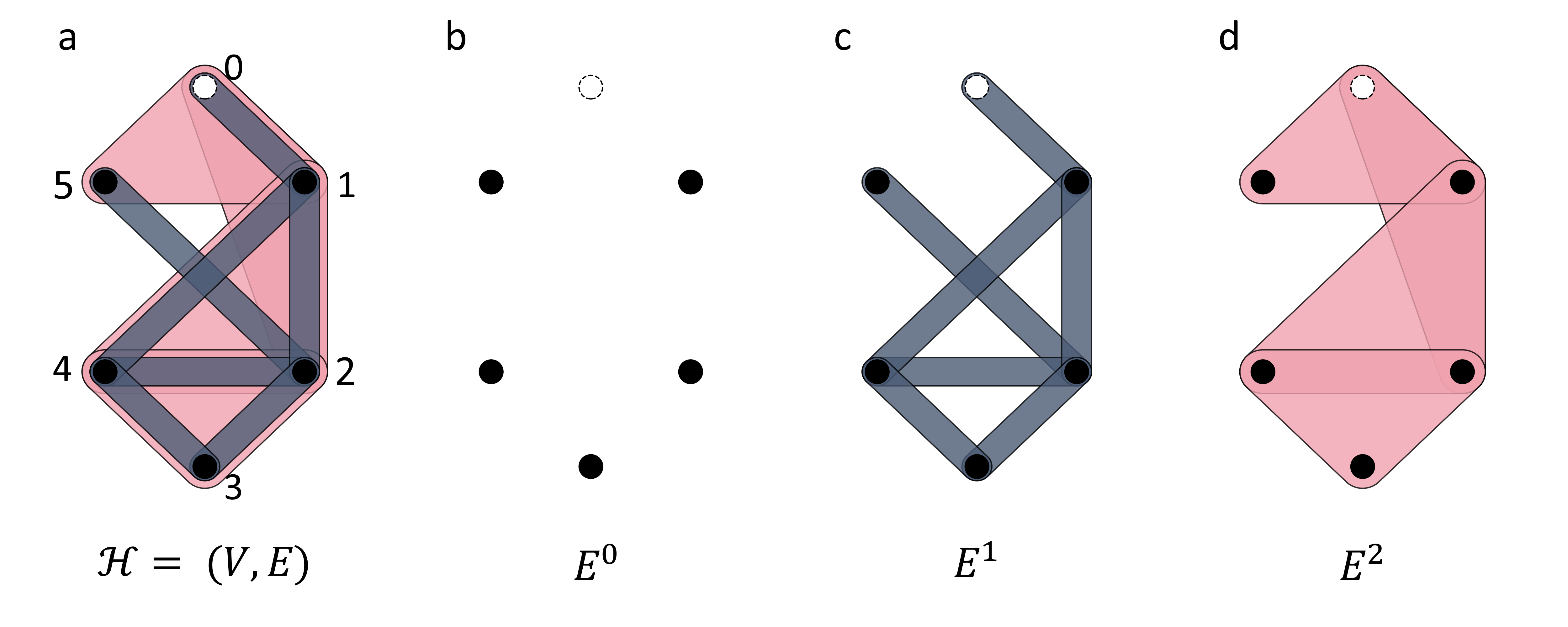
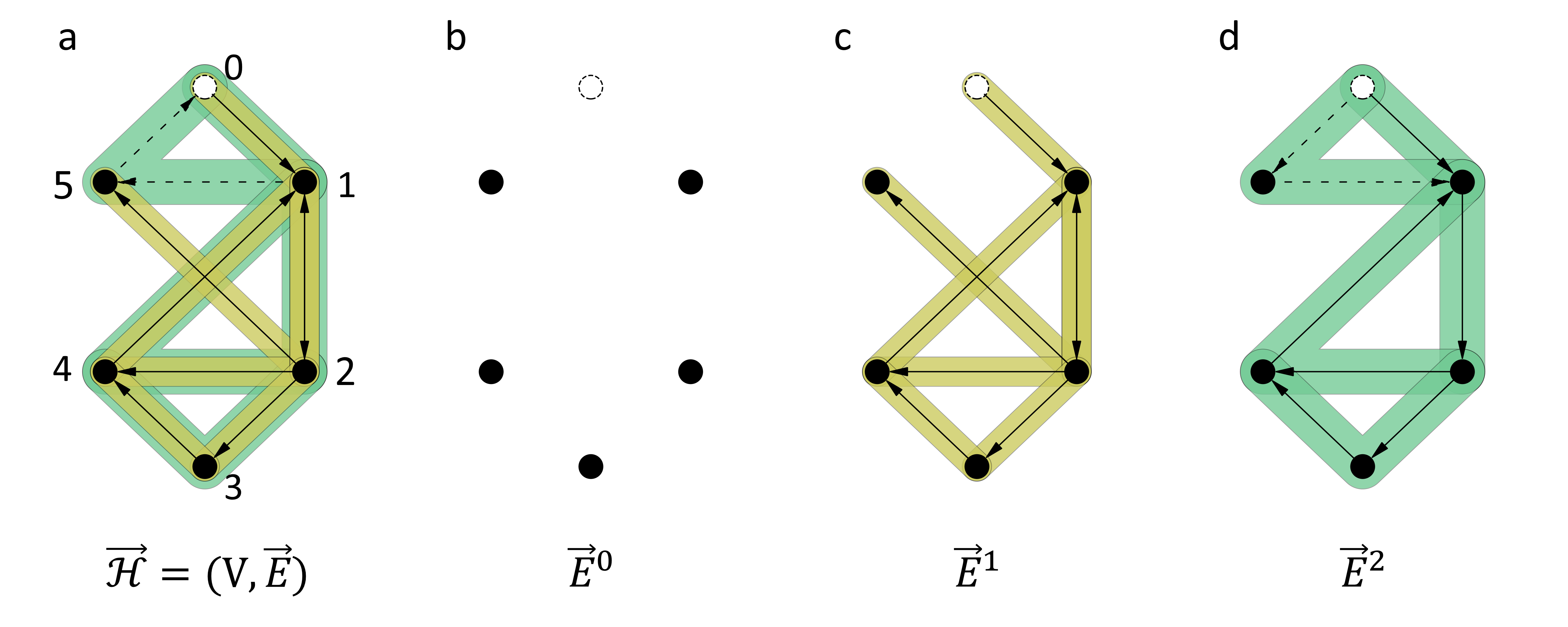
- Define hyperdigraph homology using oriented hyperedges with fixed vertex orders to encode asymmetric relationships.
- Construct topological hyperdigraph Laplacians as discrete analogs of Hodge Laplacians, generalizing graph and simplicial Laplacians to directed hypergraphs.
- Reduce hyperdigraph homology to hypergraph homology by ignoring directionality in hyperedges.
- Apply volume-based and distance-based filtrations to generate a nested sequence of hyperdigraphs for persistent analysis.
- Compute persistent Betti numbers and non-harmonic eigenvalues from the persistent Laplacian matrices across filtration parameters.
- Use smallest non-zero eigenvalues as representatives of non-harmonic spectral features to track structural evolution.
Experimental results
Research questions
- RQ1How can topological invariants be consistently defined for directed hypergraphs (hyperdigraphs) with ordered hyperedges?
- RQ2Can topological hyperdigraph Laplacians capture both topological invariants and quantitative structural features beyond Betti numbers?
- RQ3How do persistent hyperdigraph Laplacians compare to persistent homology in detecting subtle changes in complex, directed data?
- RQ4To what extent do non-harmonic spectra reveal structural dynamics not captured by harmonic spectra or Betti numbers?
- RQ5Can this framework effectively model and analyze protein-ligand interactions in molecular systems?
Key findings
- Persistent hyperdigraph Laplacians detect structural changes in protein-ligand complexes earlier and more sensitively than persistent homology, particularly through non-harmonic spectra.
- At a filtration parameter of ~2.5, the formation of new directed 1-hyperedges (ligand binding) reduced β₀ and significantly decreased λ₀ and λ₁, indicating increased connectivity and complex formation.
- The range of β₂ variation was smaller than that of λ₂, indicating that non-harmonic spectra are more sensitive to topological changes than persistent Betti numbers.
- Non-harmonic persistent eigenvalues revealed structural evolution not detectable via Betti numbers alone, demonstrating their enhanced information content.
- The method successfully distinguished topological changes in ligand binding, showing that directed hyperdigraphs and their persistent Laplacians can model complex biological interactions with higher resolution.
- Persistent hyperdigraph Laplacians outperform persistent homology by capturing both topological invariants and quantitative spectral dynamics across scales.
Read this paper
Open the full text in the Nubint reader and ask about any passage as you read.
Read this paper on NubintThis review was generated by AI from the original paper. Please check the paper before citing it.