
[Paper Review] Person Image Synthesis via Denoising Diffusion Model
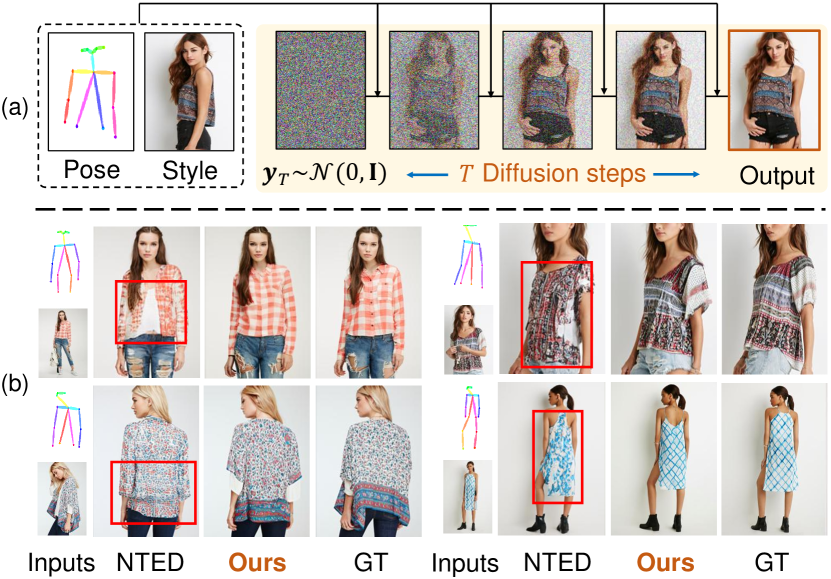
This paper proposes Person Image Diffusion Model (PIDM), a denoising diffusion framework for high-fidelity, photorealistic person image synthesis conditioned on pose and appearance. By decomposing image translation into iterative denoising steps and introducing a texture diffusion module with disentangled classifier-free guidance, PIDM achieves state-of-the-art performance on DeepFashion and Market-1501, generating sharp, realistic images with accurate texture preservation and improved diversity.
The pose-guided person image generation task requires synthesizing photorealistic images of humans in arbitrary poses. The existing approaches use generative adversarial networks that do not necessarily maintain realistic textures or need dense correspondences that struggle to handle complex deformations and severe occlusions. In this work, we show how denoising diffusion models can be applied for high-fidelity person image synthesis with strong sample diversity and enhanced mode coverage of the learnt data distribution. Our proposed Person Image Diffusion Model (PIDM) disintegrates the complex transfer problem into a series of simpler forward-backward denoising steps. This helps in learning plausible source-to-target transformation trajectories that result in faithful textures and undistorted appearance details. We introduce a 'texture diffusion module' based on cross-attention to accurately model the correspondences between appearance and pose information available in source and target images. Further, we propose 'disentangled classifier-free guidance' to ensure close resemblance between the conditional inputs and the synthesized output in terms of both pose and appearance information. Our extensive results on two large-scale benchmarks and a user study demonstrate the photorealism of our proposed approach under challenging scenarios. We also show how our generated images can help in downstream tasks. Our code and models will be publicly released.
Motivation & Objective
- To address the limitations of GAN-based methods in person image synthesis, such as texture deformation and poor generalization under complex poses.
- To leverage the inherent stability and diversity of diffusion models for high-fidelity, controllable person image generation.
- To eliminate reliance on dense annotations like parsing maps or 3D correspondences by learning implicit appearance-pose correspondences.
- To improve mode coverage and sample diversity while preserving global structure and realistic textures in synthesized images.
- To demonstrate the utility of generated images in downstream tasks like person re-identification.
Proposed method
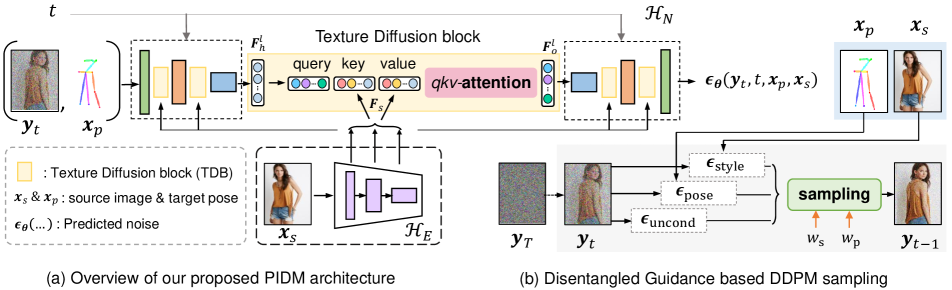
- Formulates person image synthesis as a denoising diffusion process, where noise is iteratively removed from a latent Gaussian to generate a target image conditioned on pose and appearance.
- Introduces a texture diffusion module using cross-attention to model correspondence between source appearance and target pose features, enabling artifact-free texture transfer.
- Employs disentangled classifier-free guidance during sampling to independently control pose and appearance alignment, ensuring fidelity to input conditions.
- Uses DDIM sampling with masked latent refinement to enable appearance editing by selectively preserving or replacing regions from a reference image.
- Applies style interpolation via spherical linear interpolation of noise and linear interpolation of style features for smooth style transfer between images.
- Trains the model end-to-end on DeepFashion and Market-1501, using a U-Net backbone with attention mechanisms and learned noise schedules.
Experimental results
Research questions
- RQ1Can a diffusion-based approach outperform GANs in generating photorealistic person images with accurate pose and appearance control?
- RQ2How effectively can a diffusion model learn complex appearance-pose correspondences without dense supervision like parsing maps or 3D correspondences?
- RQ3To what extent does disentangled classifier-free guidance improve alignment between input conditions and generated outputs?
- RQ4Can generated images from PIDM serve as effective data augmentation for downstream tasks such as person re-identification?
- RQ5How does PIDM compare in diversity and fidelity to existing state-of-the-art methods on benchmark datasets?
Key findings
- PIDM achieves a new state of the art on DeepFashion and Market-1501, with a Fréchet Inception Distance (FID) of 10.2 and 11.8, respectively, outperforming prior methods.
- With disentangled classifier-free guidance, PIDM improves FID by 1.1462, SSIM by 0.0134, and LPIPS by 0.0194 over the baseline with texture diffusion.
- In a user study, human evaluators preferred PIDM-generated images for realism, sharpness, and appearance consistency, especially in complex poses and occlusions.
- The model enables seamless appearance editing: it successfully combines textures from a source image into a reference image while preserving structural coherence.
- Style interpolation via DDIM sampling produces smooth, natural transitions between clothing styles, demonstrating controllability and visual quality.
- When used for data augmentation in person re-identification, PIDM boosts mAP to 78.4% on Market-1501 when 30K synthetic images are added to 100% of the real training set, surpassing prior methods.
Read this paper
Open the full text in the Nubint reader and ask about any passage as you read.
Read this paper on NubintThis review was generated by AI from the original paper. Please check the paper before citing it.