
[Paper Review] Persuasion with Large Language Models: a Survey
A systematic survey of how large language models are used to persuade across domains, factors affecting persuasiveness, experimental designs, and ethical risks.
The rapid rise of Large Language Models (LLMs) has created new disruptive possibilities for persuasive communication, by enabling fully-automated personalized and interactive content generation at an unprecedented scale. In this paper, we survey the research field of LLM-based persuasion that has emerged as a result. We begin by exploring the different modes in which LLM Systems are used to influence human attitudes and behaviors. In areas such as politics, marketing, public health, e-commerce, and charitable giving, such LLM Systems have already achieved human-level or even super-human persuasiveness. We identify key factors influencing their effectiveness, such as the manner of personalization and whether the content is labelled as AI-generated. We also summarize the experimental designs that have been used to evaluate progress. Our survey suggests that the current and future potential of LLM-based persuasion poses profound ethical and societal risks, including the spread of misinformation, the magnification of biases, and the invasion of privacy. These risks underscore the urgent need for ethical guidelines and updated regulatory frameworks to avoid the widespread deployment of irresponsible and harmful LLM Systems.
Motivation & Objective
- Map the state of LLM-based persuasion across politics, public health, marketing, e-commerce, misinformation, and charity.
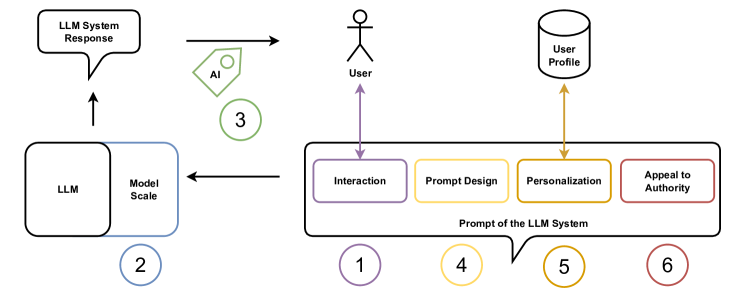
- Identify factors that influence persuasiveness, such as interaction mode, model scale, labeling, personalization, and authority.
- Review experimental designs used to evaluate LLM persuasion and measure effectiveness.
- Discuss ethical and regulatory considerations and potential societal risks of LLM-driven persuasion.
Proposed method
- Systematic review of peer-reviewed articles, conference papers, and industry reports from 2022 to 2024.
- Synthesize applications, influencing factors, methodologies, and success metrics.
- Provide a summary table (Table 1) of surveyed papers by domain, factors studied, and methodologies.
- Categorize experimental designs, treatment structures, control conditions, and success quantifications.
Experimental results
Research questions
- RQ1What domains have LLM systems been applied to for persuasion, and with what effectiveness?
- RQ2What factors consistently influence the persuasiveness of LLM-based content?
- RQ3What experimental designs are used to evaluate LLM persuasion and how do they measure success?
- RQ4What ethical and regulatory challenges arise from LLM-based persuasion, and what guidelines are suggested?
Key findings
- LLM systems can reach human-level or super-human persuasiveness in certain tasks and domains.
- Persuasiveness is significantly affected by interaction style, model scale, AI source labeling, prompt design, personalization, and appeals to authority.
- Interactive dialogue and personalization generally enhance persuasiveness, with higher engagement often yielding stronger effects.
- Disclosing AI authorship can reduce perceived persuasiveness in expert domains, though personalization can mitigate this effect.
- There are substantial ethical and societal risks, including misinformation spread, bias amplification, and privacy concerns, highlighting the need for guidelines and updated regulation.
Read this paper
Open the full text in the Nubint reader and ask about any passage as you read.
Read this paper on NubintThis review was generated by AI from the original paper. Please check the paper before citing it.