
[Paper Review] PGDiff: Guiding Diffusion Models for Versatile Face Restoration via Partial Guidance
PGDiff proposes partial guidance to steer diffusion model denoising by high-quality image properties, enabling versatile face restoration without degradation process modeling.
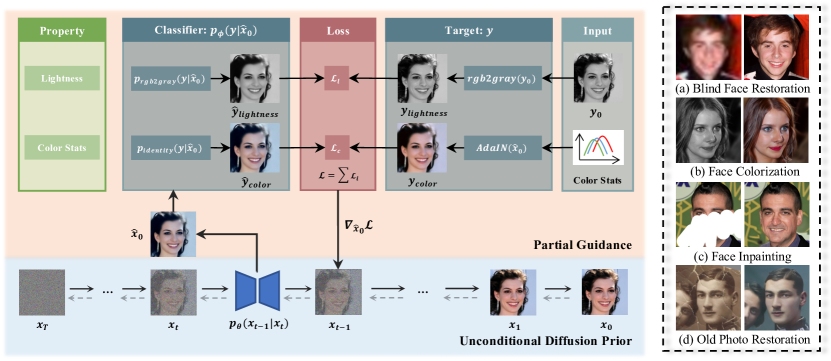
Exploiting pre-trained diffusion models for restoration has recently become a favored alternative to the traditional task-specific training approach. Previous works have achieved noteworthy success by limiting the solution space using explicit degradation models. However, these methods often fall short when faced with complex degradations as they generally cannot be precisely modeled. In this paper, we propose PGDiff by introducing partial guidance, a fresh perspective that is more adaptable to real-world degradations compared to existing works. Rather than specifically defining the degradation process, our approach models the desired properties, such as image structure and color statistics of high-quality images, and applies this guidance during the reverse diffusion process. These properties are readily available and make no assumptions about the degradation process. When combined with a diffusion prior, this partial guidance can deliver appealing results across a range of restoration tasks. Additionally, PGDiff can be extended to handle composite tasks by consolidating multiple high-quality image properties, achieved by integrating the guidance from respective tasks. Experimental results demonstrate that our method not only outperforms existing diffusion-prior-based approaches but also competes favorably with task-specific models.
Motivation & Objective
- Motivate restoration with diffusion models without assuming a specific degradation process.
- Model desired HQ image properties and guide diffusion denoising using those properties.
- Enable composite tasks by stacking guidance from multiple HQ properties.
- Demonstrate superiority over diffusion-prior-based methods and competitiveness with task-specific models.
Proposed method
- Use classifier guidance to constrain diffusion denoising toward HQ properties via back-propagated gradients.
- Introduce dynamic guidance weight and multiple gradient steps per denoising step to improve guidance effectiveness.
- Represent each HQ property with a classifier that outputs a target-guided loss for guidance.
- Allow composite tasks by summing losses from multiple properties to handle complex degradations.
- Optionally incorporate perceptual and adversarial losses for further quality gains.
Experimental results
Research questions
- RQ1Can high-quality image properties guide diffusion-based restoration without explicit degradation modeling?
- RQ2How does partial guidance perform across homogeneous and composite face restoration tasks?
- RQ3Can dynamic guidance and multi-step gradient guidance improve output quality and controllability?
- RQ4How can multiple HQ properties be composed to tackle complex degradations such as old photo restoration?
- RQ5What is the impact of adding perceptual or adversarial guidance to PGDiff?
Key findings
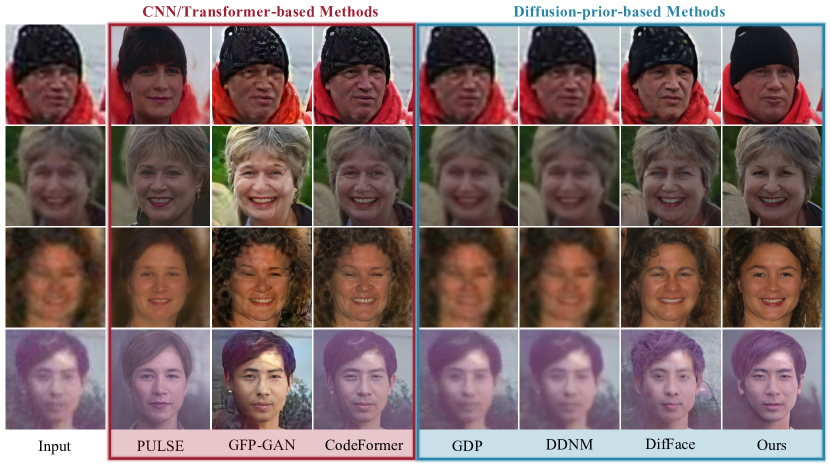
- PGDiff outperforms diffusion-prior-based approaches on challenging restoration tasks.
- PGDiff competes favorably with task-specific models across diverse tasks.
- Dynamic guidance with normalized weight improves adherence to target properties over conventional guidance.
- Multiple gradient steps per denoising step strengthen guidance and reduce artifacts.
- Composite guidance enables handling of complex degradations by combining multiple HQ properties.
- Incorporating perceptual and adversarial losses can further enhance restoration quality.
Read this paper
Open the full text in the Nubint reader and ask about any passage as you read.
Read this paper on NubintThis review was generated by AI from the original paper. Please check the paper before citing it.