
[Paper Review] Phi-4 Technical Report
Phi-4 is a 14B parameter language model that leverages heavily synthetic data, advanced data curation, and novel post-training to surpass its GPT-4o teacher on STEM reasoning benchmarks while maintaining competitive performance at a small scale.
We present phi-4, a 14-billion parameter language model developed with a training recipe that is centrally focused on data quality. Unlike most language models, where pre-training is based primarily on organic data sources such as web content or code, phi-4 strategically incorporates synthetic data throughout the training process. While previous models in the Phi family largely distill the capabilities of a teacher model (specifically GPT-4), phi-4 substantially surpasses its teacher model on STEM-focused QA capabilities, giving evidence that our data-generation and post-training techniques go beyond distillation. Despite minimal changes to the phi-3 architecture, phi-4 achieves strong performance relative to its size -- especially on reasoning-focused benchmarks -- due to improved data, training curriculum, and innovations in the post-training scheme.
Motivation & Objective
- Motivate the need for high-quality synthetic data to improve reasoning and problem-solving in smaller LLMs.
- Propose a multi-stage data strategy combining synthetic data generation, organic data curation, and post-training refinements.
- Demonstrate that data quality and training regimen can outperform larger models on reasoning benchmarks.
- Show evidence that phi-4 matches or exceeds larger baselines on multiple reasoning-heavy tasks while maintaining efficiency.
Proposed method
- Develop a 14B decoder-only transformer with a 4096 context length (extended to 16K in midtraining) and multilingual tokenization.
- Generate ~400B unweighted tokens of synthetic data via diverse techniques (multi-agent prompting, self-revision, instruction reversal, pivotal token strategies).
- Curate and filter high-quality organic data (web, books, code) to seed synthetic generation and improve alignment with reasoning tasks.
- Apply a staged training regimen with pretraining, midtraining, and post-training; adjust data mixtures and curricula based on ablations and target benchmarks.
- Use post-training methods including refined SFT datasets and Direct Preference Optimization (DPO) with pivotal-token search to steer outputs toward high-accuracy reasoning and safety.
![Figure 1 : Average performance of different models on the November 2024 AMC-10 and AMC-12 tests. This is the average score (with maximum score 150) over the four tests on 100 runs with temperature $t=0.5$ . We chose $t=0.5$ to follow simple-evals [ 24 ] . Error bars are $2\sigma$ of the estimate. On](https://ar5iv.labs.arxiv.org/html/2412.08905/assets/x1.png)
Experimental results
Research questions
- RQ1How does a data-centric training recipe with synthetic data influence reasoning capabilities in a 14B model?
- RQ2Can synthetic data and refined post-training close the gap with much larger models on STEM benchmarks like GPQA and MATH?
- RQ3What data mixtures and curricula maximize long-context reasoning and knowledge retention in phi-4?
- RQ4What is the impact of post-training methods (SFT, DPO, pivotal token search) on safety, robustness, and alignment?
Key findings
- Phi-4 achieves strong performance on reasoning benchmarks relative to its size, including comparisons to larger models on several STEM tasks.
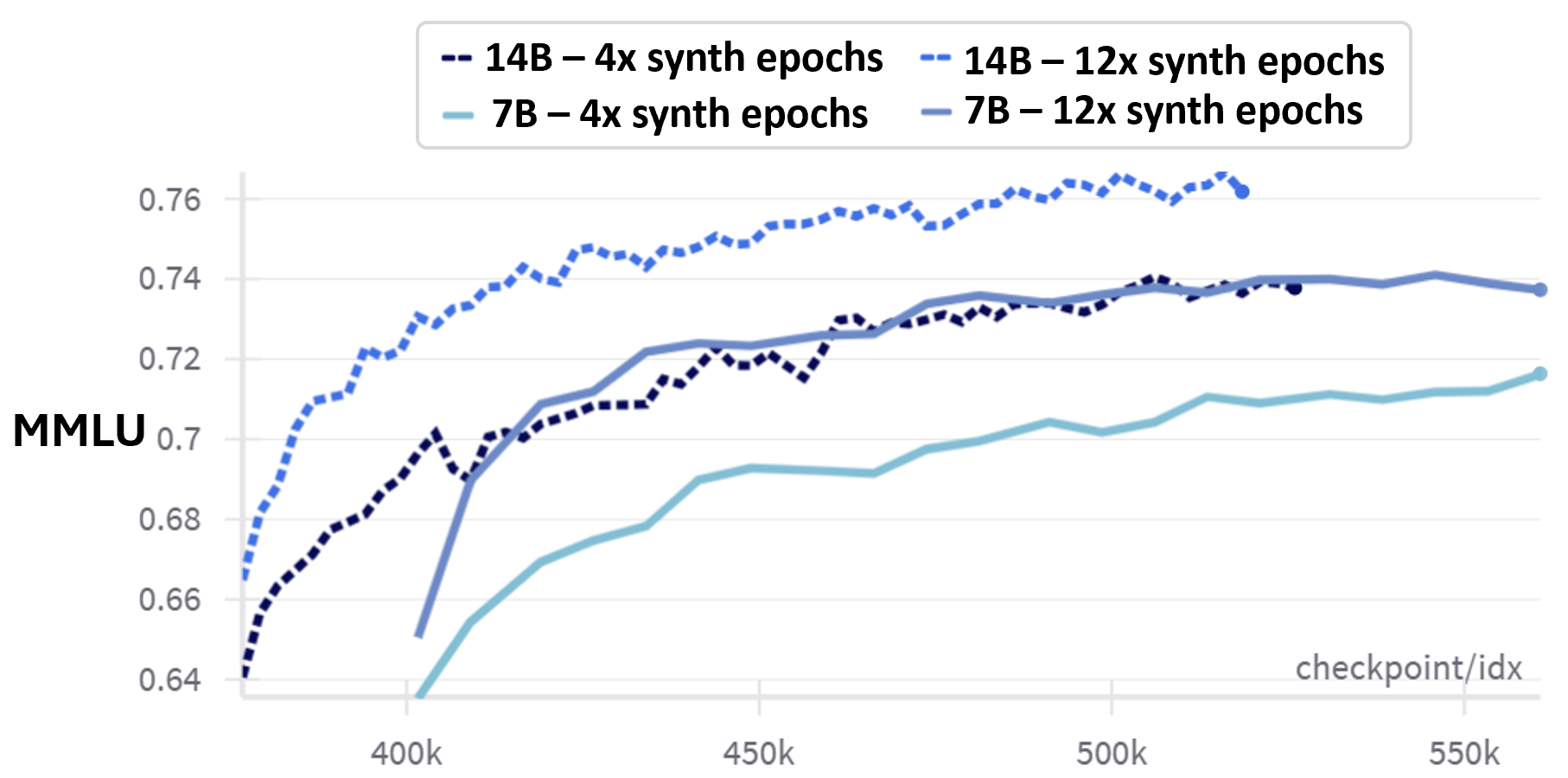
- Synthetic data is a central driver of performance, with targeted data generation and midtraining data mixtures improving long-context and reasoning capabilities.
- Post-training techniques (revised SFT, DPO with pivotal token search, judge-guided DPO) further refine outputs and enhance alignment and safety.
- A fresh, contamination-aware evaluation approach indicates phi-4’s gains are not driven by test-set leakage, including evaluation on fresh AMC-2024 contests showing competitive results on math benchmarks.
- Midtraining to extend context length (4K to 16K) combined with long-context data improves performance on long-context tasks.
- Data-ablation studies demonstrate that prioritizing synthetic data and targeted high-quality organic data yields better reasoning gains than uniform data mixes, with post-training balancing knowledge and reasoning strengths.
Better researchstarts right now
From reading papers to final review, dramatically reduce your research time.
No credit card · Free plan available
This review was created by AI and reviewed by human editors.