
[Paper Review] Phonon-induced spin-spin interactions in diamond nanostructures: application to spin squeezing
This paper proposes a phonon-mediated long-range spin-spin interaction in diamond nanobeam structures hosting nitrogen-vacancy (NV) centers, using strain-induced coupling to mechanical vibrational modes to generate effective spin-spin interactions. The method enables significant spin squeezing under realistic conditions by suppressing decoherence via spin echo and mechanical driving, offering a pathway for enhanced quantum sensing and spin-based quantum information processing.
We propose and analyze a novel mechanism for long-range spin-spin interactions in diamond nanostructures. The interactions between electronic spins, associated with nitrogen-vacancy centers in diamond, are mediated by their coupling via strain to the vibrational mode of a diamond mechanical nanoresonator. This coupling results in phonon-mediated effective spin-spin interactions that can be used to generate squeezed states of a spin ensemble. We show that spin dephasing and relaxation can be largely suppressed, allowing for substantial spin squeezing under realistic experimental conditions. Our approach has implications for spin-ensemble magnetometry, as well as phonon-mediated quantum information processing with spin qubits.
Motivation & Objective
- To develop a mechanism for long-range, coherent spin-spin interactions in diamond nanostructures using phonon-mediated coupling.
- To enable spin squeezing in NV-center ensembles by leveraging strain-induced spin-phonon coupling in mechanical nanoresonators.
- To suppress decoherence from spin dephasing and mechanical dissipation using spin echo and mechanical driving techniques.
- To demonstrate feasibility of substantial spin squeezing under realistic experimental parameters.
- To explore applications in quantum-enhanced magnetometry and phonon-mediated quantum information processing.
Proposed method
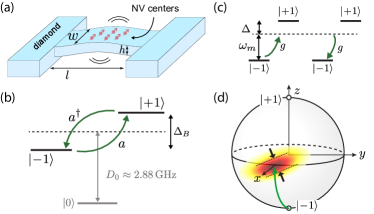
- The system consists of an ensemble of NV centers in a diamond nanobeam, where mechanical vibrations induce strain that couples to the NV spin triplet states via the spin-phonon interaction.
- The effective spin-spin interaction arises from virtual phonon exchange mediated by the mechanical mode, described by a Tavis-Cummings-type Hamiltonian coupling collective spin operators to a single mechanical mode.
- Spin echo sequences are employed to suppress dephasing, with a filter function formalism used to model pulse sequence effects on decoherence.
- Mechanical driving is applied to suppress thermal and number fluctuation noise, with the drive frequency tuned to coherence revival times.
- The dephasing and coherent terms are calculated using spectral functions of the mechanical oscillator, including thermal and driven components.
- Optimal squeezing is derived by minimizing the spin uncertainty, with analytical expressions for squeezing variance under perturbative and strong-drive conditions.
Experimental results
Research questions
- RQ1Can phonon-mediated spin-spin interactions be engineered in diamond nanostructures to enable long-range entanglement of NV centers?
- RQ2How can spin dephasing and mechanical dissipation be suppressed while preserving coherent spin-spin interactions?
- RQ3What level of spin squeezing can be achieved using strain-coupled mechanical modes under realistic experimental parameters?
- RQ4How does mechanical driving enhance spin squeezing by modifying the noise spectrum of the mechanical oscillator?
- RQ5Can the proposed mechanism enable improved performance in NV ensemble magnetometry or quantum information processing?
Key findings
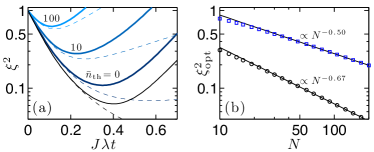
- Significant spin squeezing is achievable with realistic parameters, as demonstrated by analytical optimization of the squeezing variance.
- Spin echo techniques effectively suppress dephasing, with the filter function formalism enabling precise control over decoherence in pulse sequences.
- Mechanical driving reduces the dominant dephasing contributions by shifting the oscillator's spectral response, enabling a net reduction in effective noise.
- In the strong-drive limit, the optimal squeezing is achieved when the drive strength is set to the maximum allowed in the perturbative regime, scaling as $ \xi^2 \sim \frac{\gamma\bar{n}_{\rm th}}{Jg^2 t} + \frac{t}{T_2} $.
- The coherent term $ \mu $ from the asymmetric part of the noise spectrum contributes to additional squeezing, particularly when the drive is tuned to coherence revival times.
- The method enables substantial spin squeezing even with $ \chi_{\rm dr} \gg \chi_{\rm th} $, demonstrating robustness against thermal noise.
Read this paper
Open the full text in the Nubint reader and ask about any passage as you read.
Read this paper on NubintThis review was generated by AI from the original paper. Please check the paper before citing it.