
[Paper Review] Photorealistic Video Generation with Diffusion Models
This paper introduces W.A.L.T., a transformer-based latent diffusion model for photorealistic video generation that uses a causal encoder to unify image and video latents and windowed attention for efficient spatiotemporal modeling. It achieves state-of-the-art FVD scores on UCF-101 without classifier-free guidance, demonstrating superior quality and efficiency in text-to-video generation at 512×896 resolution and 8 fps.
We present W.A.L.T, a transformer-based approach for photorealistic video generation via diffusion modeling. Our approach has two key design decisions. First, we use a causal encoder to jointly compress images and videos within a unified latent space, enabling training and generation across modalities. Second, for memory and training efficiency, we use a window attention architecture tailored for joint spatial and spatiotemporal generative modeling. Taken together these design decisions enable us to achieve state-of-the-art performance on established video (UCF-101 and Kinetics-600) and image (ImageNet) generation benchmarks without using classifier free guidance. Finally, we also train a cascade of three models for the task of text-to-video generation consisting of a base latent video diffusion model, and two video super-resolution diffusion models to generate videos of $512 imes 896$ resolution at $8$ frames per second.
Motivation & Objective
- To develop a scalable, efficient, and high-quality video generation framework using transformers, overcoming limitations of U-Net-based diffusion models in video generation.
- To unify image and video modeling in a shared latent space using a causal encoder, enabling joint training on large-scale image and video datasets.
- To reduce computational cost in video diffusion by introducing a windowed attention mechanism that limits self-attention to local spatial and spatiotemporal windows.
- To achieve state-of-the-art performance in both image and video generation without relying on classifier-free guidance.
- To enable high-resolution, temporally consistent text-to-video generation at 512×896 resolution and 8 fps using a cascade of three diffusion models.
Proposed method
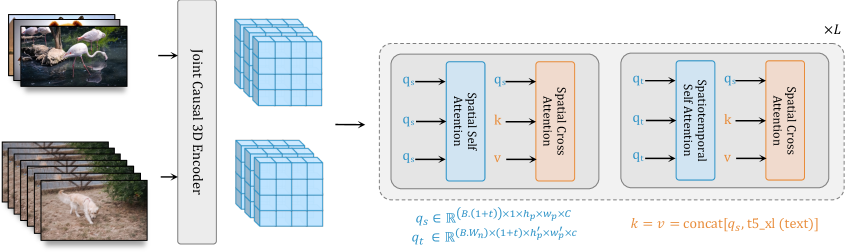
- A causal encoder compresses images and videos into a unified, lower-dimensional latent space, enabling joint training on image and video datasets.
- The transformer backbone employs alternating window-restricted spatial and spatiotemporal self-attention layers to reduce memory and compute costs.
- Spatial attention layers process images and video frames independently, while spatiotemporal layers model temporal dependencies in videos using non-overlapping local windows.
- Identity attention masks allow image inputs to pass through spatiotemporal layers unchanged, preserving modality-specific processing.
- Text conditioning is applied via spatial cross-attention, enabling text-to-video generation with natural language prompts.
- A three-stage cascade model is trained: a base latent video diffusion model followed by two video super-resolution diffusion models to scale up to 512×896 resolution.
Experimental results
Research questions
- RQ1Can a transformer-based architecture achieve state-of-the-art performance in video generation while maintaining computational efficiency?
- RQ2Does joint training on image and video datasets improve generation quality in latent video diffusion models?
- RQ3Can windowed attention mechanisms effectively replace full-attention or U-Net backbones in video diffusion without sacrificing quality?
- RQ4How does model scaling and joint image-video pretraining affect text-to-video generation performance?
- RQ5Can a cascaded diffusion framework generate high-resolution, photorealistic, and temporally consistent videos from text prompts?
Key findings
- W.A.L.T. achieves a state-of-the-art FVD score of 258.1 on the UCF-101 zero-shot text-to-video benchmark using a 3B-parameter model trained jointly on image and video data.
- The model achieves an inception score of 35.1 on UCF-101, outperforming all prior methods except PYoCo, which uses stronger text encoders.
- Joint training on image and video datasets leads to a 20.5% improvement in FVD over a video-only baseline, demonstrating the benefit of multi-modal pretraining.
- Scaling the model from 419M to 3B parameters improves FVD by 116.7 points, indicating strong scalability of the framework.
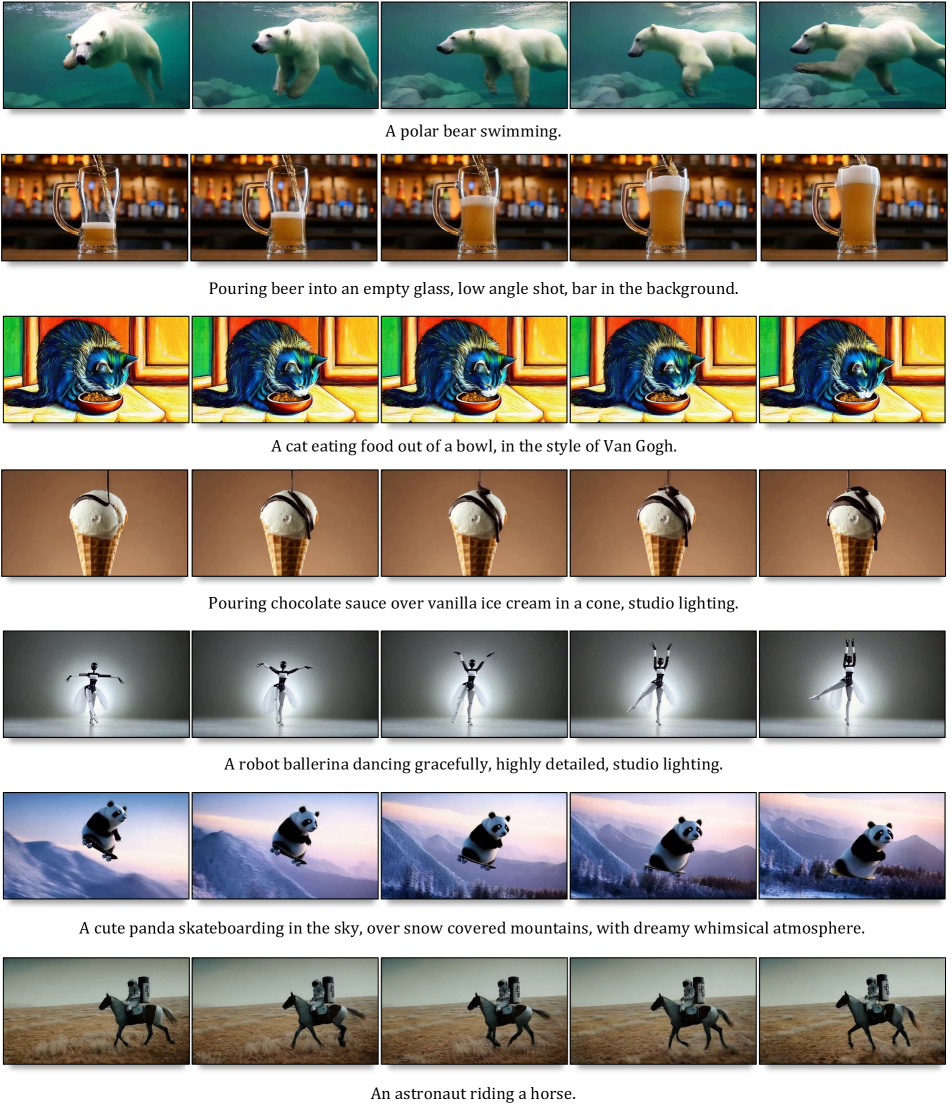
- The model generates 512×896 resolution videos at 8 fps with high temporal consistency and photorealistic quality, as validated by qualitative samples.
- The method achieves SOTA results on UCF-101 and Kinetics-600 for class-conditional video generation and ImageNet for class-conditional image generation without using classifier-free guidance.
Read this paper
Open the full text in the Nubint reader and ask about any passage as you read.
Read this paper on NubintThis review was generated by AI from the original paper. Please check the paper before citing it.