
[Paper Review] PhySG: Inverse Rendering with Spherical Gaussians for Physics-based Material Editing and Relighting
PhySG presents an end-to-end differentiable inverse rendering pipeline that jointly reconstructs geometry, materials, and illumination from multi-view RGB images under static natural lighting. By representing BRDFs and environment maps with spherical Gaussians and geometry with a neural SDF, it enables accurate novel view synthesis, relighting, and physics-based material editing—outperforming non-physical neural rendering baselines in handling specular reflections.
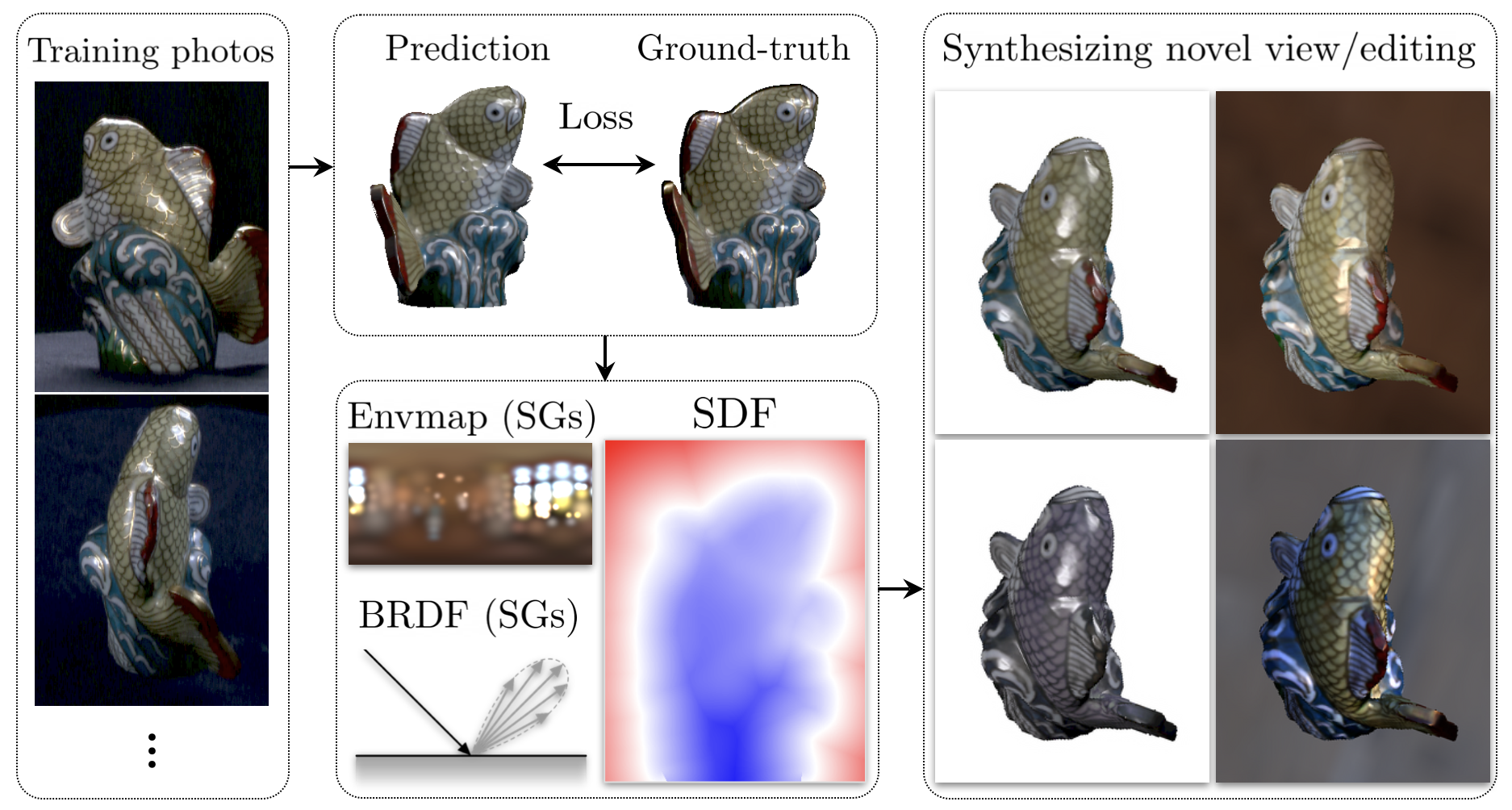
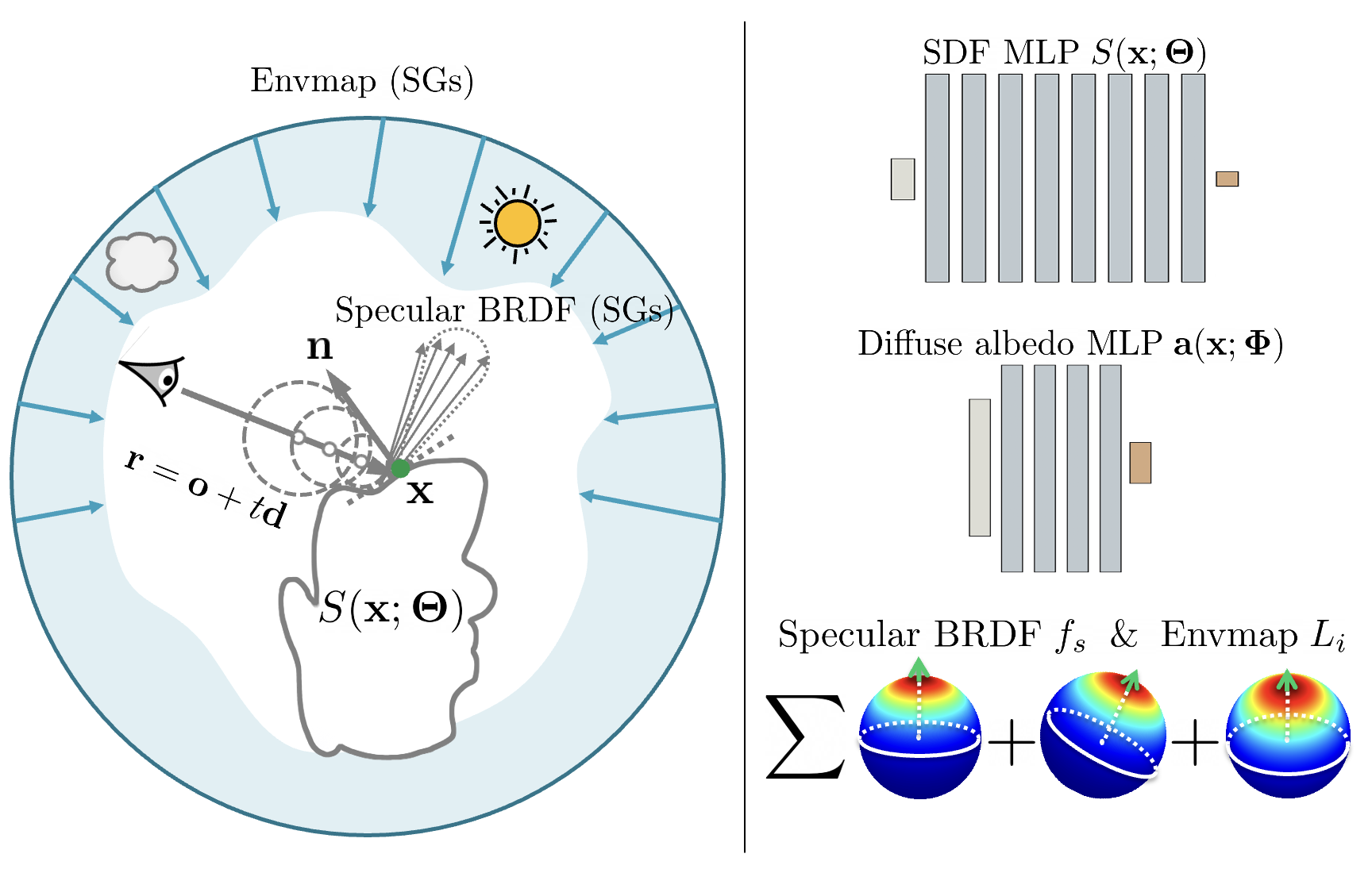
We present PhySG, an end-to-end inverse rendering pipeline that includes a fully differentiable renderer and can reconstruct geometry, materials, and illumination from scratch from a set of RGB input images. Our framework represents specular BRDFs and environmental illumination using mixtures of spherical Gaussians, and represents geometry as a signed distance function parameterized as a Multi-Layer Perceptron. The use of spherical Gaussians allows us to efficiently solve for approximate light transport, and our method works on scenes with challenging non-Lambertian reflectance captured under natural, static illumination. We demonstrate, with both synthetic and real data, that our reconstructions not only enable rendering of novel viewpoints, but also physics-based appearance editing of materials and illumination.
Motivation & Objective
- To address the challenge of jointly reconstructing geometry, materials, and illumination from multi-view RGB images under static, natural lighting without RGBD or controlled illumination.
- To enable physically plausible appearance editing and relighting by disentangling lighting and material properties.
- To overcome limitations of neural rendering methods that model appearance as a single neural surface light field, which precludes physical editing.
- To develop a fully differentiable renderer that supports end-to-end optimization using spherical Gaussians for efficient light transport approximation.
- To demonstrate robustness to weak specular highlights and applicability to real-world glossy objects with non-Lambertian reflectance.
Proposed method
- Geometry is represented as a signed distance function (SDF) parameterized by a Multi-Layer Perceptron (MLP), enabling implicit surface representation.
- Specular BRDFs and environmental illumination are modeled as mixtures of spherical Gaussians (SGs), enabling closed-form, differentiable evaluation of the rendering equation.
- The entire pipeline is end-to-end differentiable, allowing joint optimization of geometry, materials, and lighting from 2D image supervision using a photometric loss.
- Spherical Gaussians are used to approximate the rendering equation, enabling efficient and differentiable computation of light transport without Monte Carlo sampling.
- A scale alignment strategy is applied to the diffuse albedo to resolve scale ambiguity in inverse rendering, improving visual fidelity for comparison.
- The method is trained using a differentiable renderer that supports view-dependent effects, enabling accurate synthesis of specular highlights.
Experimental results
Research questions
- RQ1Can a fully differentiable inverse rendering pipeline jointly reconstruct geometry, materials, and illumination from multi-view RGB images under static natural lighting?
- RQ2How well can spherical Gaussians approximate complex light transport for specular and glossy materials in a differentiable rendering framework?
- RQ3Can the method enable physically intuitive material editing and relighting without requiring prior geometry or controlled lighting?
- RQ4How does the method perform on real-world data with challenging non-Lambertian reflectance and weak specular highlights?
- RQ5What are the limitations of the approach in handling indirect illumination and spatially varying BRDFs?
Key findings
- PhySG achieves state-of-the-art performance in novel view synthesis on synthetic and real data, outperforming NeRF, IDR, and DVR in handling specular reflections.
- The method successfully reconstructs plausible environment maps even from images with very weak specular highlights, demonstrating robustness to low reflectance.
- Physics-based material editing and relighting are achieved by disentangling BRDF and illumination through spherical Gaussian representations.
- The geometry reconstruction quality is nearly on par with IDR, while surpassing it in appearance modeling and editability.
- The method generalizes to real-world scenes with glossy, non-Lambertian materials, producing photo-realistic results in novel view synthesis and editing.
- Baseline methods like redner fail to converge when optimizing from a spherical initialization, highlighting the advantage of the SDF-based implicit geometry in PhySG.
Read this paper
Open the full text in the Nubint reader and ask about any passage as you read.
Read this paper on NubintThis review was generated by AI from the original paper. Please check the paper before citing it.