
[Paper Review] Physical Layer Security Enhancement With Reconfigurable Intelligent Surface-Aided Networks
This paper proposes a stochastic geometry-based framework to analyze physical layer security in reconfigurable intelligent surface (RIS)-aided downlink MIMO networks with randomly located multi-antenna users and a multi-antenna eavesdropper. By deriving exact closed-form expressions for the signal-to-interference-plus-noise ratio (SINR) distribution using Fisher-Snedecor F-distribution modeling, the study demonstrates that RIS significantly enhances secrecy performance—especially with a larger number of reflecting elements—outperforming traditional MIMO systems in secrecy outage probability, secrecy capacity, and average secrecy rate.
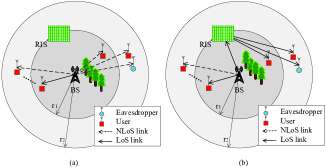
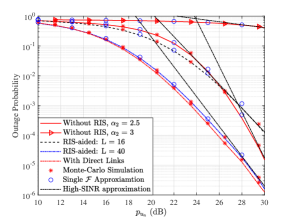
Reconfigurable intelligent surface (RIS)-aided wireless communications have drawn significant attention recently. We study the physical layer security of the downlink RIS-aided transmission framework for randomly located users in the presence of a multi-antenna eavesdropper. To show the advantages of RIS-aided networks, we consider two practical scenarios: Communication with and without RIS. In both cases, we apply the stochastic geometry theory to derive exact probability density function (PDF) and cumulative distribution function (CDF) of the received signal-to-interference-plus-noise ratio. Furthermore, the obtained PDF and CDF are exploited to evaluate important security performance of wireless communication including the secrecy outage probability, the probability of nonzero secrecy capacity, and the average secrecy rate. Monte-Carlo simulations are subsequently conducted to validate the accuracy of our analytical results. Compared with traditional MIMO systems, the RIS-aided system offers better performance in terms of physical layer security. In particular, the security performance is improved significantly by increasing the number of reflecting elements equipped in a RIS. However, adopting RIS equipped with a small number of reflecting elements cannot improve the system performance when the path loss of NLoS is small.
Motivation & Objective
- To evaluate the physical layer security (PLS) performance of RIS-aided downlink MIMO networks in realistic scenarios with randomly located users and a multi-antenna eavesdropper.
- To establish a novel analytical framework based on stochastic geometry to model the topological randomness of user locations and channel conditions.
- To quantify the secrecy performance gains provided by RIS compared to conventional MIMO systems, particularly in terms of secrecy outage probability, nonzero secrecy capacity, and average secrecy rate.
- To investigate the impact of RIS configuration—especially the number of reflecting elements—on security enhancement under varying propagation conditions.
Proposed method
- Models the downlink RIS-aided MIMO system using stochastic geometry to capture the random spatial distribution of users and eavesdroppers.
- Derives exact closed-form expressions for the probability density function (PDF) and cumulative distribution function (CDF) of the received SINR using the Fisher-Snedecor F-distribution.
- Applies Mellin-Barnes integral representations and Meijer's G-function to express the CDF and outage probability in analytically tractable forms.
- Considers two scenarios: with and without RIS deployment, enabling comparative analysis of secrecy performance.
- Uses the derived SINR distributions to compute key secrecy metrics: secrecy outage probability, probability of nonzero secrecy capacity, and average secrecy rate.
- Validates analytical results through Monte Carlo simulations, ensuring accuracy across diverse path loss and deployment conditions.
Experimental results
Research questions
- RQ1How does the deployment of a reconfigurable intelligent surface (RIS) affect the physical layer secrecy performance in a downlink MIMO network with randomly located users?
- RQ2What is the impact of the number of reflecting elements in an RIS on the secrecy outage probability and average secrecy rate?
- RQ3Under what propagation conditions does RIS fail to improve security, particularly when the non-line-of-sight (NLoS) path loss is small?
- RQ4How do the statistical properties of the SINR—specifically its PDF and CDF—differ between RIS-aided and non-RIS-aided systems?
- RQ5Can stochastic geometry effectively model the secrecy performance of RIS-aided networks with multi-antenna eavesdroppers and user mobility?
Key findings
- RIS-aided systems significantly outperform traditional MIMO systems in physical layer security, particularly in reducing secrecy outage probability.
- The secrecy performance improves substantially with an increasing number of reflecting elements on the RIS, demonstrating a direct scaling gain.
- When the path loss in the non-line-of-sight (NLoS) link is small, RIS with a small number of reflecting elements fails to enhance security, indicating a threshold effect.
- The derived PDF and CDF of the SINR are expressed in terms of Meijer's G-function, enabling exact analytical evaluation of secrecy metrics.
- The probability of nonzero secrecy capacity and average secrecy rate are analytically derived and validated via Monte Carlo simulations, confirming the accuracy of the stochastic geometry framework.
- The proposed framework successfully captures the impact of user location randomness and multi-antenna eavesdropping, offering a practical tool for secure RIS network design.
Better researchstarts right now
From reading papers to final review, dramatically reduce your research time.
No credit card · Free plan available
This review was created by AI and reviewed by human editors.