
[Paper Review] Physics Informed Deep Learning: Applications in Transportation
This paper proposes physics-informed deep learning (PIDL) to enhance traffic state estimation using sparse sensor data by embedding the Lighthill-Whitham-Richards (LWR) conservation law into a deep neural network. PIDL achieves 75.2% accuracy with 8.24s training time—significantly outperforming a standard deep learning model (24.3% accuracy, 41.18s) under extreme data scarcity (20.8% of data available), demonstrating improved convergence and reconstruction accuracy in real-time transportation applications.
A recent development in machine learning - physics-informed deep learning (PIDL) - presents unique advantages in transportation applications such as traffic state estimation. Consolidating the benefits of deep learning (DL) and the governing physical equations, it shows the potential to complement traditional sensing methods in obtaining traffic states. In this paper, we first explain the conservation law from the traffic flow theory as ``physics'', then present the architecture of a PIDL neural network and demonstrate its effectiveness in learning traffic conditions of unobserved areas. In addition, we also exhibit the data collection scenario using fog computing infrastructure. A case study on estimating the vehicle velocity is presented and the result shows that PIDL surpasses the performance of a regular DL neural network with the same learning architecture, in terms of convergence time and reconstruction accuracy. The encouraging results showcase the broad potential of PIDL for real-time applications in transportation with a low amount of training data.
Motivation & Objective
- To address the challenge of traffic state estimation (TSE) with sparse, noisy, and incomplete sensor data from loop detectors and other field sensors.
- To improve the accuracy and convergence speed of deep learning models in TSE by integrating physical laws of traffic flow as inductive bias.
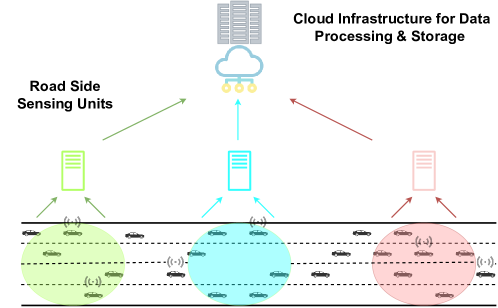
- To demonstrate the feasibility of PIDL in real-time transportation systems using a fog computing data collection architecture.
- To evaluate PIDL performance under extreme data scarcity, simulating real-world sensor failure and limited transmission capacity.
- To compare PIDL against standard deep learning under identical architectures to isolate the impact of physics-informed regularization.
Proposed method
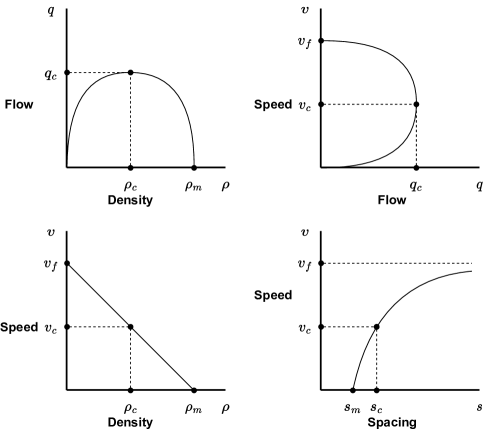
- The PIDL model integrates the Lighthill-Whitham-Richards (LWR) conservation law as a physics-based regularization term in the loss function, enforcing continuity between flow, density, and speed.
- The model uses a deep neural network with identical architecture to a standard DL network, differing only in the inclusion of physics-based loss terms.
- The physics loss is derived from the continuity equation: ∂q/∂x + ∂ρ/∂t = 0, ensuring conservation of vehicles across space and time.
- A synthetic dataset of vehicle velocity is generated using the Lax-Hopf method under zero upstream and downstream flow conditions, simulating traffic shockwaves.
- Fog computing infrastructure is employed to model data collection, with edge devices transmitting only 20.8% of available data to reduce network load.
- Greenshields’ fundamental diagram is used to define the relationship between speed, density, and flow, providing the physical constraints for the model.
Experimental results
Research questions
- RQ1Can incorporating the LWR conservation law into a deep learning model improve estimation accuracy and convergence speed in traffic state estimation with sparse data?
- RQ2How does physics-informed deep learning perform under extreme data scarcity, such as only 20.8% of sensor data being available?
- RQ3Can PIDL generalize to unobserved regions of a road network where no sensors are present?
- RQ4How does PIDL compare to standard deep learning in terms of training time and reconstruction accuracy under identical network architectures?
- RQ5What is the impact of varying training sample sizes on PIDL and standard DL performance in TSE?
Key findings
- PIDL achieved 75.2% estimation accuracy with a training time of 8.24 seconds, significantly outperforming standard deep learning, which achieved only 24.3% accuracy and required 41.18 seconds.
- Under a low-data regime (20.8% of data available), PIDL successfully reconstructed the spatial-temporal velocity field with patterns matching the synthetic dataset, while the standard DL model failed to produce a meaningful estimation.
- With increasing training sample sizes (500 to 1000 data points, representing 0.416% to 0.832% of total data), PIDL maintained superior accuracy, reaching 81.65% at 500 samples and 83.32% at 750 samples, while DL remained below 36%.
- The performance gap between PIDL and standard DL widened as data scarcity increased, indicating that physics-informed regularization effectively mitigates overfitting in low-data regimes.
- PIDL demonstrated robustness and faster convergence, suggesting strong potential for real-time deployment in transportation systems with limited data.
- The results confirm that embedding physical laws into deep learning improves generalization and accuracy, especially when training data is sparse or noisy.
Read this paper
Open the full text in the Nubint reader and ask about any passage as you read.
Read this paper on NubintThis review was generated by AI from the original paper. Please check the paper before citing it.