
[Paper Review] Physics Informed Deep Learning for Flow and Transport in Porous Media
This paper presents a physics-informed deep learning framework using neural networks trained to satisfy the governing partial differential equations (PDEs) of flow and transport in porous media, specifically the Buckley-Leverett equation. By embedding physical laws and boundary conditions directly into the loss function, the model accurately captures shock and rarefaction waves in 1D and 2D hyperbolic problems, achieving state-of-the-art results with robust convergence despite discontinuities.
We present our progress on the application of physics informed deep learning to reservoir simulation problems. The model is a neural network that is jointly trained to respect governing physical laws and match boundary conditions. The methodology is hereby used to simulate a 2-phase immiscible transport problem (Buckley-Leverett). The model is able to produce an accurate physical solution both in terms of shock and rarefaction and honors the governing partial differential equation along with initial and boundary conditions. We test various hypothesis (uniform and non-uniform initial conditions) and show that with the proper implementation of physical constraints, a robust solution can be trained within a reasonable amount of time and iterations. We revisit some of the limitations presented in previous work \cite{Fuks2020} and further the applicability of this method in a forward, pure hyperbolic setup. We also share some practical findings on the application of physics informed neural networks (PINN). We review various network architectures presented in the literature and show tips that helped improve their convergence and accuracy. The proposed methodology is a simple and elegant way to instill physical knowledge to machine-learning algorithms. This alleviates the two most significant shortcomings of machine-learning algorithms: the requirement for large datasets and the reliability of extrapolation. The principles presented can be generalized in innumerable ways in the future and should lead to a new class of algorithms to solve both forward and inverse physical problems.
Motivation & Objective
- To address the lack of robust, physically consistent machine learning methods for Earth systems with complex physics and limited data.
- To develop a deep learning framework that enforces conservation laws and boundary conditions directly in the training process.
- To improve generalization and reliability of ML models in subsurface flow simulation without requiring large labeled datasets.
- To demonstrate the method’s effectiveness on non-linear, hyperbolic PDEs such as the Buckley-Leverett problem with discontinuous solutions.
- To explore architectural and training strategies that enhance convergence and accuracy in physics-informed neural networks (PINNs).
Proposed method
- A deep neural network is trained to approximate the solution of the Buckley-Leverett PDE by minimizing a composite loss function that includes residual PDE terms, initial conditions, and boundary conditions.
- The loss function incorporates physical constraints such as entropy conditions and flux continuity to ensure physically valid solutions, especially at discontinuities.
- The permeability field is modeled as a neural network surrogate, trained jointly with the flow solution but without backpropagating gradients through it to avoid artifacts.
- Network architectures including Fourier networks, DGM, and SiRen (periodic networks) are evaluated, with simple fully connected networks showing superior performance for this problem.
- A grid-less, collocation-based approach samples points across space and time, enabling full-domain optimization in each training iteration.
- Proper weighting of loss components and implementation of entropy constraints are critical to stabilize training and improve convergence.
Experimental results
Research questions
- RQ1Can physics-informed neural networks accurately simulate non-linear, hyperbolic PDEs with discontinuous solutions such as shocks and rarefactions in porous media flow?
- RQ2How do different neural network architectures (e.g., Fourier, SiRen, DGM) compare in solving the Buckley-Leverett problem with respect to accuracy and convergence?
- RQ3What role do physical constraints—such as entropy conditions and flux continuity—play in stabilizing training and improving solution fidelity?
- RQ4Can PINNs generalize effectively to problems with non-uniform initial conditions and complex heterogeneities without large-scale labeled data?
- RQ5How does the joint training of flow solutions and permeability field surrogates affect solution quality and training stability?
Key findings
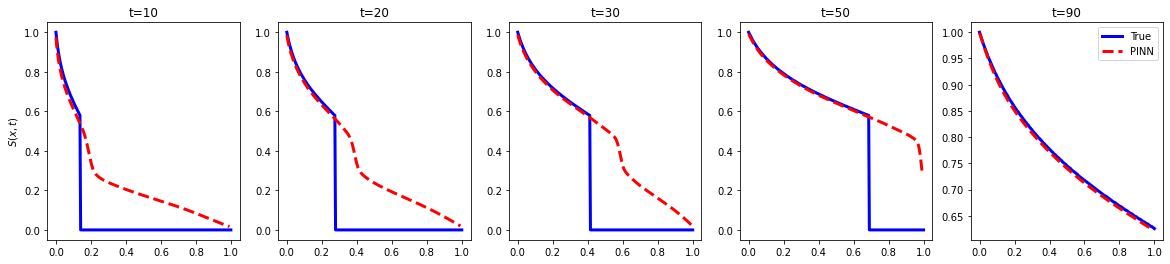
- The model successfully captures both shock and rarefaction waves in the 1D Buckley-Leverett problem with high accuracy, setting a new state of the art.
- Training convergence is significantly improved by incorporating entropy conditions and proper loss weighting, especially in the presence of sharp discontinuities.
- The 2D simulations required approximately 400,000 iterations and 3 hours of training time on a Tesla V100 GPU, with each iteration processing the full space-time domain.
- Artifacts in the permeability field were avoided by preventing gradient flow through the surrogate permeability network, preserving its static nature.
- Simple fully connected networks outperformed more complex architectures like Fourier and SiRen networks for this problem, suggesting architectural simplicity can be advantageous.
- The method enables early inference—usable results are available before full training completion—due to full-domain optimization per iteration.
Read this paper
Open the full text in the Nubint reader and ask about any passage as you read.
Read this paper on NubintThis review was generated by AI from the original paper. Please check the paper before citing it.