
[Paper Review] Physics-Informed Deep Learning for Traffic State Estimation
This paper proposes a physics-informed deep learning (PIDL) framework for highway traffic state estimation using loop detector data, integrating LWR-based traffic flow models with deep neural networks to improve estimation accuracy and data efficiency. The method achieves superior performance with fewer sensors—achieving errors below 0.06 using only eight loop detectors—outperforming both model-driven and data-driven baselines.
Traffic state estimation (TSE), which reconstructs the traffic variables (e.g., density) on road segments using partially observed data, plays an important role on efficient traffic control and operation that intelligent transportation systems (ITS) need to provide to people. Over decades, TSE approaches bifurcate into two main categories, model-driven approaches and data-driven approaches. However, each of them has limitations: the former highly relies on existing physical traffic flow models, such as Lighthill-Whitham-Richards (LWR) models, which may only capture limited dynamics of real-world traffic, resulting in low-quality estimation, while the latter requires massive data in order to perform accurate and generalizable estimation. To mitigate the limitations, this paper introduces a physics-informed deep learning (PIDL) framework to efficiently conduct high-quality TSE with small amounts of observed data. PIDL contains both model-driven and data-driven components, making possible the integration of the strong points of both approaches while overcoming the shortcomings of either. This paper focuses on highway TSE with observed data from loop detectors, using traffic density as the traffic variables. We demonstrate the use of PIDL to solve (with data from loop detectors) two popular physical traffic flow models, i.e., Greenshields-based LWR and three-parameter-based LWR, and discover the model parameters. We then evaluate the PIDL-based highway TSE using the Next Generation SIMulation (NGSIM) dataset. The experimental results show the advantages of the PIDL-based approach in terms of estimation accuracy and data efficiency over advanced baseline TSE methods.
Motivation & Objective
- To address the limitations of traditional model-driven and data-driven traffic state estimation (TSE) methods, which rely heavily on physical models or require massive data, respectively.
- To develop a hybrid framework that combines the physical consistency of traffic flow models with the learning capacity of deep learning for improved TSE performance.
- To demonstrate the effectiveness of physics-informed deep learning (PIDL) in highway TSE using real-world loop detector data from the NGSIM dataset.
- To enable data-efficient estimation by leveraging physics-informed regularization in deep learning, reducing reliance on large-scale sensor deployments.
- To explore the flexibility of adjusting model-driven and data-driven components via hyperparameters to optimize performance under varying data availability.
Proposed method
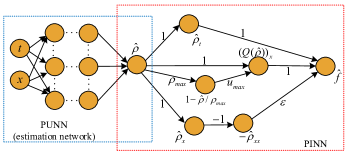
- The PIDL framework consists of a physics-uninformed neural network (PUNN) for traffic state estimation and a physics-informed neural network (PINN) that enforces physical constraints from LWR models.
- The PINN component encodes the LWR partial differential equation (PDE) as a residual loss, ensuring that the estimated traffic states are physically consistent with the underlying traffic dynamics.
- Two architectures are designed: one based on the Greenshields-based LWR model and another on the three-parameter-based LWR model, each used to regularize the PUNN during training.
- The loss function combines data fidelity loss (from observed loop detector data) and physics residual loss (from the PDE), with hyperparameters α and β controlling the trade-off between data and physics.
- Model parameters (e.g., free-flow speed, jam density) are discovered end-to-end during training by optimizing the loss function.
- The framework is trained and evaluated on the Next Generation Simulation (NGSIM) dataset, with performance assessed under varying numbers of loop detectors.
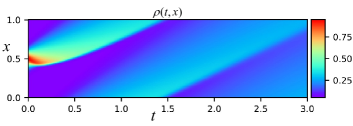
Experimental results
Research questions
- RQ1Can physics-informed deep learning improve traffic state estimation accuracy while reducing data requirements compared to conventional model-driven and data-driven methods?
- RQ2How effectively can the PIDL framework estimate traffic density using only a small number of loop detectors?
- RQ3To what extent can the PIDL framework discover unknown parameters in LWR-based traffic flow models during the estimation process?
- RQ4How does the relative contribution of the model-driven and data-driven components affect estimation performance as data availability varies?
- RQ5What is the computational cost of the PIDL framework compared to established TSE baselines in terms of training and inference time?
Key findings
- The PIDL-based method achieves estimation errors below 0.06 using only eight loop detectors, outperforming all baselines, including EKF and deep learning models, under the same conditions.
- When the number of loop detectors is limited (≤6), the EKF method performs better than neural network-based methods, but the PIDL method consistently outperforms EKF across all data levels.
- As the number of loop detectors increases, the performance of EKF plateaus due to model limitations, while the PIDL method continues to improve by leveraging more data.
- The optimal balance between model-driven and data-driven components shifts from favoring the physics-informed component (higher β/α ratio) with few sensors to favoring the data-driven component (lower β/α ratio) with abundant data.
- Training time for PIDL is higher than EKF due to backpropagation through the PINN, but inference time is comparable to standard neural networks, making it practical for real-time applications.
- The PIDL framework successfully discovers model parameters (e.g., free-flow speed, jam density) during the training process, demonstrating its capability for joint estimation and calibration.
Read this paper
Open the full text in the Nubint reader and ask about any passage as you read.
Read this paper on NubintThis review was generated by AI from the original paper. Please check the paper before citing it.