
[Paper Review] Physics-Informed Deep Learning For Traffic State Estimation: A Survey and the Outlook
This paper presents a systematic design pipeline for physics-informed deep learning (PIDL) in traffic state estimation (TSE), integrating physics-based models with deep neural networks via customizable hybrid computational graphs. It demonstrates that PIDL achieves superior accuracy and robustness with limited data compared to pure physics or data-driven models, offering a unified framework adaptable across transportation applications.
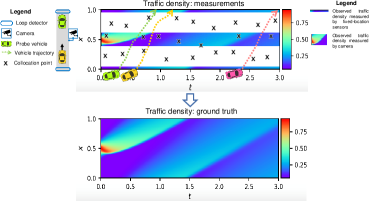
For its robust predictive power (compared to pure physics-based models) and sample-efficient training (compared to pure deep learning models), physics-informed deep learning (PIDL), a paradigm hybridizing physics-based models and deep neural networks (DNN), has been booming in science and engineering fields. One key challenge of applying PIDL to various domains and problems lies in the design of a computational graph that integrates physics and DNNs. In other words, how physics are encoded into DNNs and how the physics and data components are represented. In this paper, we provide a variety of architecture designs of PIDL computational graphs and how these structures are customized to traffic state estimation (TSE), a central problem in transportation engineering. When observation data, problem type, and goal vary, we demonstrate potential architectures of PIDL computational graphs and compare these variants using the same real-world dataset.
Motivation & Objective
- To address the challenge of integrating physics-based models with deep learning in traffic state estimation (TSE) for improved robustness and sample efficiency.
- To establish a systematic design pipeline for hybrid computational graphs that unify physics and neural networks in PIDL applications.
- To guide researchers in transportation and other domains toward effective PIDL implementation through modular architecture and visualization tools.
- To explore open challenges in applying PIDL to social systems like traffic, where human behavior introduces nonlinearity and uncertainty.
- To identify future research directions, including multimodal IoT data integration, network-scale TSE, and universal PIDL architectures.
Proposed method
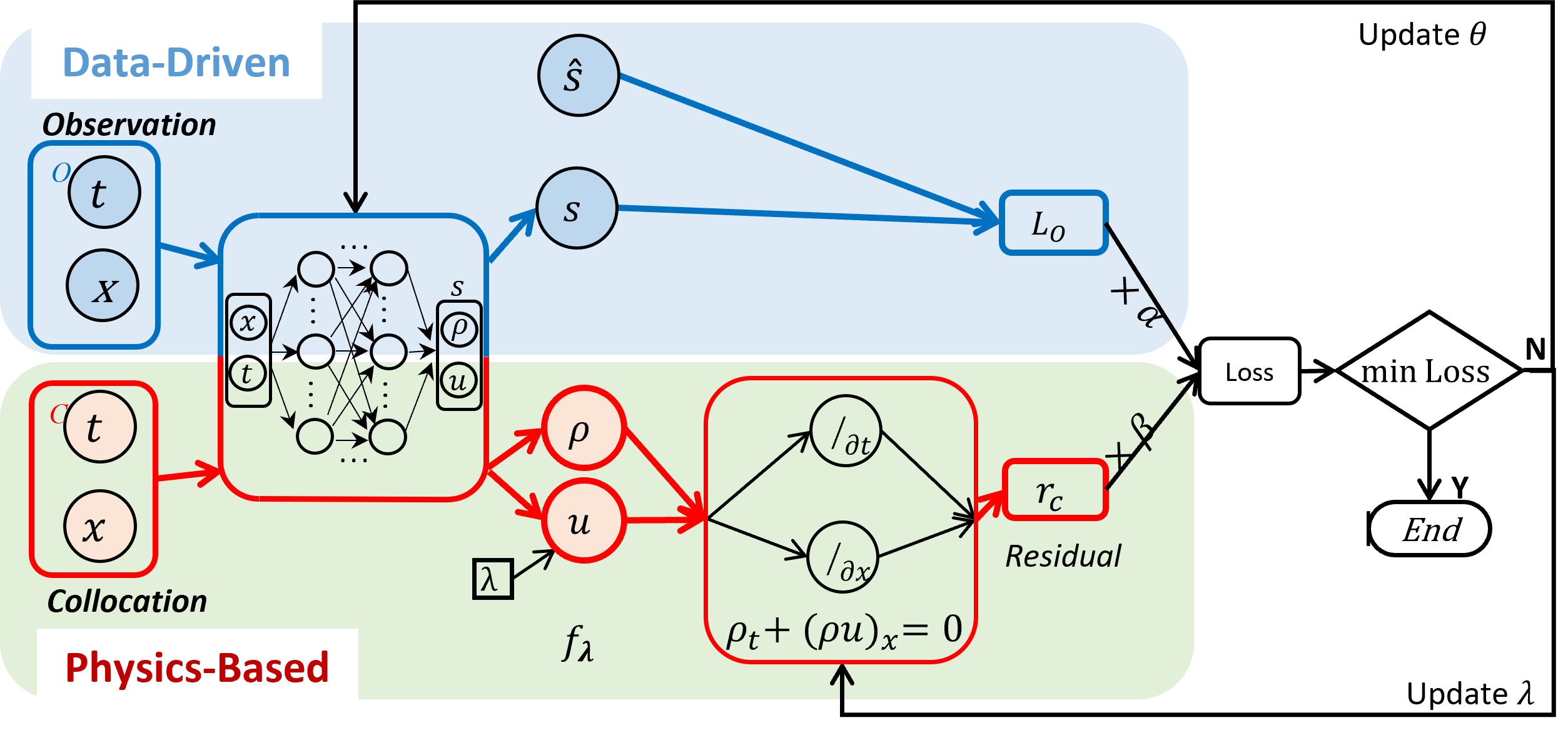
- Proposes a hybrid computational graph (HCG) framework composed of a physics-informed computational graph (PICG) and a physics-uninformed neural network (PUNN) to embed physical laws into deep learning.
- Uses partial differential equations (PDEs), such as LWR and ARZ models, as the physics component to enforce physical consistency in traffic dynamics.
- Employs physics-informed loss functions that penalize deviations from PDE constraints while training on real-world traffic data.
- Designs modular, customizable architectures for PIDL that adapt to varying data availability, problem types, and physical constraints.
- Introduces a visualization tool to aid in understanding and decomposing PIDL problems across domains.
- Validates the framework on real-world datasets across diverse urban environments (e.g., San Francisco, Mumbai), adjusting inputs to include road type, speed limits, and traffic composition for transferability.
Experimental results
Research questions
- RQ1How can physics be systematically encoded into deep neural networks for traffic state estimation using hybrid computational graphs?
- RQ2What are the optimal architectures and loss functions for PIDL in TSE under limited data and partial physical knowledge?
- RQ3Can PIDL models generalize across different urban environments and traffic conditions with minimal retraining?
- RQ4How can multimodal, multi-fidelity IoT data (e.g., trajectories, radar, LiDAR) be integrated into PIDL to enrich traffic state representation?
- RQ5Is there potential for a universal PIDL architecture across scientific and engineering domains?
Key findings
- PIDL outperforms both pure physics-based and data-driven models in accuracy and robustness when trained on small datasets, demonstrating the 'sweet spot' of small data and partial knowledge.
- The hybrid computational graph framework enables effective integration of PDE-based traffic models (e.g., LWR, ARZ) with deep neural networks, ensuring physical consistency in predictions.
- Customizing input features—such as road type, speed limits, and traffic composition—improves generalization across diverse urban environments like San Francisco and Mumbai.
- Multimodal IoT data, including trajectories and camera images, can enrich traffic state estimation beyond aggregate metrics like density and velocity, suggesting a paradigm shift toward perception-based state representation.
- Meta-learning of hyperparameters across related PDE families (e.g., LWR and ARZ) offers a promising path toward transferable PIDL models in complex traffic networks.
- Open challenges remain in causal inference, uncertainty quantification, and developing robust evaluation metrics for PIDL models against baselines.
Read this paper
Open the full text in the Nubint reader and ask about any passage as you read.
Read this paper on NubintThis review was generated by AI from the original paper. Please check the paper before citing it.