
[Paper Review] Physics-Informed Localized Learning for Advection-Diffusion-Reaction Systems
This paper proposes a physics-informed localized learning method that accelerates training of surrogate models for advection-diffusion-reaction systems by learning local representations of global state variables. It achieves up to 18x faster training than E2C/E2CO models—reducing 3D reservoir simulation training from 47.2 to 2.6 hours—while maintaining high accuracy in predicting pressure and saturation with mean absolute errors of 50–125 psi and 0.002–0.007 fraction, respectively.
The global push to advance Carbon Capture and Sequestration initiatives and green energy solutions, such as geothermal, have thrust new demands upon the current state-of-the-art subsurface fluid simulators. The requirement to be able to simulate a large order of reservoir states simultaneously, in a short period of time, has opened the door of opportunity for the application of machine learning techniques for surrogate modelling. We propose a novel physics-informed and boundary condition-aware Localized Learning method which extends the Embed-to-Control (E2C) and Embed-to-Control and Observe (E2CO) models to learn local representations of global state variables in an Advection-Diffusion Reaction system. Trained on reservoir simulation data, we show that our model is able to predict future states of the system, for a given set of controls, to a great deal of accuracy with only a fraction of the available information. It hence reduces training times significantly compared to the original E2C and E2CO models, lending to its benefit in application to optimal control problems.
Motivation & Objective
- To address the computational bottleneck in subsurface fluid simulations for carbon capture and geothermal energy by enabling fast, accurate surrogate modeling.
- To reduce training time of machine learning-based surrogate models for advection-diffusion-reaction systems without sacrificing predictive accuracy.
- To develop a localized learning approach that captures non-linear dynamics efficiently by focusing on local state representations.
- To integrate physics-informed losses into the learning framework to improve generalization and accuracy.
- To enable real-time optimal control in reservoir simulation by accelerating inference and training through localized, physics-aware learning.
Proposed method
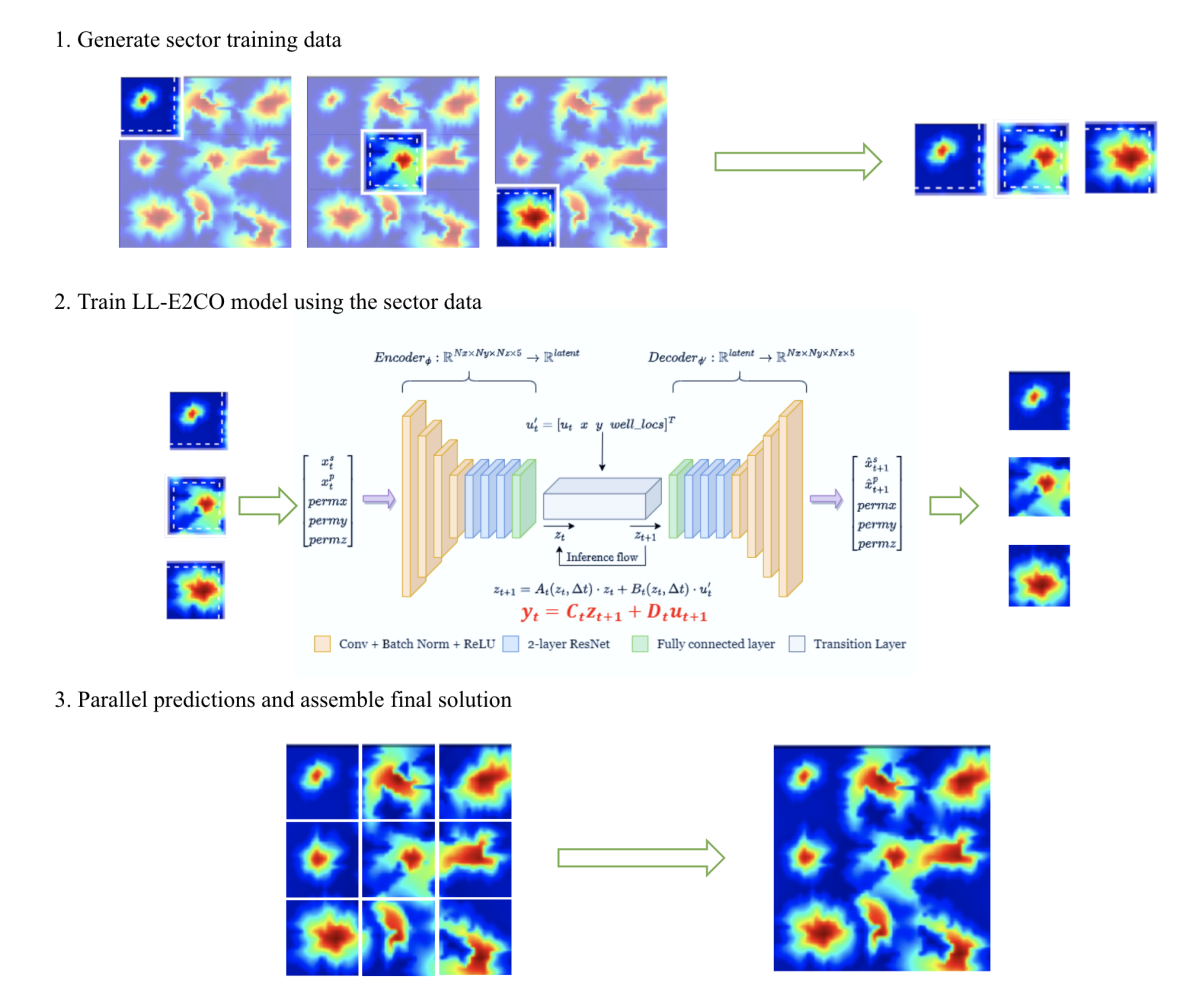
- The method extends Embed-to-Control (E2C) and Embed-to-Control and Observe (E2CO) by introducing localized learning, where the model learns local representations of global state variables in an ADR system.
- It uses a variational auto-encoder to embed full-state fields into a latent space, followed by a locally linear transition model that predicts future states from control inputs.
- Physics-informed losses are incorporated to enforce consistency with the underlying ADR PDE, improving generalization and accuracy.
- The model is trained on reservoir simulation data, using only a fraction of the available information to predict future system states.
- The approach supports batch inference, enabling parallelized evaluation across multiple control configurations for optimal control applications.
- The method is evaluated on 2D and 3D ADR systems with realistic reservoir dimensions, including a 60×220×40 grid with sectorized local inference.
Experimental results
Research questions
- RQ1Can localized learning reduce training time in surrogate modeling of ADR systems while preserving predictive accuracy?
- RQ2How does physics-informed regularization improve the generalization of localized machine learning models in subsurface flow simulations?
- RQ3To what extent can a model trained on partial data predict full-state system evolution in advection-diffusion-reaction systems?
- RQ4How does the model’s performance in predicting pressure (a global variable) compare to saturation (a more local variable)?
- RQ5Can the localized learning framework enable real-time optimal control in reservoir simulation by accelerating inference and training?
Key findings
- Training time for the 3D 60×220×40 case was reduced from 47.2 hours (E2C) to 2.6 hours (LL-E2C), a 18x speedup.
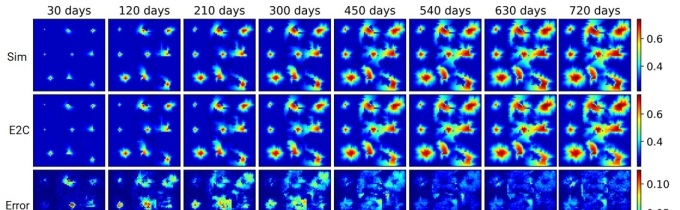
- The LL-E2C model achieved mean absolute errors of 50–125 psi for pressure and 0.002–0.007 fraction for saturation across all test cases.
- The LL-E2CO model predicted field production rates within 5% error of the simulator across all time steps, even at later predictions.
- Physics-informed losses significantly improved accuracy, especially in regions of high non-linearity such as wave fronts.
- Inference speedup over high-fidelity solvers reached 10^4×, enabling efficient batch processing for optimal control problems.
- The model performed better on saturation than pressure, likely due to the latter being a more global state variable.
Read this paper
Open the full text in the Nubint reader and ask about any passage as you read.
Read this paper on NubintThis review was generated by AI from the original paper. Please check the paper before citing it.