
[Paper Review] Piercing the Veil of TVL: DeFi Reappraised
This paper proposes Total Value Redeemable (TVR) as a refined metric to replace Total Value Locked (TVL) in DeFi, addressing systemic double counting that inflates TVL by up to 2x. By formalizing a TVR framework and introducing the DeFi money multiplier, the study shows TVR is more stable and accurate than TVL, especially during market downturns, with a $139.87B discrepancy observed at peak DeFi activity in December 2021.
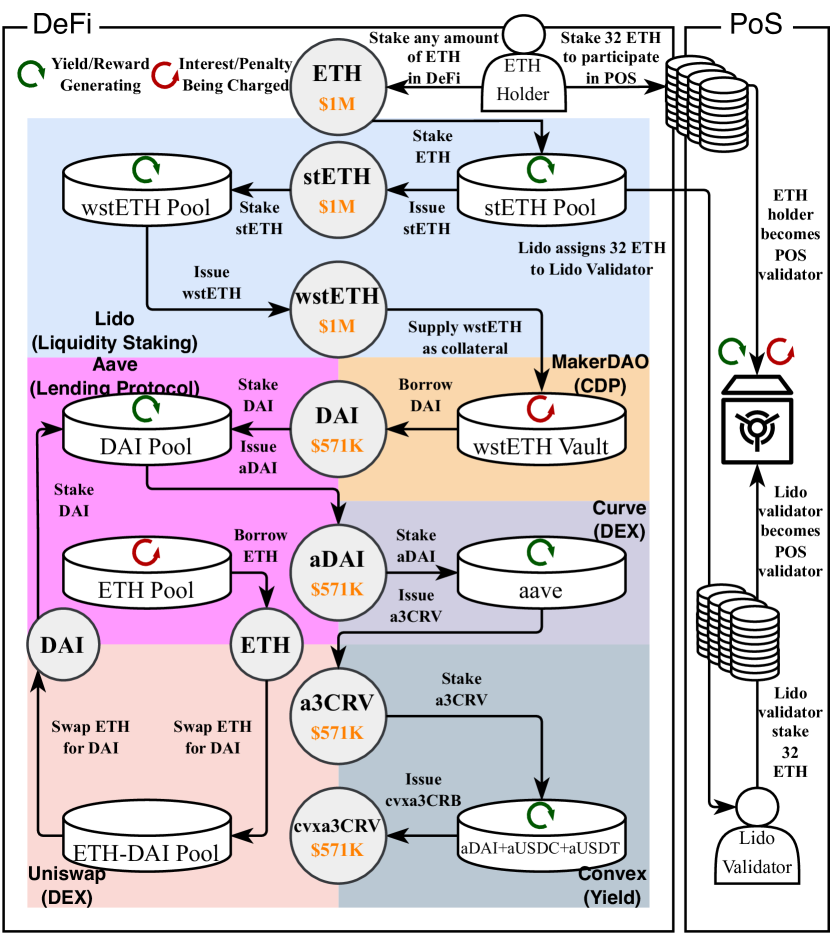
Total value locked (TVL) is widely used to measure the size and popularity of decentralized finance (DeFi). However, TVL can be easily manipulated and inflated through "double counting" activities such as wrapping and leveraging. As existing methodologies addressing double counting are inconsistent and flawed, we propose a new framework, termed "total value redeemable (TVR)", to assess the true underlying value of DeFi. Our formal analysis reveals how DeFi's complex network spreads financial contagion via derivative tokens, increasing TVL's sensitivity to external shocks. To quantify double counting, we construct the DeFi multiplier, which mirrors the money multiplier in traditional finance (TradFi). This measurement reveals substantial double counting in DeFi, finding that the gap between TVL and TVR reached \$139.87 billion during the peak of DeFi activity on December 2, 2021, with a TVL-to-TVR ratio of approximately 2. We conduct sensitivity tests to evaluate the stability of TVL compared to TVR, demonstrating the former's significantly higher level of instability than the latter, especially during market downturns: A 25% decline in the price of Ether (ETH) leads to a \$1 billion greater non-linear decrease in TVL compared to TVR via the liquidations triggered by derivative tokens. We also document that the DeFi money multiplier is positively correlated with crypto market indicators and negatively correlated with macroeconomic indicators. Overall, our findings suggest that TVR is more reliable and stable than TVL.
Motivation & Objective
- To address the pervasive issue of double counting in DeFi's Total Value Locked (TVL) metric, which inflates perceived protocol value.
- To formalize a new metric, Total Value Redeemable (TVR), that reflects the true underlying value locked in DeFi protocols.
- To quantify the extent of double counting using a novel DeFi money multiplier, analogous to the traditional finance money multiplier.
- To demonstrate that TVR is more stable than TVL during market downturns, reducing overestimation of losses.
- To provide a transparent, standardized framework for assessing real DeFi system value and systemic risk.
Proposed method
- Formalize the TVL framework to identify and isolate the sources of double counting in DeFi protocols.
- Define TVR as the sum of all plain (non-derivative) tokens locked in protocols, excluding derivative tokens that contribute to double counting.
- Construct the DeFi money multiplier as the ratio of TVL to TVR, quantifying the degree of financial leverage and double counting.
- Use on-chain data from major DeFi protocols to decompose TVL into plain and derivative token components.
- Track token composition in TVR over time to analyze structural changes in DeFi value lock.
- Compare TVL and TVR performance under stress scenarios, such as a 25% ETH price drop, to assess stability.
Experimental results
Research questions
- RQ1To what extent does double counting inflate the Total Value Locked (TVL) metric in DeFi protocols?
- RQ2How can a more accurate and stable metric for DeFi value be constructed to reflect actual underlying economic value?
- RQ3What is the systemic risk introduced by double counting in TVL, particularly during market downturns?
- RQ4How does the proposed DeFi money multiplier quantify the degree of leverage and double counting in the DeFi ecosystem?
- RQ5How does TVR compare to TVL in stability and reliability during periods of market volatility?
Key findings
- At the peak of DeFi activity on December 2, 2021, the discrepancy between TVL and TVR reached $139.87 billion, resulting in a TVL-to-TVR ratio of approximately 2.
- A 25% decline in ETH price leads to an overestimation of DeFi market value loss by more than $1 billion when using TVL instead of TVR.
- The TVR metric is significantly more stable than TVL during market turmoil, reducing the risk of panic-driven withdrawals.
- The study identifies a maximum double counting of $182.15 billion, with a TVL-to-TVR ratio peaking near 3 in the analyzed ecosystem.
- The DeFi money multiplier, derived from TVL and TVR, is positively correlated with crypto market indicators and negatively correlated with macroeconomic indicators.
- The paper demonstrates that financial contagion in DeFi spreads via derivative tokens, amplifying liquidations and stablecoin depegging during stress events.
Read this paper
Open the full text in the Nubint reader and ask about any passage as you read.
Read this paper on NubintThis review was generated by AI from the original paper. Please check the paper before citing it.