
[Paper Review] PINA: Leveraging Side Information in eXtreme Multi-label Classification via Predicted Instance Neighborhood Aggregation
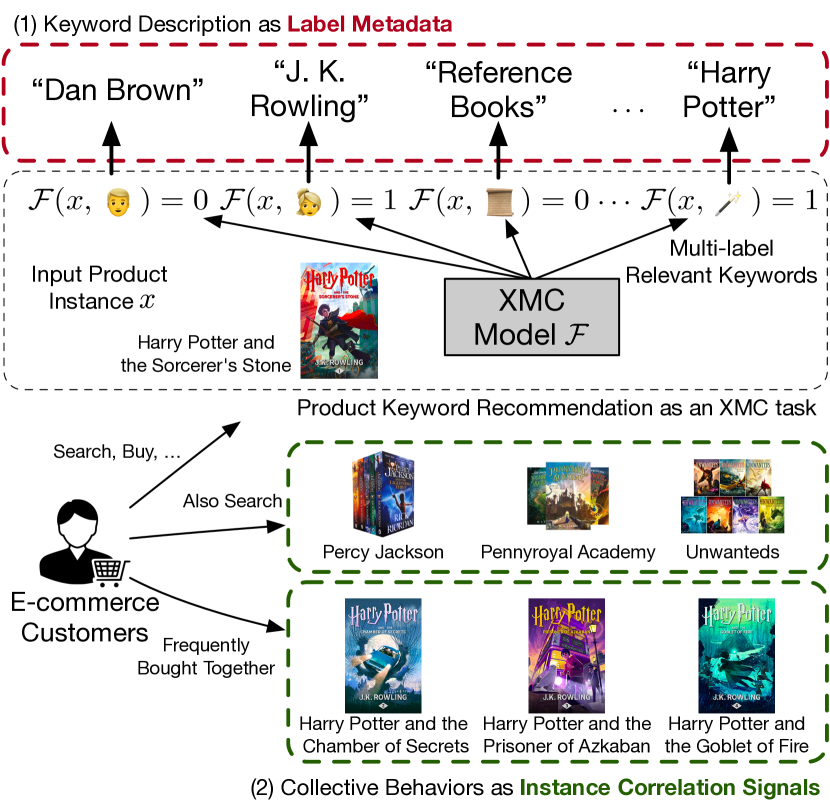
PINA introduces a data enhancement framework that improves extreme multi-label classification (XMC) by leveraging side information—label metadata and instance correlation signals—through predicted instance neighborhood aggregation. By adapting graph convolution-like message passing to XMC, PINA boosts XR-Transformer performance by up to 5% accuracy on the LF-AmazonTitles-1.3M dataset and achieves a 3.5% relative accuracy gain on an industrial-scale proprietary dataset.
The eXtreme Multi-label Classification~(XMC) problem seeks to find relevant labels from an exceptionally large label space. Most of the existing XMC learners focus on the extraction of semantic features from input query text. However, conventional XMC studies usually neglect the side information of instances and labels, which can be of use in many real-world applications such as recommendation systems and e-commerce product search. We propose Predicted Instance Neighborhood Aggregation (PINA), a data enhancement method for the general XMC problem that leverages beneficial side information. Unlike most existing XMC frameworks that treat labels and input instances as featureless indicators and independent entries, PINA extracts information from the label metadata and the correlations among training instances. Extensive experimental results demonstrate the consistent gain of PINA on various XMC tasks compared to the state-of-the-art methods: PINA offers a gain in accuracy compared to standard XR-Transformers on five public benchmark datasets. Moreover, PINA achieves a $\sim 5\%$ gain in accuracy on the largest dataset LF-AmazonTitles-1.3M. Our implementation is publicly available.
Motivation & Objective
- To address the limitation of existing XMC models that ignore valuable side information such as label text and user behavior correlations.
- To enable traditional XMC models like XR-Transformer and XR-Linear to incorporate side information without architectural overhaul.
- To develop a unified, data-augmentation-based method that improves prediction accuracy through neighborhood aggregation of related instances and labels.
- To empirically validate the effectiveness of side information in both public benchmark datasets and real-world industrial applications.
Proposed method
- PINA formulates the XMC problem as a neighborhood prediction task, treating the label matrix as a bipartite graph where instances and labels are connected by relevance.
- It predicts neighborhoods for training instances using a pre-trained transformer-based text vectorizer and label metadata, generating synthetic neighborhood features.
- The method performs neighborhood aggregation by combining instance features with aggregated features from predicted neighbors, mimicking graph convolution operations.
- A two-stage training process is used: first, a neighbor predictor is trained using label text and instance features; second, the XMC model is fine-tuned with augmented features.
- The framework supports both label metadata and instance correlation signals, enabling application to diverse real-world XMC tasks.
- It is designed as a plug-in enhancement, compatible with existing XMC models such as XR-Transformer and XR-Linear, without requiring model retraining from scratch.
Experimental results
Research questions
- RQ1Can side information such as label text and user behavior correlations improve extreme multi-label classification performance?
- RQ2How can graph-based neighborhood aggregation techniques be adapted to the XMC setting where test instances lack explicit neighborhoods?
- RQ3Does incorporating predicted neighborhoods through a pre-trained model lead to consistent gains across diverse XMC datasets?
- RQ4Is the performance gain from PINA due to feature concatenation alone, or does the neighborhood aggregation mechanism itself contribute significantly?
Key findings
- PINA achieves a 5% relative accuracy gain on the largest public benchmark, LF-AmazonTitles-1.3M, outperforming state-of-the-art methods that use label text.
- On the same dataset, XR-Transformer enhanced with PINA surpasses all previously published results, establishing a new state of the art.
- On an industrial-scale proprietary dataset with instance correlation signals, PINA improves XR-Linear performance by 3.5% in relative accuracy.
- Ablation studies confirm that the neighborhood aggregation mechanism contributes significantly beyond simply concatenating pretrained text features.
- Pretraining the neighbor predictor with label text improves performance, while using only instance features leads to degradation, validating the importance of label metadata.
- The method consistently improves performance across multiple metrics (P@1, P@3, P@5, R@10) on both public and private datasets.
Read this paper
Open the full text in the Nubint reader and ask about any passage as you read.
Read this paper on NubintThis review was generated by AI from the original paper. Please check the paper before citing it.