
[Paper Review] Pisces VII/Triangulum III -- M33's second dwarf satellite galaxy
This paper confirms Pisces VII/Triangulum III (Pisc VII) as the second known satellite of M33 using deep Gemini GMOS-N imaging, measuring its distance at 916⁺⁶⁵₋₅₃ kpc and confirming its half-light radius (186⁺⁵⁸₋₃₂ pc), absolute magnitude (MV = −6.0 ± 0.3), and luminosity (2.2⁺⁰.⁷₋₀.⁵ × 10⁴ L☉). The galaxy's location within M33’s halo supports the hypothesis that M33 is on its first infall to the Andromeda system, while its potential young stellar population (~1.5 Gyr) challenges current models of reionization-driven quenching in ultra-faint dwarfs.
Pisces VII/Triangulum III (Pisc~VII) was discovered in the DESI Legacy Imaging Survey and was shown to be a Local Group dwarf galaxy with follow-up imaging from the 4-m Telescopio Nazionale Galileo. However, this imaging was unable to reach the horizontal branch of Pisc VII, preventing a precision distance measurement. The distance bound from the red giant branch population placed Pisc VII as either an isolated ultra-faint dwarf galaxy or the second known satellite galaxy of Triangulum (M33). Using deep imaging from Gemini GMOS-N, we have resolved the horizontal branch of Pisc VII, and measure a distance of $D=916^{+65}_{-53}$~kpc, making Pisc VII a likely satellite of M33. We also remeasure its size and luminosity from this deeper data, finding $r_{ m half}=186^{+58}_{-32}$ pc, $M_V=-6.0\pm0.3$ and $L=2.2^{+0.7}_{-0.5} imes10^4\,{ m L}_\odot$. Given its position in the M33 halo, we argue that Pisc VII could support the theory that M33 is on its first infall to the Andromeda system. We also discuss the presence of blue plume and helium burning stars in the colour-magnitude diagram of Pisc VII that are consistent with ages of $\sim1.5$~Gyr. If these are truly members of the galaxy, it would transform our understanding of how reionisation affects the faintest galaxies. Future deep imaging and dynamics could allow significant insight into both the stellar populations of Pisc VII and the evolution of M33
Motivation & Objective
- To determine the true distance and structural parameters of Pisces VII/Triangulum III (Pisc VII), a faint dwarf galaxy candidate discovered in the DESI Legacy Imaging Survey.
- To assess whether Pisc VII is a satellite of M33 or an isolated ultra-faint dwarf galaxy (UFD) in the Local Group.
- To investigate the presence of young stellar populations in Pisc VII, particularly a blue plume and helium burning stars, which could challenge current understanding of reionization-driven quenching in faint galaxies.
- To evaluate whether Pisc VII supports the first infall scenario for M33’s orbital history, given its large projected distance from M33.
Proposed method
- Deep imaging of Pisc VII was obtained using the Gemini GMOS-N instrument to resolve the horizontal branch, enabling a precise distance measurement.
- Photometric reduction and analysis were performed using the Gemini DRAGONS pipeline to produce a high-fidelity photometric catalogue.
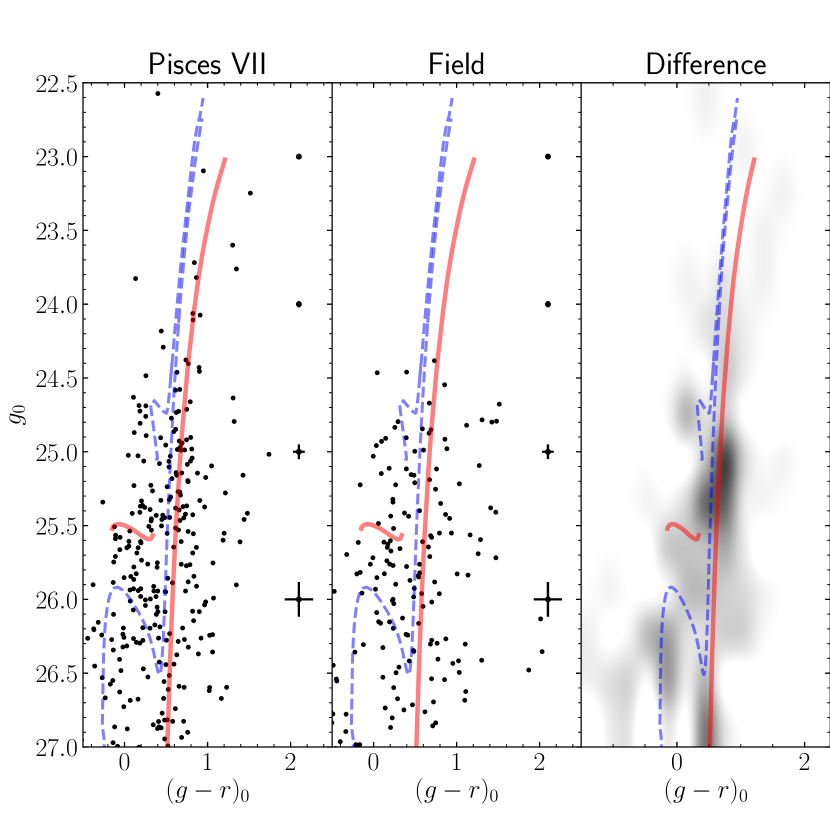
- Color-magnitude diagrams (CMDs) were constructed from the deep photometry to identify stellar populations, including the red giant branch, horizontal branch, and blue plume features.
- Distance was derived by fitting the observed horizontal branch to theoretical isochrones, with uncertainty propagated via bootstrap resampling.
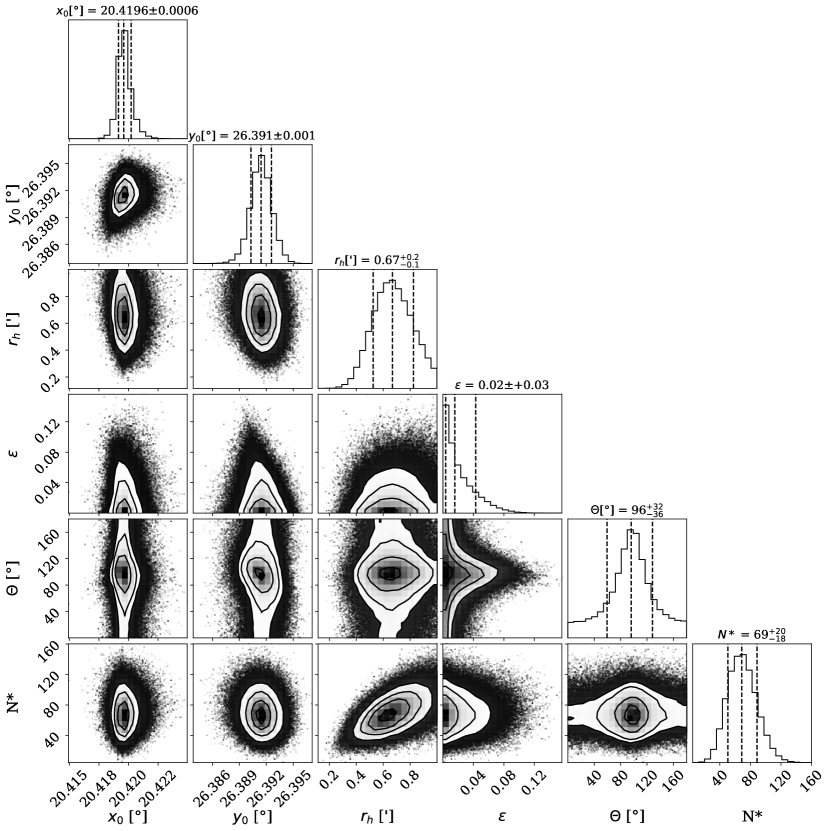
- Structural parameters such as half-light radius and luminosity were remeasured from the deeper data using stellar density and surface brightness profile fitting.
- The 3D distance to M33 was calculated using the projected angular separation and the measured line-of-sight distance, assessing binding to the M33 halo.
Experimental results
Research questions
- RQ1Is Pisces VII/Triangulum III a satellite of M33 or an isolated ultra-faint dwarf galaxy in the Local Group?
- RQ2What is the precise distance to Pisces VII, and does it place it within the virial radius of M33’s halo?
- RQ3Does the presence of blue plume and helium burning stars in the CMD indicate a young stellar population (~1.5 Gyr), and what would this imply for reionization quenching models?
- RQ4Does the location of Pisc VII at ~97 kpc from M33 support the first infall scenario for M33’s orbital history rather than a prior close passage with M31?
- RQ5What is the true luminosity, size, and structural morphology of Pisc VII based on deep imaging?
Key findings
- The distance to Pisces VII was measured as 916⁺⁶⁵₋₅₃ kpc, placing it at a 3D distance of 97 ± 6 kpc from M33, confirming its location within M33’s halo.
- The half-light radius of Pisc VII is 186⁺⁵⁸₋₃₂ pc, consistent with a dwarf spheroidal system.
- The absolute V-band magnitude is MV = −6.0 ± 0.3, and the luminosity is 2.2⁺⁰.⁷₋₀.⁵ × 10⁴ L☉, confirming its classification as an ultra-faint dwarf galaxy.
- The presence of a blue plume and helium burning stars in the CMD is consistent with a stellar population of age ∼1.5 Gyr, suggesting recent star formation.
- The large projected distance of Pisc VII from M33 supports the hypothesis that M33 is on its first infall to the Andromeda system, rather than having undergone a prior close encounter with M31.
- The detection of a second distant satellite of M33 suggests that M33 may host a wider, extended satellite system, potentially resolving its 'missing satellite' problem.
Read this paper
Open the full text in the Nubint reader and ask about any passage as you read.
Read this paper on NubintThis review was generated by AI from the original paper. Please check the paper before citing it.