
[Paper Review] Pixel-Aware Stable Diffusion for Realistic Image Super-resolution and Personalized Stylization
PASD integrates a pixel-aware cross-attention mechanism with degradation removal and high-level semantic signals to enable Real-ISR and personalized stylization using pre-trained diffusion priors, without extra image-space training.
Diffusion models have demonstrated impressive performance in various image generation, editing, enhancement and translation tasks. In particular, the pre-trained text-to-image stable diffusion models provide a potential solution to the challenging realistic image super-resolution (Real-ISR) and image stylization problems with their strong generative priors. However, the existing methods along this line often fail to keep faithful pixel-wise image structures. If extra skip connections between the encoder and the decoder of a VAE are used to reproduce details, additional training in image space will be required, limiting the application to tasks in latent space such as image stylization. In this work, we propose a pixel-aware stable diffusion (PASD) network to achieve robust Real-ISR and personalized image stylization. Specifically, a pixel-aware cross attention module is introduced to enable diffusion models perceiving image local structures in pixel-wise level, while a degradation removal module is used to extract degradation insensitive features to guide the diffusion process together with image high level information. An adjustable noise schedule is introduced to further improve the image restoration results. By simply replacing the base diffusion model with a stylized one, PASD can generate diverse stylized images without collecting pairwise training data, and by shifting the base model with an aesthetic one, PASD can bring old photos back to life. Extensive experiments in a variety of image enhancement and stylization tasks demonstrate the effectiveness of our proposed PASD approach. Our source codes are available at \url{https://github.com/yangxy/PASD/}.
Motivation & Objective
- Motivate Real-ISR to restore perceptually realistic textures without artifacts from GAN-based methods.
- Leverage pre-trained diffusion priors (e.g., Stable Diffusion) for robust image restoration and stylization.
- Introduce pixel-level guidance via a pixel-aware cross-attention module to preserve structures.
- Mitigate unknown real-world degradations with a degradation removal module.
- Demonstrate that PASD supports personalized stylization by swapping the base diffusion model.
Proposed method
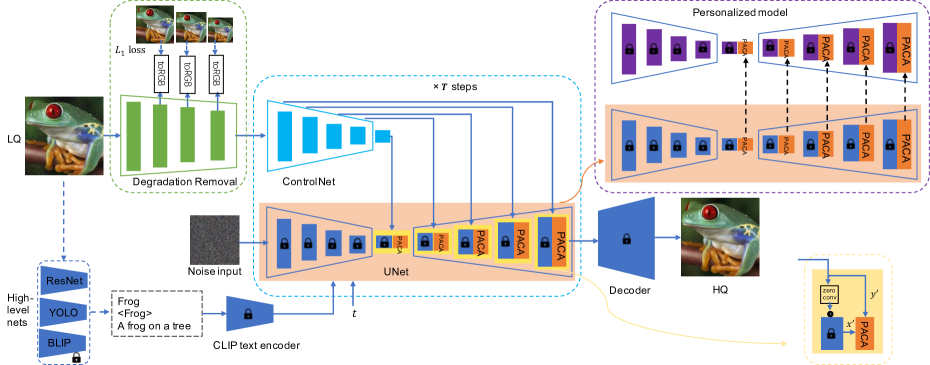
- Introduce Pixel-Aware Cross Attention (PACA) to pass pixel-level information from conditional inputs to the diffusion UNet without skipped connections.
- Add a Degradation Removal Module using a pyramid feature extractor with toRGB supervision and L1 losses at multiple scales (L_DR).
- Incorporate high-level information extraction (classification/detection/caption) and CLIP-based text guidance with classifier-free guidance for conditioning.
- Train by optimizing diffusion loss L_DF with auxiliary L_DR loss; freeze pre-trained SD and train added modules (PACA, degradation removal, ControlNet) plus high-level info paths.
- Enable personalized stylization by swapping the base diffusion model with a personalized model (no extra training) as a form of style transfer.
- Optionally utilize negative prompts to improve mode coverage during inference.
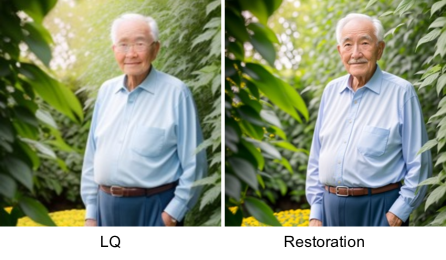
Experimental results
Research questions
- RQ1Can pixel-level conditioning via PACA improve fidelity of Real-ISR outputs without adding image-space training artifacts?
- RQ2Does degradation-robust feature extraction improve diffusion-based restoration under real-world degradations?
- RQ3Can high-level semantic signals (caption/detection/classification) further boost Real-ISR performance?
- RQ4Is PASD capable of effective personalized stylization by simply changing the base diffusion model?
- RQ5How does PASD fare against GAN-based and other diffusion-based Real-ISR methods on perceptual metrics?
Key findings
- PASD achieves stronger perceptual quality than GAN-based Real-ISR methods across MUSIQ and other perceptual metrics on RealSR and DRealSR.
- PASD outperforms competing diffusion-based Real-ISR methods in most perceptual metrics and yields the best MUSIQ scores on test datasets.
- Ablation shows PACA is crucial for maintaining pixel-accurate structure and texture; removing it degrades color/structure fidelity.
- Degradation removal and high-level information enhance results; removing them leads to dirtier outputs and worse metrics.
- PASD enables personalized stylization by swapping to a personalized diffusion model, preserving pixel-level details better than some baselines.
- User studies corroborate PASD being preferred for Real-ISR and stylization tasks.
Read this paper
Open the full text in the Nubint reader and ask about any passage as you read.
Read this paper on NubintThis review was generated by AI from the original paper. Please check the paper before citing it.