
[Paper Review] Plan-and-Solve Prompting: Improving Zero-Shot Chain-of-Thought Reasoning by Large Language Models
Plan-and-Solve prompting asks LLMs to first devise a plan and then execute it, improving zero-shot reasoning and reducing errors more than Zero-shot-CoT across multiple datasets. PS+ adds detailed guidance and often matches or exceeds few-shot CoT prompts.
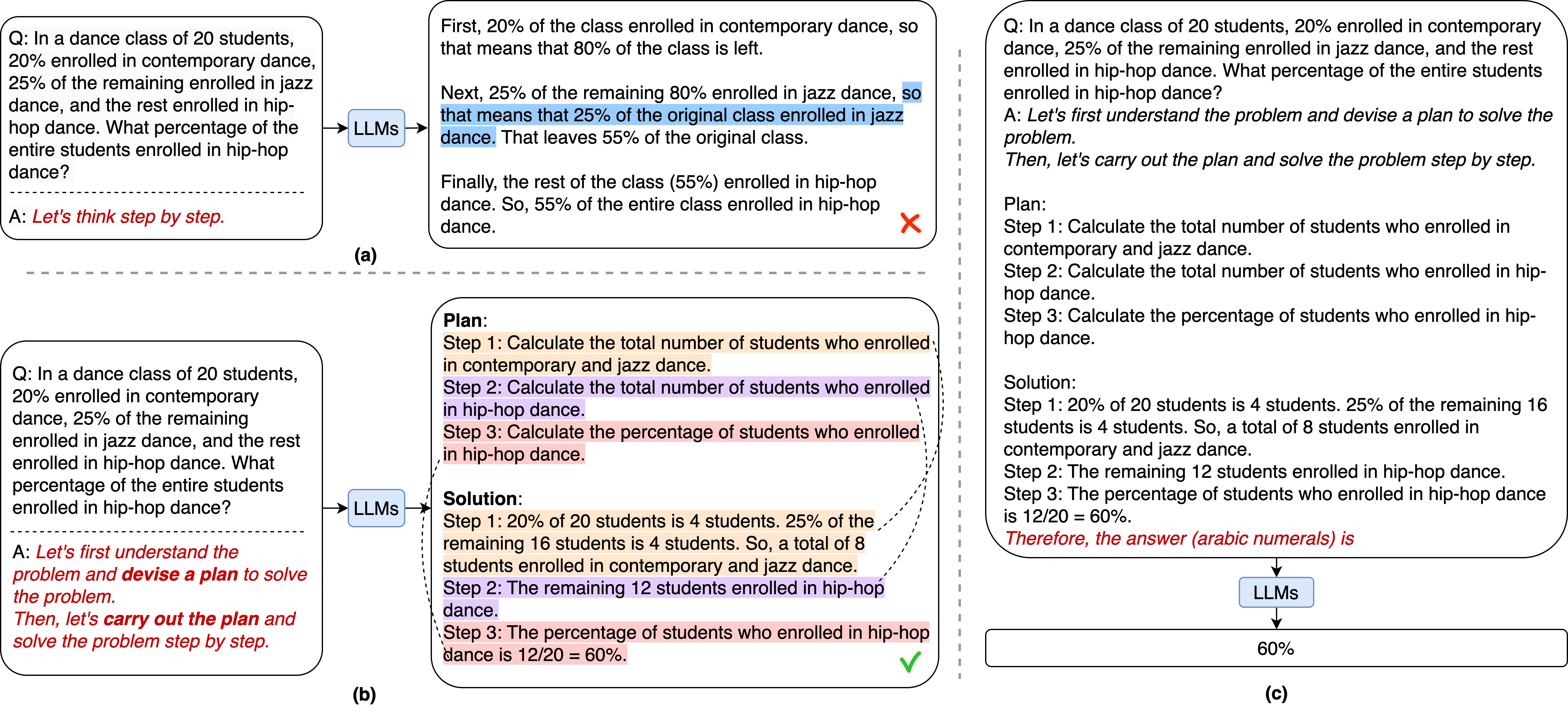
Large language models (LLMs) have recently been shown to deliver impressive performance in various NLP tasks. To tackle multi-step reasoning tasks, few-shot chain-of-thought (CoT) prompting includes a few manually crafted step-by-step reasoning demonstrations which enable LLMs to explicitly generate reasoning steps and improve their reasoning task accuracy. To eliminate the manual effort, Zero-shot-CoT concatenates the target problem statement with "Let's think step by step" as an input prompt to LLMs. Despite the success of Zero-shot-CoT, it still suffers from three pitfalls: calculation errors, missing-step errors, and semantic misunderstanding errors. To address the missing-step errors, we propose Plan-and-Solve (PS) Prompting. It consists of two components: first, devising a plan to divide the entire task into smaller subtasks, and then carrying out the subtasks according to the plan. To address the calculation errors and improve the quality of generated reasoning steps, we extend PS prompting with more detailed instructions and derive PS+ prompting. We evaluate our proposed prompting strategy on ten datasets across three reasoning problems. The experimental results over GPT-3 show that our proposed zero-shot prompting consistently outperforms Zero-shot-CoT across all datasets by a large margin, is comparable to or exceeds Zero-shot-Program-of-Thought Prompting, and has comparable performance with 8-shot CoT prompting on the math reasoning problem. The code can be found at https://github.com/AGI-Edgerunners/Plan-and-Solve-Prompting.
Motivation & Objective
- Motivate solving multi-step reasoning tasks without manual demonstrations.
- Reduce calculation, missing-step, and semantic errors in zero-shot CoT.
- Introduce plan-based prompting (PS) and enhanced PS+ to guide reasoning.
- Show PS/PS+ effectiveness across diverse reasoning datasets.
Proposed method
- Propose Plan-and-Solve (PS) prompting where the model first devises a plan and then carries out subtasks to solve the problem.
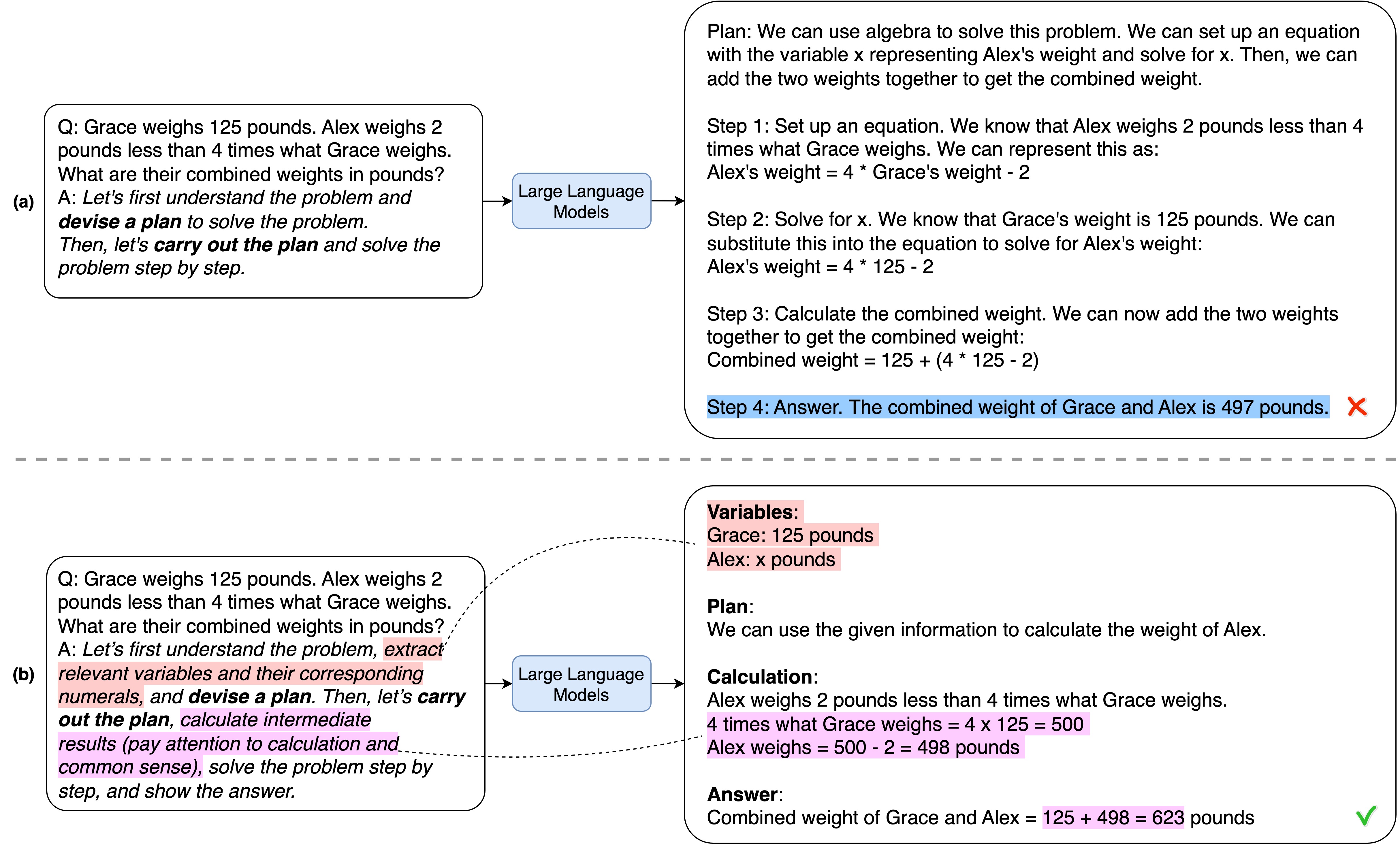
- Extend PS with detailed instructions to form PS+ (e.g., extract relevant variables, calculate intermediate results, emphasize calculations).
- Use a two-step process: Step 1 generate reasoning and plan; Step 2 extract the final numeric answer from the reasoning text.
- Apply greedy decoding (one output chain) and add answer extraction prompting to obtain the final numeric answer.
- Evaluate on ten datasets spanning arithmetic, commonsense, and symbolic reasoning with GPT-3 (text-davinci-003).
- Compare against Zero-shot-CoT, Zero-shot-PoT, Manual-CoT (8-shot), Auto-CoT (automatic demonstrations), and 8-shot CoT baselines.
Experimental results
Research questions
- RQ1Does Zero-shot PS+ prompting outperform Zero-shot-CoT across arithmetic, commonsense, and symbolic tasks?
- RQ2How does PS+ compare to PoT and to few-shot CoT prompting in terms of accuracy across diverse datasets?
- RQ3What is the impact of adding detailed instructions (PS+) on calculation and missing-step errors and overall reasoning quality?
- RQ4Can PS/PS+ prompting approach match or exceed manual demonstration prompting without exemplars?
Key findings
- PS+ prompting consistently outperforms Zero-shot-CoT across all arithmetic datasets by a large margin and often matches or exceeds PoT on those tasks.
- PS+ achieves average arithmetic accuracy of 76.7 vs 72.9 for PS and 70.4 for Zero-shot-CoT, and rivals or surpasses several few-shot baselines (Manual-CoT 77.6, Auto-CoT 75.9).
- On commonsense tasks, Zero-shot-PS+ attains 71.9% (CSQA) and 65.4% (StrategyQA), outperforming Zero-shot-CoT (65.2% and 63.8%).
- On symbolic tasks, Zero-shot-PS+ scores 75.2% (Last Letter) and 99.6% (Coin Flip), beating Zero-shot-CoT (64.8% and 96.8%).
- Self-consistency with PS+ markedly boosts performance on GSM8K (73.7% with SC vs 58.7% without) and SVAMP (84.4% with SC vs 75.7% without).
- Error analysis shows PS+ yields fewer calculation (5%) and missing-step (7%) errors than Zero-shot-CoT (7% and 12%).
Read this paper
Open the full text in the Nubint reader and ask about any passage as you read.
Read this paper on NubintThis review was generated by AI from the original paper. Please check the paper before citing it.