
[Paper Review] Plan-Seq-Learn: Language Model Guided RL for Solving Long Horizon Robotics Tasks
PSL integrates an LLM-based high-level plan with vision-based sequencing and RL to solve long-horizon robotic tasks from scratch, without a predefined skill library. It achieves strong results across 25+ tasks with up to 10 stages.
Large Language Models (LLMs) have been shown to be capable of performing high-level planning for long-horizon robotics tasks, yet existing methods require access to a pre-defined skill library (e.g. picking, placing, pulling, pushing, navigating). However, LLM planning does not address how to design or learn those behaviors, which remains challenging particularly in long-horizon settings. Furthermore, for many tasks of interest, the robot needs to be able to adjust its behavior in a fine-grained manner, requiring the agent to be capable of modifying low-level control actions. Can we instead use the internet-scale knowledge from LLMs for high-level policies, guiding reinforcement learning (RL) policies to efficiently solve robotic control tasks online without requiring a pre-determined set of skills? In this paper, we propose Plan-Seq-Learn (PSL): a modular approach that uses motion planning to bridge the gap between abstract language and learned low-level control for solving long-horizon robotics tasks from scratch. We demonstrate that PSL achieves state-of-the-art results on over 25 challenging robotics tasks with up to 10 stages. PSL solves long-horizon tasks from raw visual input spanning four benchmarks at success rates of over 85%, out-performing language-based, classical, and end-to-end approaches. Video results and code at https://mihdalal.github.io/planseqlearn/
Motivation & Objective
- Enable long-horizon robotic task completion without a fixed skill library by leveraging LLM planning to guide RL.
- Bridge abstract language plans with low-level control via a vision-based sequencing module and motion planning.
- Improve learning speed and stability with shared policies across stages and curriculum-like stage termination criteria.
- Demonstrate state-of-the-art performance across multiple benchmarks (25+ tasks, up to 10 stages) using purely visual input.
Proposed method
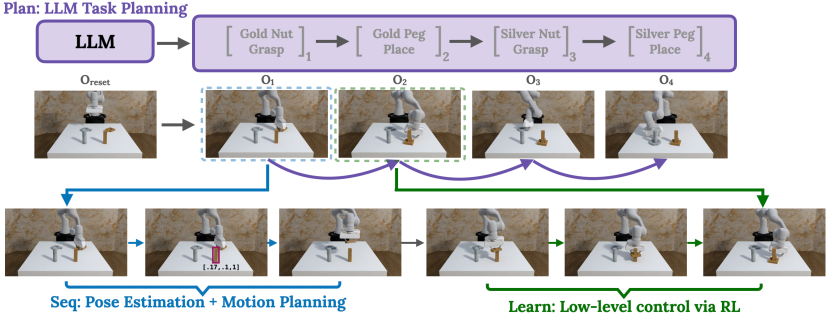
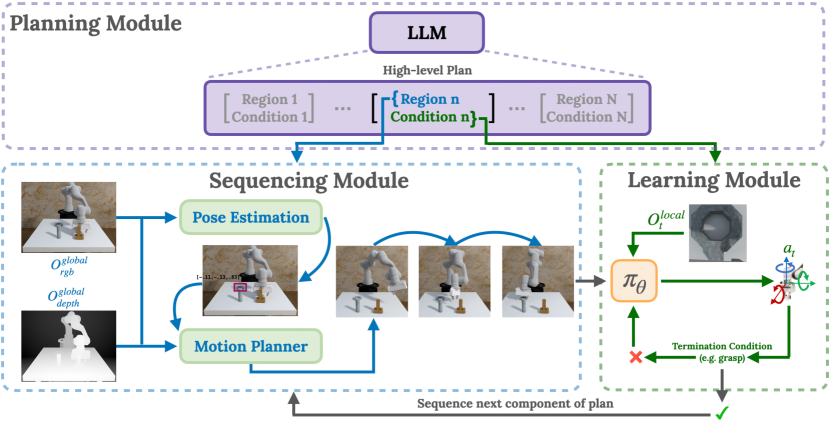
- Decompose tasks into language-generated region-stage pairs via an LLM plan (Plan).
- Use a vision-based Sequencing Module to estimate target regions from RGB-D observations and compute target poses with motion planning (Seq).
- Train a single RL policy across all stages to learn local interaction strategies (Learn).
- Apply stage termination conditions to guide curriculum and prevent dithering during plan execution.
- Train with DRQ-v2 and leverage local observations to improve data efficiency and generalization.
- Share policy and value functions across stages to handle long-horizon planning errors.
Experimental results
Research questions
- RQ1Can an LLM provide useful, zero-shot high-level plans for long-horizon robotics tasks without a predefined skill library?
- RQ2Does coupling an LLM plan with vision-based sequencing and a single RL policy improve learning efficiency and task success on long-horizon tasks?
- RQ3How does using local observations and stage termination cues affect learning speed and robustness to pose noise?
- RQ4Can this PSL framework scale to multi-stage tasks with up to 10 stages across diverse benchmarks?
Key findings
- PSL achieves over 85% success on four benchmarks with up to 10 stages using only visual input.
- On Robosuite two-stage tasks, PSL reaches 1.0 success where baselines lag (E2E, RAPS, SayCan, TAMP), with PSL averaging near 1.0 and others substantially lower.
- PSL significantly outperforms end-to-end and hierarchical RL baselines on multi-stage tasks, maintaining high success where others drop.
- The approach handles obstructed and contact-rich tasks effectively by decoupling planning (motion planning) from interaction (RL).
- Stage termination cues and shared policy across stages substantially improve learning speed and robustness to pose estimation noise.
Read this paper
Open the full text in the Nubint reader and ask about any passage as you read.
Read this paper on NubintThis review was generated by AI from the original paper. Please check the paper before citing it.