
[Paper Review] Planting a SEED of Vision in Large Language Model
SEED introduces a discrete image tokenizer that enables off-the-shelf LLMs to perform both image-to-text and text-to-image generation via LoRA-tuned multimodal models, using 5M image-text pairs and a 1D causal token design.
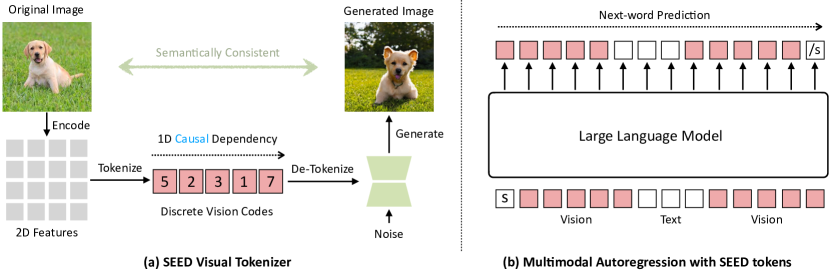
We present SEED, an elaborate image tokenizer that empowers Large Language Models (LLMs) with the emergent ability to SEE and Draw at the same time. Research on image tokenizers has previously reached an impasse, as frameworks employing quantized visual tokens have lost prominence due to subpar performance and convergence in multimodal comprehension (compared to BLIP-2, etc.) or generation (compared to Stable Diffusion, etc.). Despite the limitations, we remain confident in its natural capacity to unify visual and textual representations, facilitating scalable multimodal training with LLM's original recipe. In this study, we identify two crucial principles for the architecture and training of SEED that effectively ease subsequent alignment with LLMs. (1) Image tokens should be independent of 2D physical patch positions and instead be produced with a 1D causal dependency, exhibiting intrinsic interdependence that aligns with the left-to-right autoregressive prediction mechanism in LLMs. (2) Image tokens should capture high-level semantics consistent with the degree of semantic abstraction in words, and be optimized for both discriminativeness and reconstruction during the tokenizer training phase. As a result, the off-the-shelf LLM is able to perform both image-to-text and text-to-image generation by incorporating our SEED through efficient LoRA tuning. Comprehensive multimodal pretraining and instruction tuning, which may yield improved results, are reserved for future investigation. This version of SEED was trained in 5.7 days using only 64 V100 GPUs and 5M publicly available image-text pairs. Our preliminary study emphasizes the great potential of discrete visual tokens in versatile multimodal LLMs and the importance of proper image tokenizers in broader research.
Motivation & Objective
- Motivate a tokenizer design that unifies visual and textual representations for autoregressive LLMs.
- Develop a VQ-based image tokenizer with 1D causal dependency and high-level semantic tokens.
- Demonstrate that integrating SEED with an LLM via LoRA enables both vision-to-language and language-to-vision tasks.
- Show competitive zero-shot retrieval and generation performance against established multimodal baselines.
- Outline a scalable training recipe using limited compute and public image-text data.
Proposed method
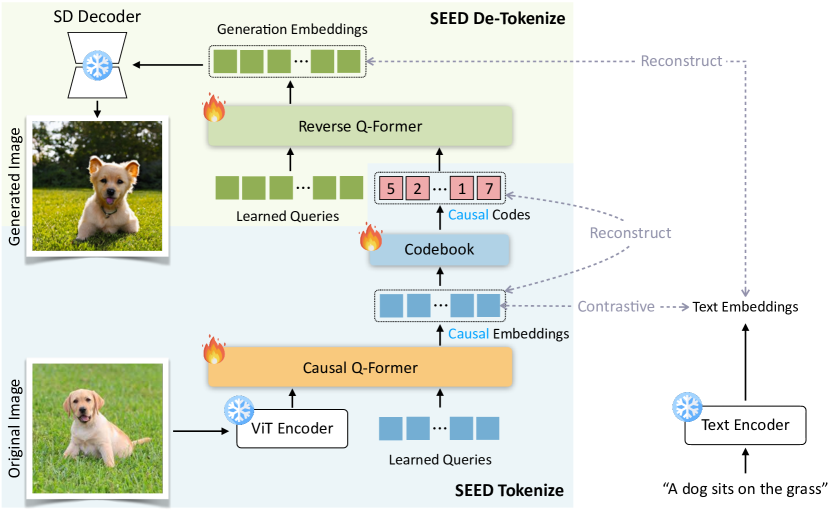
- Design SEED as a VQ-based image tokenizer with ViT encoder, Causal Q-Former, VQ Codebook, Reverse Q-Former, and UNet decoder.
- Train Causal Q-Former to produce 32 causal embeddings from 16x16 ViT features using 1D causal attention and image-text contrastive loss.
- Quantize causal embeddings with a VQ codebook to produce 32 discrete visual codes with causal dependency.
- Use a Reverse Q-Former to map discrete codes to generation embeddings aligned with Stable Diffusion latent space, enabling image synthesis.
- Train a decoder to reconstruct continuous embeddings from discrete codes and align generation embeddings to textual features via dual reconstruction losses.
- Fine-tune a SEED-OPT 2.7B model using LoRA on 5M image-text pairs to perform image-to-text and text-to-image autoregressive tasks.
Experimental results
Research questions
- RQ1Can a discretized, semantically rich image tokenizer align closely with LLM text tokens to enable unified multimodal autoregression?
- RQ2Do 1D causal, high-level semantic image tokens facilitate both image understanding and image generation within an LLM framework?
- RQ3What are the retrieval and generation capabilities of SEED compared to established multimodal baselines when integrated with a pre-trained LLM via LoRA?
- RQ4Is it feasible to train such a tokenizer and multimodal model efficiently on modest compute and data scales while preserving semantic alignment?
- RQ5How well does SEED support zero-shot image captioning and visual question answering when coupled with an LLM?
Key findings
- SEED tokens achieve competitive zero-shot image-text retrieval versus BLIP-2 on standard benchmarks.
- Discrete SEED tokens yield competitive image generation performance compared to Stable Diffusion, with CLIP-based semantic alignment.
- SEED-OPT 2.7B, trained with 5M image-text pairs via LoRA, demonstrates image-to-text and text-to-image autoregression.
- SEED enables realistic image generation by decoding discrete tokens through a Reverse Q-Former into SD-UNet latent space.
- Qualitative demonstrations show SEED can generate captions and answer open-ended visual questions without supervised VQA fine-tuning.
- The approach suggests discrete visual tokens can effectively support emergent multimodal capabilities in LLMs.
Read this paper
Open the full text in the Nubint reader and ask about any passage as you read.
Read this paper on NubintThis review was generated by AI from the original paper. Please check the paper before citing it.