
[Paper Review] PLATO-XL: Exploring the Large-scale Pre-training of Dialogue Generation
PLATO-XL is a 11-billion-parameter dialogue generation model pre-trained on large-scale Chinese and English social media conversations using a unified transformer architecture with multi-party aware pre-training. It achieves state-of-the-art performance across multiple conversational tasks, significantly reducing hallucination and inconsistency through massive parameter scale and improved modeling of conversational context.
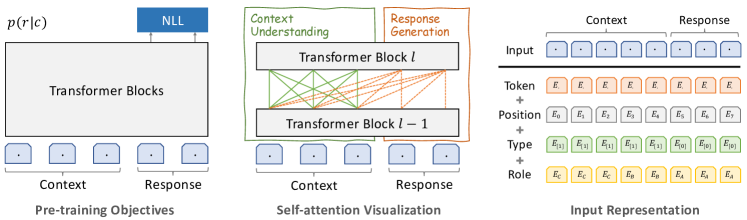
To explore the limit of dialogue generation pre-training, we present the models of PLATO-XL with up to 11 billion parameters, trained on both Chinese and English social media conversations. To train such large models, we adopt the architecture of unified transformer with high computation and parameter efficiency. In addition, we carry out multi-party aware pre-training to better distinguish the characteristic information in social media conversations. With such designs, PLATO-XL successfully achieves superior performances as compared to other approaches in both Chinese and English chitchat. We further explore the capacity of PLATO-XL on other conversational tasks, such as knowledge grounded dialogue and task-oriented conversation. The experimental results indicate that PLATO-XL obtains state-of-the-art results across multiple conversational tasks, verifying its potential as a foundation model of conversational AI.
Motivation & Objective
- To investigate the impact of model scale on dialogue generation quality, especially in reducing hallucination and inconsistency.
- To explore whether increasing model parameters beyond existing benchmarks improves performance in open-domain and task-oriented dialogues.
- To design a pre-training strategy that better captures multi-party conversation dynamics in social media data.
- To evaluate PLATO-XL as a foundational model for diverse conversational AI tasks beyond chitchat.
- To ensure safety and reduce bias in open-domain dialogue generation through data cleaning and post-processing classifiers.
Proposed method
- Adopts a unified transformer architecture optimized for high computation and parameter efficiency to train large-scale models.
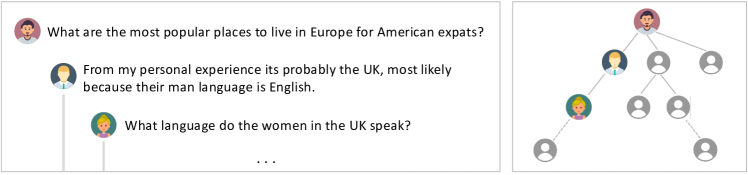
- Employs multi-party aware pre-training to model speaker roles and conversation dynamics in social media dialogues.
- Pre-trains on 11 billion parameters using large-scale multilingual (Chinese and English) social media conversation data.
- Uses input augmentation to encode conversational goals and knowledge triplets for knowledge-grounded dialogue tasks.
- Applies two-stage safety filtering: one classifier detects sensitive topics in user inputs, and another filters unsafe generated responses.
- Fine-tunes on downstream tasks using standard supervised fine-tuning with automatic evaluation metrics.
Experimental results
Research questions
- RQ1Does increasing model size beyond existing dialogue models lead to improved performance in open-domain chitchat?
- RQ2Can multi-party aware pre-training reduce inconsistency in multi-turn dialogues compared to standard pre-training?
- RQ3To what extent does a large-scale pre-trained model like PLATO-XL reduce hallucination in response generation?
- RQ4Can PLATO-XL serve as a strong foundation model for diverse conversational AI tasks, including knowledge-grounded and task-oriented dialogues?
- RQ5How effective are the safety mechanisms in mitigating biased or unsafe responses in open-domain chatbots?
Key findings
- PLATO-XL achieves state-of-the-art performance on both Chinese and English chitchat benchmarks, outperforming existing models.
- In the DuConv knowledge-grounded dialogue task, PLATO-XL improves F1 score by 2.05 points over the previous SOTA (GOKC).
- On DSTC9-Track1 for knowledge-grounded response generation, PLATO-XL achieves a 1.62-point improvement over the winning Knover model.
- In MultiWOZ 2.2 for dialog state tracking, PLATO-XL achieves a joint goal accuracy of 58.79%, surpassing the previous SOTA (DSS-DST).
- The model significantly reduces hallucination and inconsistency due to its large parameter scale and multi-party aware pre-training.
- Safety mechanisms, including data cleaning and response filtering, reduce but do not fully eliminate biased or unsafe outputs under adversarial conditions.
Read this paper
Open the full text in the Nubint reader and ask about any passage as you read.
Read this paper on NubintThis review was generated by AI from the original paper. Please check the paper before citing it.