
[Paper Review] PLiNIO: A User-Friendly Library of Gradient-based Methods for Complexity-aware DNN Optimization
PLiNIO is an open-source, user-friendly PyTorch library that enables automated, gradient-based optimization of deep neural networks for edge deployment. It unifies coarse-grained and fine-grained neural architecture search (NAS) and differentiable mixed-precision quantization (MPS), achieving up to 94.34% memory reduction with only a 0.92% accuracy drop compared to a baseline model.
Accurate yet efficient Deep Neural Networks (DNNs) are in high demand, especially for applications that require their execution on constrained edge devices. Finding such DNNs in a reasonable time for new applications requires automated optimization pipelines since the huge space of hyper-parameter combinations is impossible to explore extensively by hand. In this work, we propose PLiNIO, an open-source library implementing a comprehensive set of state-of-the-art DNN design automation techniques, all based on lightweight gradient-based optimization, under a unified and user-friendly interface. With experiments on several edge-relevant tasks, we show that combining the various optimizations available in PLiNIO leads to rich sets of solutions that Pareto-dominate the considered baselines in terms of accuracy vs model size. Noteworthy, PLiNIO achieves up to 94.34% memory reduction for a <1% accuracy drop compared to a baseline architecture.
Motivation & Objective
- To address the challenge of manually exploring the vast hyper-parameter space in DNN design for edge deployment.
- To provide a unified, accessible interface for state-of-the-art gradient-based AutoML techniques, including NAS and mixed-precision quantization.
- To enable efficient, complexity-aware design space exploration (DSE) for DNNs targeting constrained hardware.
- To support plug-and-play integration into existing PyTorch workflows without requiring expertise in NAS or quantization.
- To demonstrate that sequential application of multiple gradient-based optimizations can generate Pareto-optimal models in accuracy vs. memory trade-offs.
Proposed method
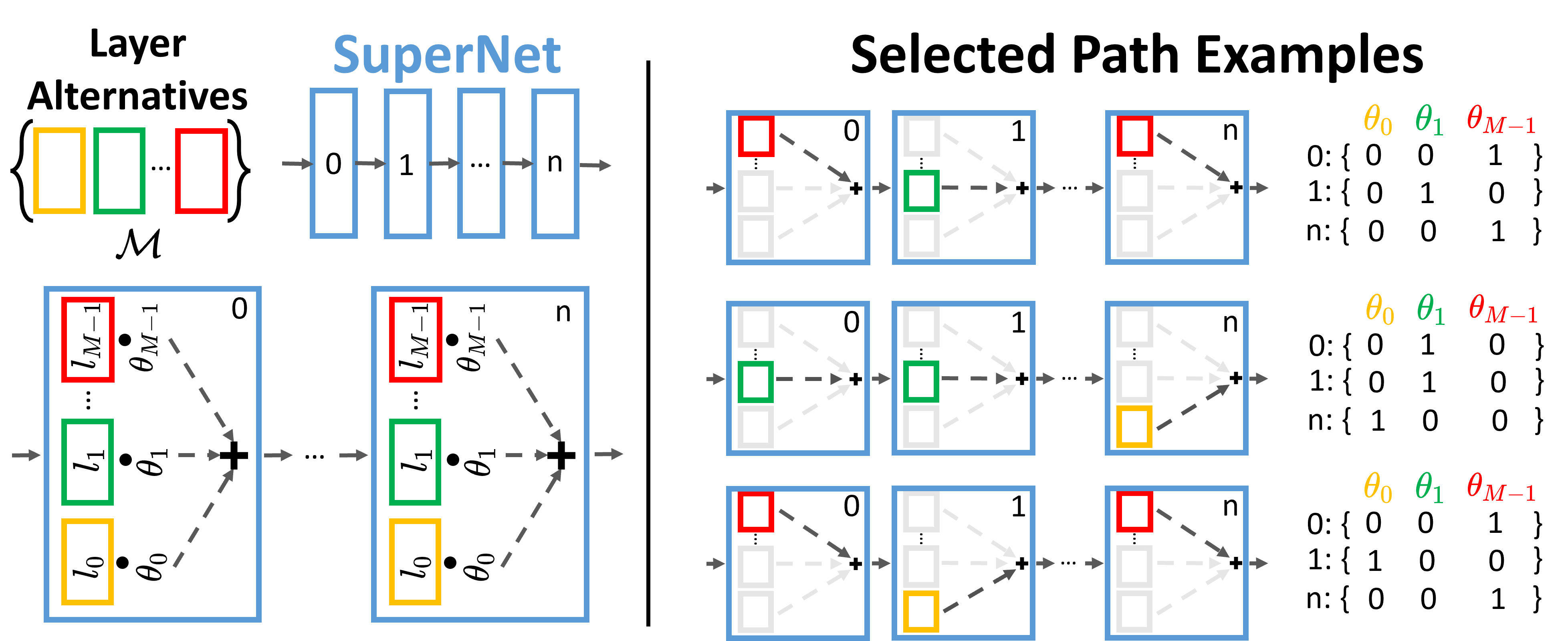
- PLiNIO implements a SuperNet-based coarse-grained NAS to search over layer types and configurations using differentiable architecture search.
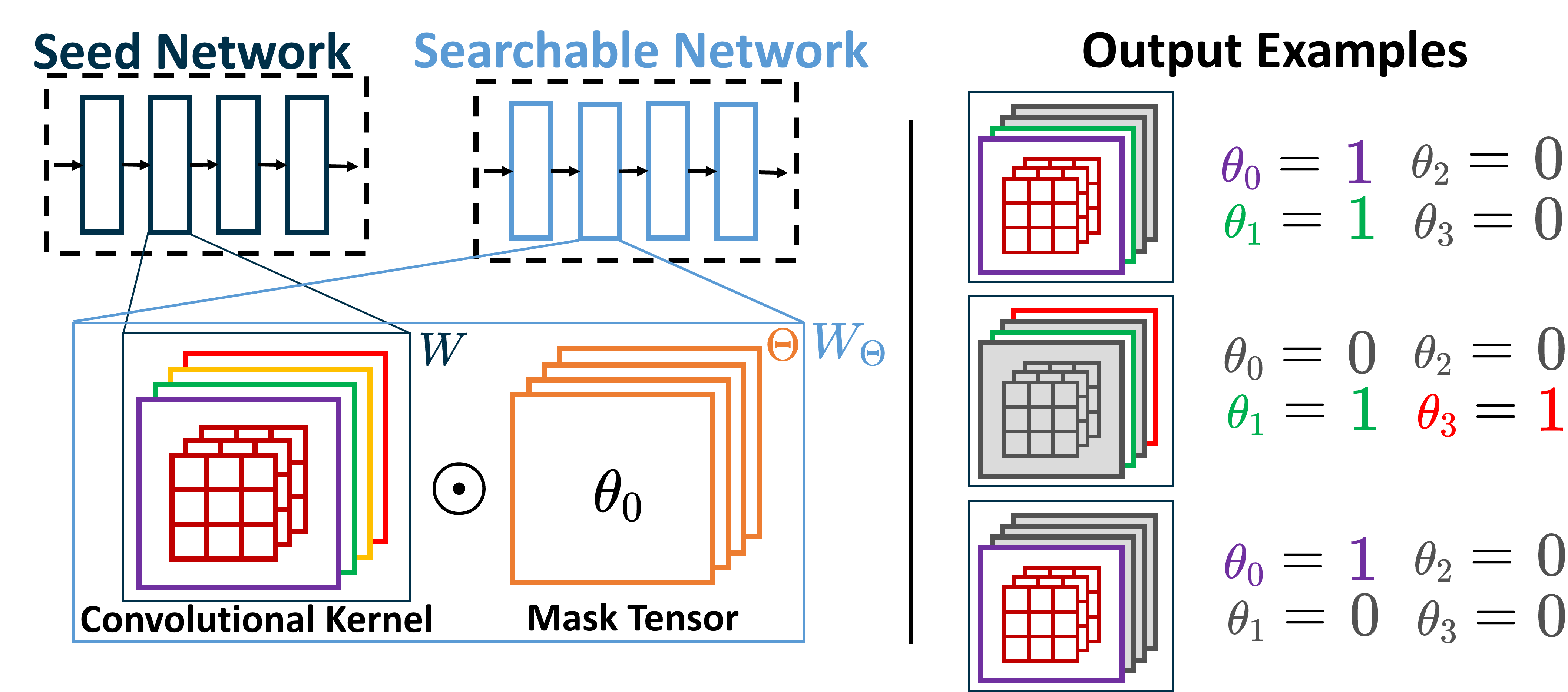
- It employs a differentiable architecture search (DARTS-style) for fine-grained NAS to optimize layer-specific hyper-parameters like channel counts.
- The library integrates a differentiable mixed-precision search (MPS) method that jointly optimizes bit-widths for weights and activations using symmetric min-max quantization and PaCT for dynamic range adjustment.
- All optimizations are exposed through a unified, PyTorch-compatible API, enabling seamless integration into standard training pipelines.
- The framework supports sequential application of NAS and MPS, allowing progressive model compression while preserving performance.
- PLiNIO’s internal design is extensible, enabling future integration of additional gradient-based optimization techniques.
Experimental results
Research questions
- RQ1Can a unified, user-friendly library streamline the application of gradient-based DNN optimization techniques for edge deployment?
- RQ2How effective is the sequential application of coarse-grained NAS, fine-grained NAS, and mixed-precision quantization in reducing model size with minimal accuracy loss?
- RQ3To what extent can gradient-based methods achieve Pareto-optimal trade-offs between model accuracy and memory footprint in edge-relevant tasks?
- RQ4How does the performance of PLiNIO compare to baseline models and individual optimization techniques in terms of memory reduction and accuracy?
- RQ5Can PLiNIO be effectively applied to real-world edge workloads without requiring deep expertise in AutoML or quantization?
Key findings
- Applying SuperNet followed by PIT (fine-grained NAS) reduced model memory by 74.68% while maintaining 84.93% accuracy on the ICL benchmark.
- The sequential application of SuperNet, PIT, and MPS achieved a 94.34% reduction in memory usage (from 302.19 kB to 17.09 kB) with only a 0.92% accuracy drop on the ICL dataset.
- On the VWW benchmark, the sequential optimization added four new Pareto-optimal models in the 80–83% accuracy range, demonstrating improved exploration of the design space.
- The most accurate quantized model achieved 83.11% accuracy with 94.34% memory reduction compared to the original 84.03% baseline, using 8-bit weights and activations with selective 4-bit precision.
- Applying MPS to the smallest Pareto-optimal model from prior optimizations reduced memory by 77.66% compared to the input of the MPS step, at the cost of 1.82% accuracy.
- Each MPS optimization epoch took 4.3× longer than a standard training epoch, but the resulting models achieved substantial compression with minimal accuracy degradation.
Read this paper
Open the full text in the Nubint reader and ask about any passage as you read.
Read this paper on NubintThis review was generated by AI from the original paper. Please check the paper before citing it.