
[Paper Review] PMC-VQA: Visual Instruction Tuning for Medical Visual Question Answering
The paper introduces MedVInT, a generative MedVQA model that aligns a pre-trained vision encoder with a large language model via visual instruction tuning, and releases PMC-VQA, a large-scale medical VQA dataset with 227k QA pairs over 149k images.
Medical Visual Question Answering (MedVQA) presents a significant opportunity to enhance diagnostic accuracy and healthcare delivery by leveraging artificial intelligence to interpret and answer questions based on medical images. In this study, we reframe the problem of MedVQA as a generation task that naturally follows the human-machine interaction and propose a generative-based model for medical visual understanding by aligning visual information from a pre-trained vision encoder with a large language model. We establish a scalable pipeline to construct a large-scale medical visual question-answering dataset, named PMC-VQA, which contains 227k VQA pairs of 149k images that cover various modalities or diseases. We train the proposed model on PMC-VQA and then fine-tune it on multiple public benchmarks, e.g., VQA-RAD, SLAKE, and Image-Clef-2019, significantly outperforming existing MedVQA models in generating relevant, accurate free-form answers. In addition, we propose a test set that has undergone manual verification, which is significantly more challenging, serving to better monitor the development of generative MedVQA methods. To facilitate comprehensive evaluation and comparison, we have maintained a leaderboard at https://paperswithcode.com/paper/pmc-vqa-visual-instruction-tuning-for-medical, offering a centralized resource for tracking progress and benchmarking state-of-the-art approaches. The PMC-VQA dataset emerges as a vital resource for the field of research, and the MedVInT presents a significant breakthrough in the area of MedVQA.
Motivation & Objective
- Reframe MedVQA as an open-ended generation task to enable free-form answers in clinical practice.
- Develop MedVInT by aligning a medical vision encoder with a language model through visual instruction tuning.
- Create a scalable pipeline to build a large, diverse MedVQA dataset (PMC-VQA) and demonstrate its value for pre-training generative MedVQA models.
- Show that pre-training on PMC-VQA plus fine-tuning yields state-of-the-art results on VQA-RAD and SLAKE and propose a challenging test set for robust benchmarking.
Proposed method
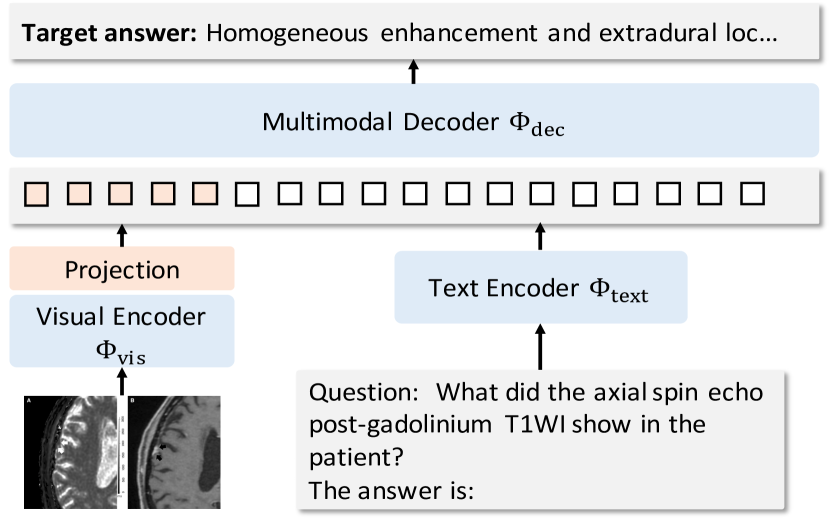
- Propose MedVInT variants for encoder-based (MedVInT-TE) and decoder-based (MedVInT-TD) language models.
- Use a ResNet-50 based visual encoder with a trainable projection to align visual and language embeddings.
- Encode the question with a language encoder and concatenate with visual embeddings as input to a multimodal decoder (initialized from scratch or pre-trained); formulate generation as a masked language modeling task for encoder-based LMs.
- Construct PMC-VQA by generating 1.5M question-answer pairs from 381K image-caption pairs using ChatGPT, followed by filtering with a QA model to ensure image-relevant answers and a classifier to remove caption-only questions.
- Pre-train MedVInT on PMC-VQA and fine-tune on VQA-RAD and SLAKE to achieve open-ended generation and multi-choice accuracy.
- Compare with state-of-the-art baselines on public MedVQA datasets and assess zero-shot and fine-tuned performance on PMC-VQA-test.

Experimental results
Research questions
- RQ1Can a generative MedVQA model outperform existing retrieval/classification-based approaches on standard MedVQA benchmarks?
- RQ2Does large-scale visual instruction tuning with a medical VQA dataset improve open-ended medical VQA performance?
- RQ3How does PMC-VQA pre-training influence performance on VQA-RAD, SLAKE, and a more challenging new benchmark?
- RQ4What is the contribution of vision vs. language backbones and projection modules to MedVInT performance?
Key findings
- MedVInT achieves state-of-the-art accuracy on VQA-RAD and SLAKE, outperforming prior methods.
- Pre-training on PMC-VQA provides large gains (≈11% on VQA-RAD and ≈4% on SLAKE for TE variant; similar gains for TD variant).
- MedVInT-TE and MedVInT-TD both perform well, with TD excelling on longer open-ended answers and TE sometimes better for concise responses.
- PMC-VQA-test presents a significantly more challenging benchmark where even strong multimodal models struggle, indicating room for improvement.
- A medical-specific visual backbone and domain-tuned language backbones yield improvements over generic backbones across PMC-VQA evaluation.
- Different projection modules (MLP vs Transformer) show comparable performance, indicating architectural flexibility in reconciling embedding spaces.
Read this paper
Open the full text in the Nubint reader and ask about any passage as you read.
Read this paper on NubintThis review was generated by AI from the original paper. Please check the paper before citing it.