
[Paper Review] POGEMA: A Benchmark Platform for Cooperative Multi-Agent Pathfinding
POGEMA provides a fast learning environment, problem instance generator, visualization toolkit, and automated benchmarking with a unified evaluation protocol for cooperative multi-agent pathfinding and navigation.
Multi-agent reinforcement learning (MARL) has recently excelled in solving challenging cooperative and competitive multi-agent problems in various environments, typically involving a small number of agents and full observability. Moreover, a range of crucial robotics-related tasks, such as multi-robot pathfinding, which have traditionally been approached with classical non-learnable methods (e.g., heuristic search), are now being suggested for solution using learning-based or hybrid methods. However, in this domain, it remains difficult, if not impossible, to conduct a fair comparison between classical, learning-based, and hybrid approaches due to the lack of a unified framework that supports both learning and evaluation. To address this, we introduce POGEMA, a comprehensive set of tools that includes a fast environment for learning, a problem instance generator, a collection of predefined problem instances, a visualization toolkit, and a benchmarking tool for automated evaluation. We also introduce and define an evaluation protocol that specifies a range of domain-related metrics, computed based on primary evaluation indicators (such as success rate and path length), enabling a fair multi-fold comparison. The results of this comparison, which involves a variety of state-of-the-art MARL, search-based, and hybrid methods, are presented.
Motivation & Objective
- Introduce POGEMA as a comprehensive toolkit for developing, debugging, and evaluating methods for multi-agent navigation.
- Provide an evaluation protocol with domain-specific metrics to enable fair comparisons across learning, planning, and hybrid approaches.
- Demonstrate POGEMA’s extensibility and compatibility with existing MARL tools and map sets.
- Showcase baseline results across MARL, search-based, and hybrid solvers to highlight strengths and limitations of different approaches.
Proposed method
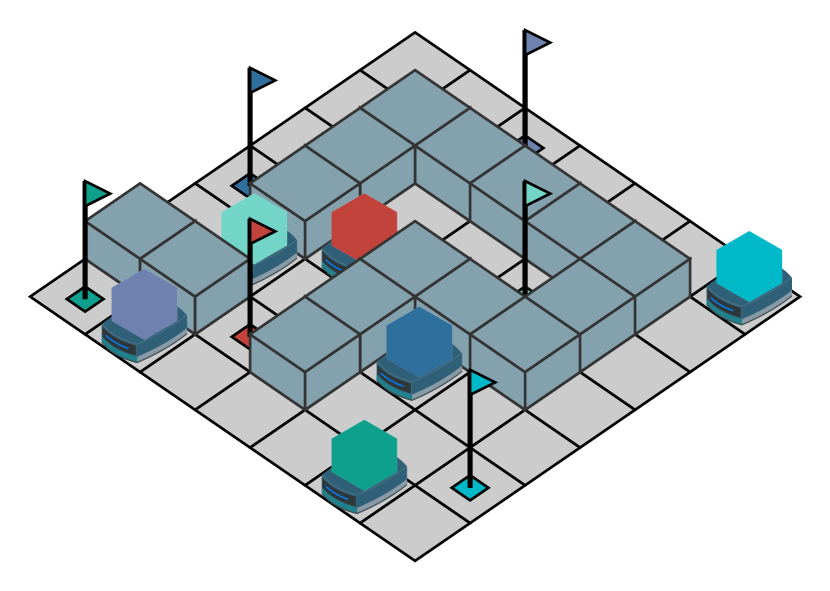
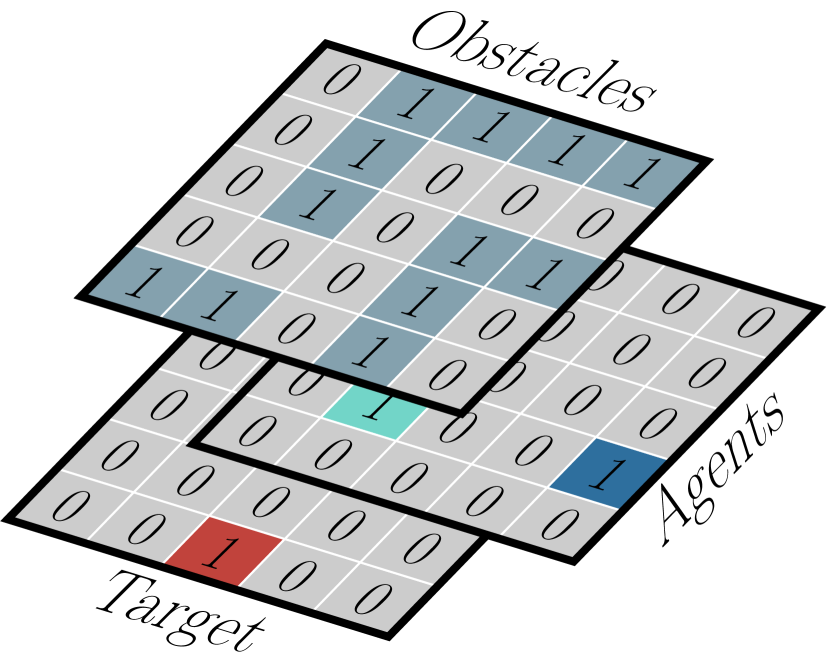
- Deliver a fast, configurable grid-world environment for multi-agent navigation with two problem settings: MAPF and lifelong MAPF (LMAPF).
- Provide a collision-shielding rule where conflicting moves result in staying in place and allow single-move priorities to resolve conflicts.
- Offer a Python-native interface with wrappers to adapt observations, rewards, and auxiliary guidance; enable procedural map generation (maze, random, warehouse, MovingAI variants, puzzles).
- Integrate with existing RL frameworks (PettingZoo, PyMARL, Gymnasium) and include a toolbox for distributed evaluation (via Dask) and visualization.
- Define a comprehensive evaluation protocol including metrics like success rate, sum of costs (SoC), makespan, throughput, and several high-level metrics (e.g., performance, out-of-distribution, scalability, cooperation, congestion, pathfinding).
- Provide a set of baselines spanning centralized planners, hybrid planners, and MARL methods to benchmark against POGEMA, with ready-made preprocessing and setup guidance.
Experimental results
Research questions
- RQ1How does POGEMA enable fair, cross-method comparisons among MARL, hybrid, and planning-based approaches for cooperative multi-agent navigation?
- RQ2What are the strengths and weaknesses of state-of-the-art baselines (centralized planners, hybrid methods, and MARL) on MAPF and LMAPF tasks under diverse map topologies and agent densities?
- RQ3How do generalization, scalability, and robustness manifest across methods when evaluated with the POGEMA protocol and map generators?
- RQ4Can the POGEMA environment and toolbox facilitate efficient, reproducible experimentation and visualization for large-scale multi-agent navigation research?
Key findings
- Centralized planners (LaCAM for MAPF, RHCR for LMAPF) achieve the best cooperation, out-of-distribution, and performance metrics across tasks.
- Specialized hybrid methods (DCC, SCRIMP) closely approach central planners, with DCC performing well on out-of-distribution and pathfinding, and SCRIMP excelling in congestion.
- MARL baselines (MAMBA, QMIX, VDN, IQL, QPLEX) underperform relative to hybrid and centralized methods, highlighting the need for larger-scale benchmarks and integration with planning components.
- LR-based approaches without communication (e.g., Follower, MATS-LP) show competitive results in certain metrics but can suffer from high runtimes or limited global information.
- LMAPF results favor RHCR for cooperation/out-of-distribution/performance/pathfinding, but suffer in congestion and scalability; MATS-LP and Follower offer alternatives depending on metric emphasis.
- MAMBA emerges as the strongest MARL performer among decentralized methods but still trails hybrid/centralized approaches on most metrics.
Read this paper
Open the full text in the Nubint reader and ask about any passage as you read.
Read this paper on NubintThis review was generated by AI from the original paper. Please check the paper before citing it.