
[Paper Review] Point-NeRF: Point-based Neural Radiance Fields
Point-NeRF proposes a point-based neural radiance field representation that uses learnable 3D point clouds with neural features to enable fast, high-quality novel view synthesis. By initializing from a pre-trained deep network and applying per-scene fine-tuning with adaptive point growing and pruning, it achieves NeRF-level quality in 20–40 minutes—30× faster than standard NeRF—while being robust to noisy or incomplete point clouds from other reconstruction methods.
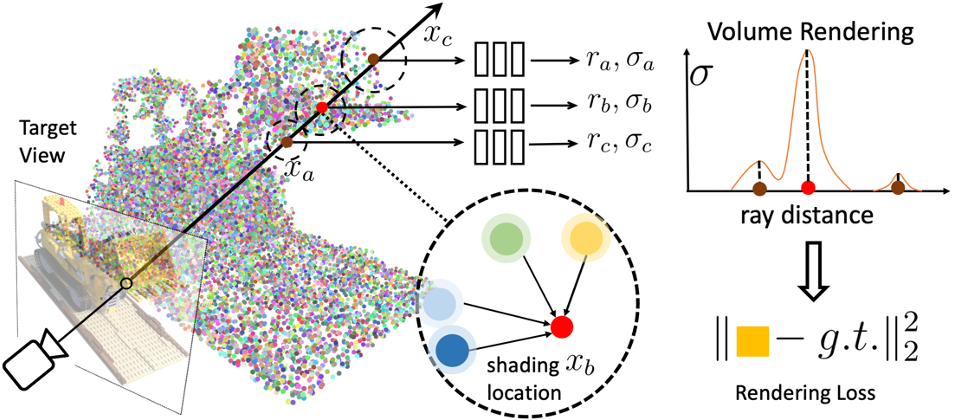
Volumetric neural rendering methods like NeRF generate high-quality view synthesis results but are optimized per-scene leading to prohibitive reconstruction time. On the other hand, deep multi-view stereo methods can quickly reconstruct scene geometry via direct network inference. Point-NeRF combines the advantages of these two approaches by using neural 3D point clouds, with associated neural features, to model a radiance field. Point-NeRF can be rendered efficiently by aggregating neural point features near scene surfaces, in a ray marching-based rendering pipeline. Moreover, Point-NeRF can be initialized via direct inference of a pre-trained deep network to produce a neural point cloud; this point cloud can be finetuned to surpass the visual quality of NeRF with 30X faster training time. Point-NeRF can be combined with other 3D reconstruction methods and handles the errors and outliers in such methods via a novel pruning and growing mechanism. The experiments on the DTU, the NeRF Synthetics , the ScanNet and the Tanks and Temples datasets demonstrate Point-NeRF can surpass the existing methods and achieve the state-of-the-art results.
Motivation & Objective
- To address the prohibitively long training time of NeRF by introducing a more efficient radiance field representation.
- To combine the strengths of deep multi-view stereo (MVS) for fast geometry initialization and neural radiance fields for high-quality rendering.
- To develop a generic framework that can initialize and optimize radiance fields from any point cloud, including those with holes and outliers.
- To improve rendering quality and robustness by introducing a novel point growing and pruning mechanism during per-scene optimization.
Proposed method
- Represent the scene as a neural point cloud where each point encodes local 3D geometry and appearance via learnable neural features.
- Use a 3D MLP to aggregate neighboring neural points and predict volume density and view-dependent radiance at any 3D location, enabling differentiable ray marching.
- Initialize the point-based radiance field via end-to-end training of a deep network that predicts depth and 2D features from input images, followed by unprojection to 3D.
- Apply a two-stage optimization: initial end-to-end training for generalization, followed by per-scene fine-tuning with a novel point growing and pruning mechanism.
- Introduce geometric reasoning during volume rendering to grow new points near boundaries in high-density regions and prune points in low-density regions.
- Leverage pre-trained MVS networks (e.g., cost-volume networks) and CNNs to generate initial point clouds and features, enabling fast inference-based initialization.

Experimental results
Research questions
- RQ1Can a point-based neural radiance field representation achieve high-fidelity novel view synthesis with significantly reduced training time compared to standard NeRF?
- RQ2Can a pre-trained deep network be used to directly infer a neural point cloud initialization that enables fast per-scene optimization?
- RQ3How effective is the proposed point growing and pruning mechanism in improving rendering quality when starting from low-quality or incomplete point clouds?
- RQ4Can Point-NeRF generalize across diverse datasets and outperform existing methods, including NeRF and other neural radiance field models?
Key findings
- Point-NeRF achieves state-of-the-art novel view synthesis performance on DTU, NeRF Synthetic, Tanks and Temples, and ScanNet datasets.
- With only 20–40 minutes of per-scene optimization, Point-NeRF surpasses NeRF, which requires over 20 hours of training, demonstrating a 30× speedup.
- On the NeRF Synthetic dataset, Point-NeRF trained for 20K steps matches NeRF quality but in 30× less time, achieving PSNR of 30.97 and SSIM of 0.942 on the Hotdog scene.
- When initialized from COLMAP point clouds (which contain holes and noise), Point-NeRF still achieves high-quality results, with PSNR of 30.18 and SSIM of 0.941 on the Ship scene after 200K optimization steps.
- The point growing and pruning mechanism significantly improves reconstruction quality: on the Hotdog scene, PSNR increases from 29.91 to 35.49 and SSIM from 0.978 to 0.986 when using the mechanism with COLMAP points.
- The method successfully recovers fine details and thin structures (e.g., ropes) and fills large geometric holes, as shown in qualitative comparisons on sparse and incomplete point clouds.
Read this paper
Open the full text in the Nubint reader and ask about any passage as you read.
Read this paper on NubintThis review was generated by AI from the original paper. Please check the paper before citing it.