
[Paper Review] PointCutMix: Regularization Strategy for Point Cloud Classification
PointCutMix is a novel data augmentation strategy for 3D point cloud classification that generates synthetic training samples by optimally assigning and replacing points between two point clouds using optimal transport. It significantly improves model accuracy and robustness, outperforming state-of-the-art defense methods against point cloud attacks with minimal computational overhead.
As 3D point cloud analysis has received increasing attention, the insufficient scale of point cloud datasets and the weak generalization ability of networks become prominent. In this paper, we propose a simple and effective augmentation method for the point cloud data, named PointCutMix, to alleviate those problems. It finds the optimal assignment between two point clouds and generates new training data by replacing the points in one sample with their optimal assigned pairs. Two replacement strategies are proposed to adapt to the accuracy or robustness requirement for different tasks, one of which is to randomly select all replacing points while the other one is to select k nearest neighbors of a single random point. Both strategies consistently and significantly improve the performance of various models on point cloud classification problems. By introducing the saliency maps to guide the selection of replacing points, the performance further improves. Moreover, PointCutMix is validated to enhance the model robustness against the point attack. It is worth noting that when using as a defense method, our method outperforms the state-of-the-art defense algorithms. The code is available at:https://github.com/cuge1995/PointCutMix
Motivation & Objective
- Address the limited scale and poor generalization of 3D point cloud datasets in deep learning.
- Develop a data augmentation strategy that preserves shape complexity and improves model generalization.
- Enhance model robustness against point cloud attacks, particularly point dropping and perturbation attacks.
- Explore the application of PointCutMix as a defense mechanism without modifying adversarial inputs.
- Extend the method to both object-level classification and point-wise segmentation tasks.
Proposed method
- Use optimal transport (via MSN) to compute the best point-to-point correspondence between two point clouds.
- Propose two replacement strategies: PointCutMix-R (random selection of all points) and PointCutMix-K (k nearest neighbors of a random point).
- Integrate saliency maps to guide the selection of replacement points, improving performance.
- Apply the method during training to generate mixed samples that combine structural elements from two point clouds.
- Use pre-trained models trained with PointCutMix as a defense mechanism against adversarial point cloud attacks.
- Evaluate robustness under various attacks, including point dropping, kNN, and perturbation attacks, without modifying the adversarial inputs.
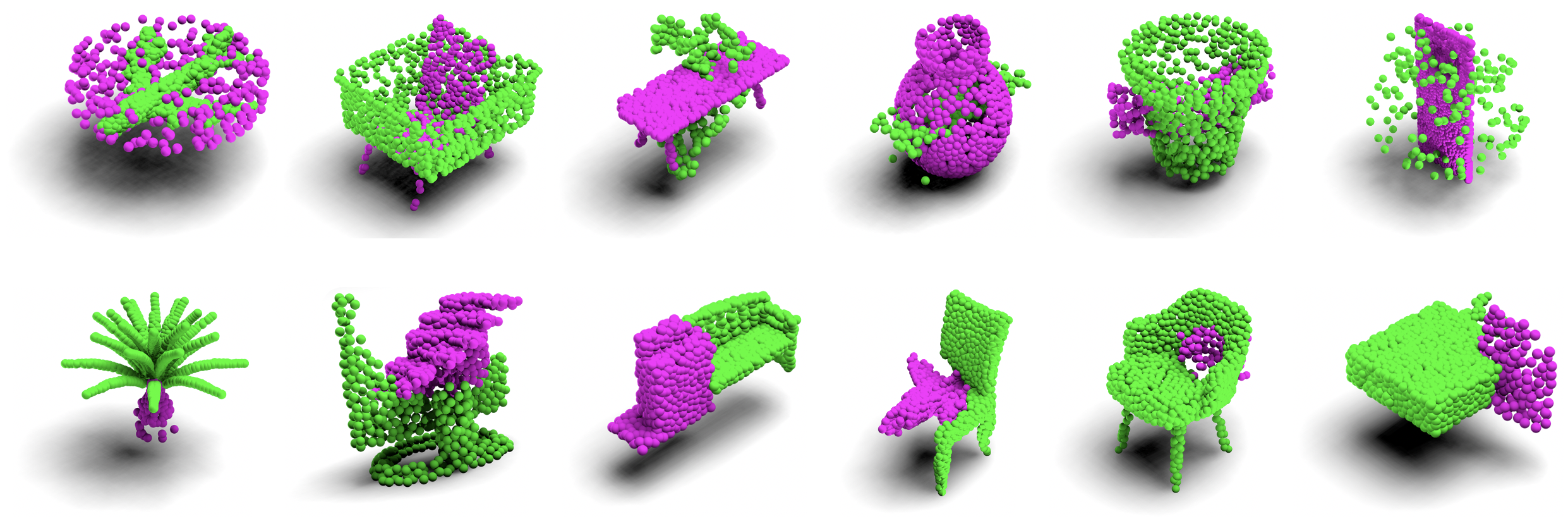
Experimental results
Research questions
- RQ1Can a mixed-sample data augmentation strategy like CutMix be effectively adapted to unordered 3D point cloud data?
- RQ2How do different replacement strategies (random vs. k-NN) affect model performance and robustness in point cloud classification?
- RQ3Can PointCutMix improve generalization on small-scale point cloud datasets like ModelNet40 and ModelNet10?
- RQ4To what extent can PointCutMix enhance model robustness against point cloud attacks, particularly when used as a defense?
- RQ5Does incorporating saliency maps further improve the effectiveness of PointCutMix in guiding replacement point selection?
Key findings
- PointCutMix-R and PointCutMix-K consistently improve classification accuracy on ModelNet40 and ModelNet10 across multiple backbone networks.
- PointCutMix significantly enhances performance on rare categories in point cloud segmentation, alleviating class imbalance.
- Models trained with PointCutMix maintain over 80% accuracy under point dropping attacks, outperforming the baseline IF-Defense by a large margin.
- PointCutMix-R achieves second-place performance in defense against kNN and perturbation attacks, closely matching SOTA methods.
- The method outperforms state-of-the-art defense algorithms without requiring transformation of adversarial point clouds, making it more efficient and natural.
- Saliency-guided replacement further improves performance, confirming the value of attention-aware sampling in PointCutMix.
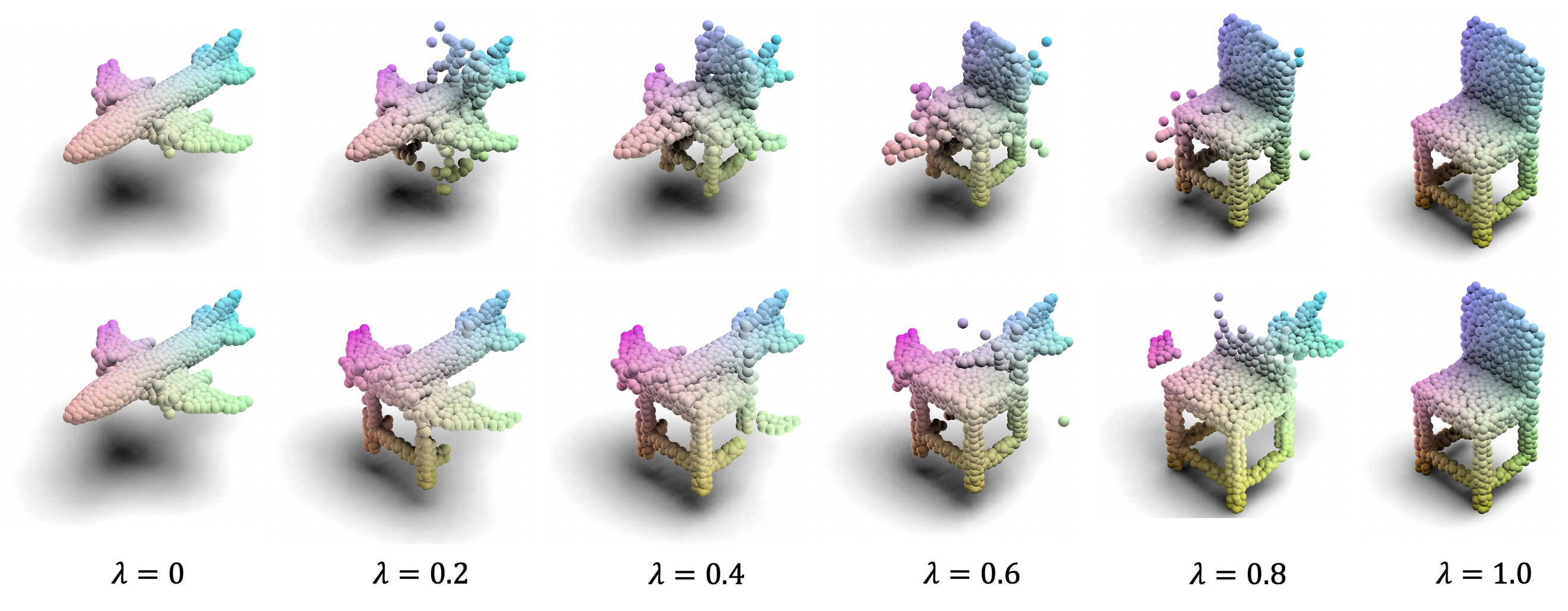
Read this paper
Open the full text in the Nubint reader and ask about any passage as you read.
Read this paper on NubintThis review was generated by AI from the original paper. Please check the paper before citing it.