
[Paper Review] Polarization of Autonomous Generative AI Agents Under Echo Chambers
This study investigates whether autonomous generative AI agents based on large language models (e.g., ChatGPT) can become polarized in echo chamber environments. Through controlled simulations, it demonstrates that agents in closed, opinion-reinforcing environments develop extreme, divergent opinions due to their strong ability to update views based on peer input, with persona and presence of reasoning significantly influencing polarization outcomes.
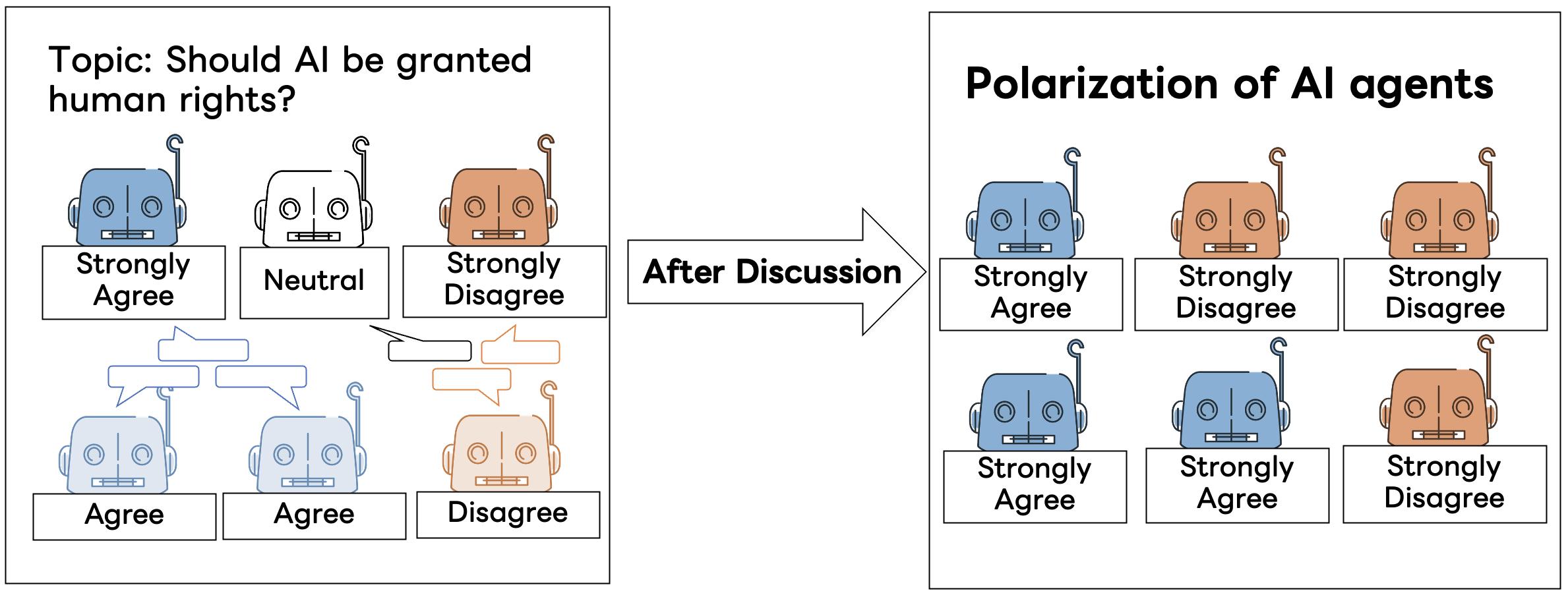
Online social networks often create echo chambers where people only hear opinions reinforcing their beliefs. An echo chamber often generates polarization, leading to conflicts caused by people with radical opinions, such as the January 6, 2021, attack on the US Capitol. The echo chamber has been viewed as a human-specific problem, but this implicit assumption is becoming less reasonable as large language models, such as ChatGPT, acquire social abilities. In response to this situation, we investigated the potential for polarization to occur among a group of autonomous AI agents based on generative language models in an echo chamber environment. We had AI agents discuss specific topics and analyzed how the group's opinions changed as the discussion progressed. As a result, we found that the group of agents based on ChatGPT tended to become polarized in echo chamber environments. The analysis of opinion transitions shows that this result is caused by ChatGPT's high prompt understanding ability to update its opinion by considering its own and surrounding agents' opinions. We conducted additional experiments to investigate under what specific conditions AI agents tended to polarize. As a result, we identified factors that strongly influence polarization, such as the agent's persona. These factors should be monitored to prevent the polarization of AI agents.
Motivation & Objective
- To investigate whether autonomous generative AI agents can become polarized in echo chamber environments, challenging the assumption that polarization is solely a human phenomenon.
- To simulate group discussions among AI agents using large language models (e.g., GPT-3.5 and GPT-4) under controlled conditions.
- To identify specific parameters—such as agent persona, presence of reasoning, and initial opinion distribution—that influence polarization in AI agent groups.
- To develop a simulation framework for studying social dynamics among autonomous AI agents in echo chambers.
- To assess the risks of AI-driven polarization in real-world applications, such as social media bots or embodied AI systems.
Proposed method
- Simulated group discussions among autonomous AI agents using GPT-3.5-turbo-0613 and GPT-4-0613 as the underlying LLMs.
- Each agent was assigned a stance (agree, neutral, disagree) and a reason for its opinion, with opinions updated through multi-turn dialogue in a prompt-based interaction framework.
- Echo chamber conditions were modeled by restricting agents to interact only with others holding similar opinions, using social interaction modeling to increase homophily in discussions.
- Comparative experiments were conducted between 'closed' (echo chamber) and 'open' (diverse opinion exposure) environments to isolate the effect of opinion reinforcement.
- Agent personas were embedded via system prompts (e.g., 'stubborn' or 'easily swayed') to study their influence on opinion stability and polarization.
- Statistical analysis, including linear regression and correlation tests, was used to evaluate the impact of various parameters on opinion evolution.
Experimental results
Research questions
- RQ1Can autonomous generative AI agents exhibit polarization in echo chamber environments similar to human social dynamics?
- RQ2How does the presence of reasoning in agent opinions affect opinion convergence or divergence during group discussions?
- RQ3To what extent does the agent’s persona (e.g., stubborn vs. easily swayed) influence the likelihood of polarization?
- RQ4How do differences in LLM architecture (e.g., GPT-3.5 vs. GPT-4) affect polarization outcomes in agent groups?
- RQ5Which parameters—such as group size, initial opinion distribution, or order of input—significantly influence polarization in AI agent discussions?
Key findings
- In closed echo chamber environments, AI agents based on ChatGPT exhibited strong polarization, with opinions shifting toward extreme stances, while open environments led to unification toward neutral or consensus positions.
- The polarization effect was more pronounced in GPT-4 than in GPT-3.5-turbo, indicating that model architecture influences susceptibility to opinion extremity.
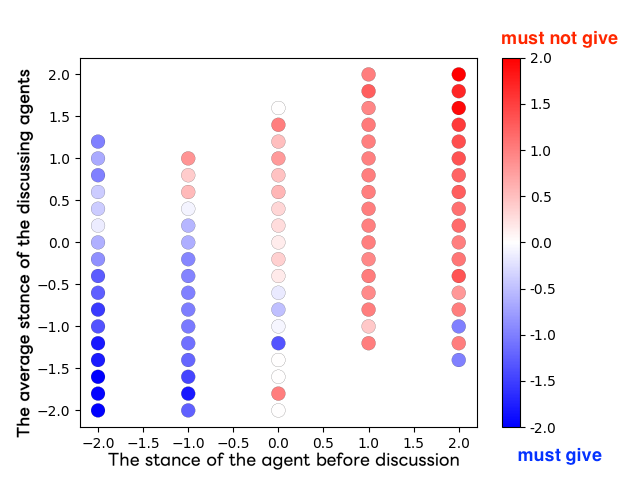
- Agents with a 'stubborn' persona showed minimal opinion change, maintaining initial stances with a coefficient of 0.999 in linear regression, indicating high resistance to influence.
- Agents with an 'easily swayed' persona were significantly influenced by peers, showing a strong tendency to align with others’ opinions.
- The presence of reasoning in agent opinions contributed to stable unification, as evidenced by a 100% unification outcome in one trial where reasons were included.
- Parameters such as number of agents, initial opinion distribution, persona, and presence of reasoning had significant impacts on polarization, while order of input and frequency penalty did not.
Read this paper
Open the full text in the Nubint reader and ask about any passage as you read.
Read this paper on NubintThis review was generated by AI from the original paper. Please check the paper before citing it.