
[Paper Review] Position: What Can Large Language Models Tell Us about Time Series Analysis
This position paper argues that large language models (LLMs) can serve as central hubs for time series analysis, functioning as data/model enhancers, predictors, and agents, and outlines integration strategies and research directions.
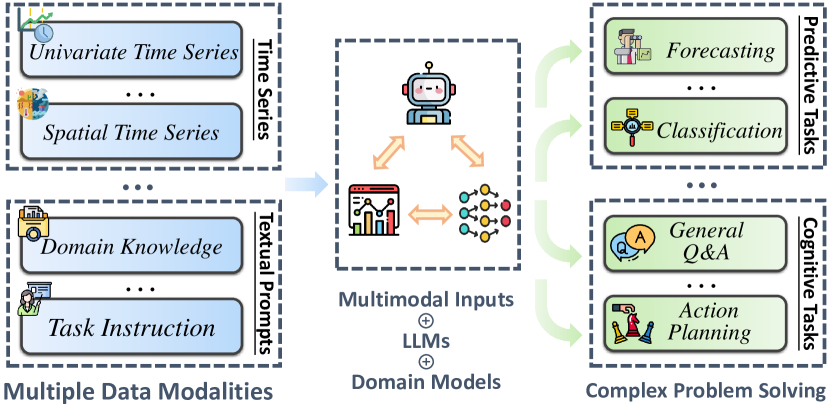
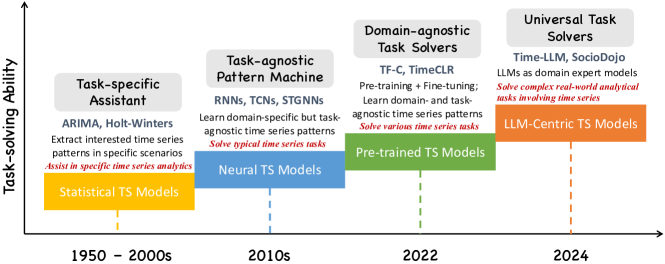
Time series analysis is essential for comprehending the complexities inherent in various realworld systems and applications. Although large language models (LLMs) have recently made significant strides, the development of artificial general intelligence (AGI) equipped with time series analysis capabilities remains in its nascent phase. Most existing time series models heavily rely on domain knowledge and extensive model tuning, predominantly focusing on prediction tasks. In this paper, we argue that current LLMs have the potential to revolutionize time series analysis, thereby promoting efficient decision-making and advancing towards a more universal form of time series analytical intelligence. Such advancement could unlock a wide range of possibilities, including time series modality switching and question answering. We encourage researchers and practitioners to recognize the potential of LLMs in advancing time series analysis and emphasize the need for trust in these related efforts. Furthermore, we detail the seamless integration of time series analysis with existing LLM technologies and outline promising avenues for future research.
Motivation & Objective
- Articulate the potential of LLMs to revolutionize time series analysis and promote universal intelligent systems.
- Systematically review existing work and categorize integration forms of LLMs with time series analysis.
- Propose future opportunities, challenges, and research directions for LLM-centric time series research.
Proposed method
- Classify time series tasks and LLM integration into data-based enhancers, model-based enhancers, and LLM-centered predictors.
- Describe tuning-based and non-tuning-based approaches for adapting LLMs to time series data through patching, tokenization, and prompting.
- Discuss agent-based use of LLMs for general time series analysis and report empirical insights from zero-shot experiments.
Experimental results
Research questions
- RQ1Can LLMs act as effective enhancers, predictors, and agents for time series analysis?
- RQ2What are the main integration forms and methods to combine LLMs with time series models?
- RQ3What challenges and opportunities arise in making LLM-centric time series analysis reliable and scalable?
Key findings
- LLMs have potential to augment time series data and models with external knowledge and reasoning.
- LLMs can serve as zero-shot or few-shot predictors for time series tasks, sometimes outperforming domain-specific models in certain settings.
- Tuning-based LLM predictors offer adaptability but risk catastrophic forgetting and high training costs, while non-tuning approaches rely on prompt engineering and face stability concerns.
- LLMs can function as time series agents, but hallucination and distribution understanding remain major limitations requiring integration of domain knowledge and robust prompting.
Read this paper
Open the full text in the Nubint reader and ask about any passage as you read.
Read this paper on NubintThis review was generated by AI from the original paper. Please check the paper before citing it.