
[Paper Review] Posterior Collapse and Latent Variable Non-identifiability
The paper proves posterior collapse in VAEs is equivalent to non-identifiability of latent variables and introduces latent-identifiable VAEs (lidvae) using Brenier maps and input-convex neural networks to ensure identifiability without changing the VAE objective.
Variational autoencoders model high-dimensional data by positing low-dimensional latent variables that are mapped through a flexible distribution parametrized by a neural network. Unfortunately, variational autoencoders often suffer from posterior collapse: the posterior of the latent variables is equal to its prior, rendering the variational autoencoder useless as a means to produce meaningful representations. Existing approaches to posterior collapse often attribute it to the use of neural networks or optimization issues due to variational approximation. In this paper, we consider posterior collapse as a problem of latent variable non-identifiability. We prove that the posterior collapses if and only if the latent variables are non-identifiable in the generative model. This fact implies that posterior collapse is not a phenomenon specific to the use of flexible distributions or approximate inference. Rather, it can occur in classical probabilistic models even with exact inference, which we also demonstrate. Based on these results, we propose a class of latent-identifiable variational autoencoders, deep generative models which enforce identifiability without sacrificing flexibility. This model class resolves the problem of latent variable non-identifiability by leveraging bijective Brenier maps and parameterizing them with input convex neural networks, without special variational inference objectives or optimization tricks. Across synthetic and real datasets, latent-identifiable variational autoencoders outperform existing methods in mitigating posterior collapse and providing meaningful representations of the data.
Motivation & Objective
- Clarify the link between posterior collapse and latent variable non-identifiability in variational autoencoders.
- Show that posterior collapse can occur in classical models with exact inference, not just neural-augmented VAEs.
- Propose and validate latent-identifiable VAE (lidvae) that enforces identifiability without modifying the variational objective.
- Demonstrate that lidvae preserves data fidelity while mitigating posterior collapse across synthetic and real data.
Proposed method
- Formally define posterior collapse and latent variable non-identifiability and prove their equivalence (Theorem 1).
- Argue that identifiability depends on the model and data, not solely on inference or optimization.
- Construct lidvae by enforcing injective likelihoods via Brenier maps parameterized with input-convex neural networks (icNNs).
- Use a two-step Brenier map composition with a diagonal-zero-one matrix to build an injective mapping for p(x|z).
- Show that lidvae retains the same inference procedure (ELBO optimization) as classical VAEs while guaranteeing identifiability (Proposition 2).
- Extend lidvae to latent-identifiable mixtures (lidmvae) and sequential variants (lidsvae) with analogous injective mappings.
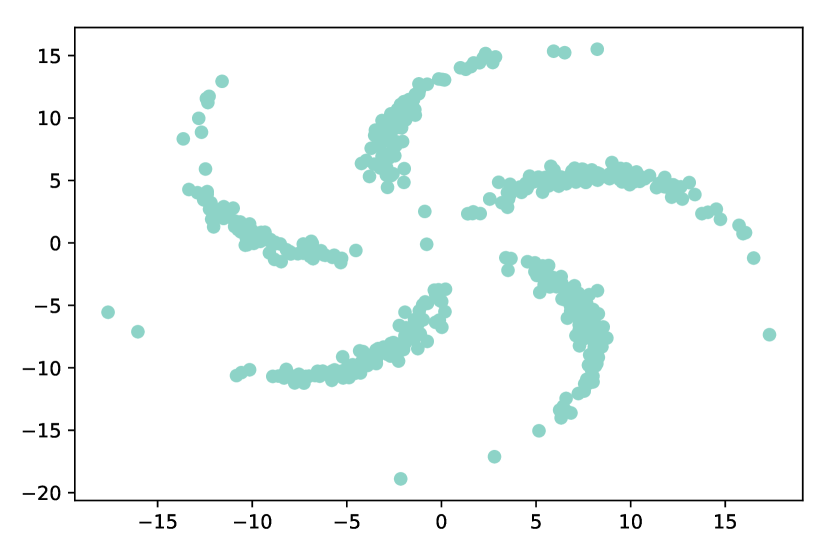
Experimental results
Research questions
- RQ1Is posterior collapse fundamentally tied to latent variable non-identifiability in the generative model?
- RQ2Can latent variable identifiability be achieved without altering the VAE objective or inference procedure?
- RQ3Do latent-identifiable VAEs (lidvae) mitigate posterior collapse while maintaining or improving data fidelity across tasks?
- RQ4Can Brenier maps and input-convex neural networks provide a practical and scalable route to identifiability in VAEs?
- RQ5Do identifiable variants of mixture and sequential VAEs (lidmvae, lidsvae) generalize identifiability benefits beyond standard VAEs?
Key findings
- Posterior collapse occurs if and only if latent variables are non-identifiable in the generative model (Theorem 1).
- Latent-identifiable VAEs (lidvae) guarantee identifiability of latent variables by constructing an injective likelihood using Brenier maps parameterized by input-convex neural networks.
- lidvae preserves the standard VAE inference objective and capacity while avoiding posterior collapse, at the cost of increased computational complexity.
- Latent-identifiable variants such as lidmvae and lidsvae extend identifiability benefits to mixture and sequential VAEs.
- Empirical results indicate lidvae outperforms existing VAEs in mitigating posterior collapse across synthetic and real datasets without sacrificing fit to data.
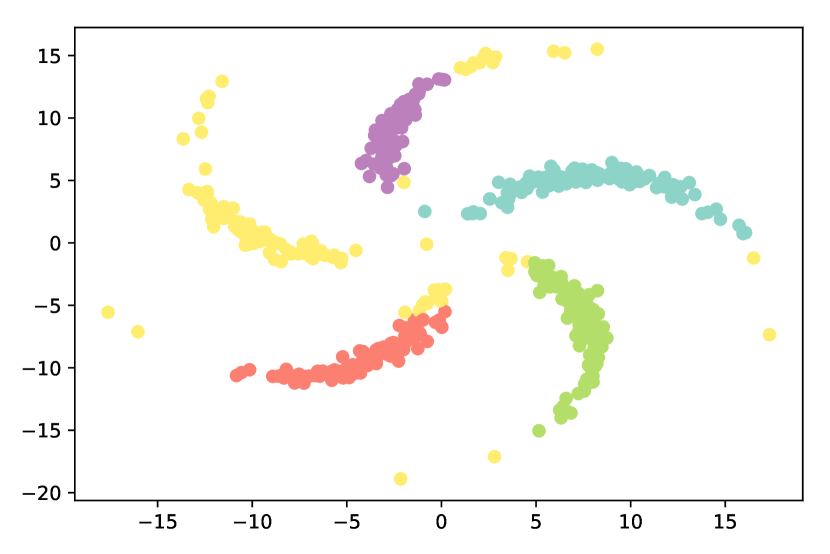
Read this paper
Open the full text in the Nubint reader and ask about any passage as you read.
Read this paper on NubintThis review was generated by AI from the original paper. Please check the paper before citing it.