
[Paper Review] Potential renormalisation, Lamb shift and mean-force Gibbs state -- to shift or not to shift?
This paper demonstrates that despite common theoretical inconsistencies, subtracting the reorganisation energy and omitting Lamb-shift terms in weak-coupling master equations for a damped harmonic oscillator yields an accurate approximation to the exact mean-force Gibbs state, especially at low to moderate temperatures and even up to intermediate coupling. The success arises because these seemingly unjustified steps effectively embed the correct asymptotic steady state into the master equation.
Often, the microscopic interaction mechanism of an open quantum system gives rise to a `counter term' which renormalises the system Hamiltonian. Such term compensates for the distortion of the system's potential due to the finite coupling to the environment. Even if the coupling is weak, the counter term is, in general, not negligible. Similarly, weak-coupling master equations feature a number of `Lamb-shift terms' which, contrary to popular belief, cannot be neglected. Yet, the practice of vanishing both counter term and Lamb shift when dealing with master equations is almost universal; and, surprisingly, it can yield better results. By accepting the conventional wisdom, one may approximate the dynamics more accurately and, importantly, the resulting master equation is guaranteed to equilibrate to the correct steady state in the high-temperature limit. In this paper we discuss why is this the case. Specifically, we show that, if the potential distortion is small -- but non-negligible -- the counter term does not influence any dissipative processes to second order in the coupling. Furthermore, we show that, for large environmental cutoff, the Lamb-shift terms approximately cancel any coherent effects due to the counter term -- this renders the combination of both contributions irrelevant in practice. We thus provide precise conditions under which the open-system folklore regarding Lamb shift and counter terms is rigorously justified.
Motivation & Objective
- To resolve the paradox that removing both the counter-term and Lamb-shift terms in weak-coupling master equations still yields accurate results despite theoretical inconsistencies.
- To clarify the role of potential renormalisation (reorganisation energy) and Lamb-shift terms in determining the correct steady-state dynamics of open quantum systems.
- To analytically demonstrate, using a damped harmonic oscillator model, that the combined omission of these terms leads to an accurate approximation of the exact mean-force Gibbs state.
- To highlight the critical implications of these approximations for accurate heat current calculations in quantum thermodynamics.
Proposed method
- Analytically solving the exact dynamics of a damped quantum harmonic oscillator coupled to a thermal bath with linear coupling.
- Deriving the Born–Markov Redfield master equation from a renormalised system Hamiltonian that subtracts the reorganisation energy.
- Systematically removing all Lamb-shift terms from the derived master equation to assess their impact on the steady state.
- Computing the asymptotic covariance matrix of position and momentum to compare the approximate master equation with the exact steady-state solution.
- Using Laplace transforms and spectral decomposition to evaluate the long-time limit of the memory integral and noise kernel contributions.
- Establishing that the resulting master equation asymptotically reproduces the classical limit of the mean-force Gibbs state, even without explicit counter-terms or Lamb shifts.
Experimental results
Research questions
- RQ1Why does the standard practice of omitting both the counter-term and Lamb-shift terms in weak-coupling master equations still yield accurate results for the steady state?
- RQ2To what extent does the omission of Lamb-shift terms affect the accuracy of the master equation in describing the long-time dynamics of open quantum systems?
- RQ3How does the inclusion of reorganisation energy in the system Hamiltonian influence the steady-state properties of the system?
- RQ4In what parameter regimes (e.g., temperature, coupling strength) does the approximate master equation remain accurate despite the removal of physically relevant terms?
- RQ5Can the mean-force Gibbs state be effectively embedded into a master equation through these approximations, even when the underlying physics is not fully accounted for?
Key findings
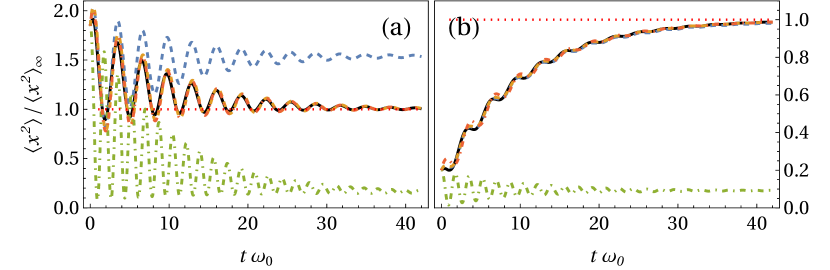
- The combined omission of the counter-term and Lamb-shift terms in the master equation leads to an excellent approximation of the exact steady state for the damped harmonic oscillator, even when the system-bath coupling is weak but the reorganisation energy is non-negligible.
- The resulting master equation asymptotically reproduces the classical limit of the mean-force Gibbs state, confirming that the approximation implicitly embeds the correct steady-state structure.
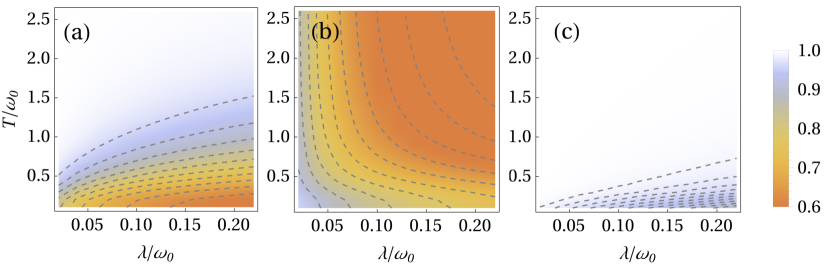
- The approximation remains accurate at moderate-to-low temperatures and even up to intermediate coupling strengths, where perturbative assumptions break down.
- The asymptotic position-momentum covariance vanishes in the long-time limit, consistent with the mean-force Gibbs state, despite the absence of Lamb-shift terms.
- The exact steady-state momentum variance is recovered by the approximate master equation through the interplay of the memory integral and noise kernel, validating the approach analytically.
- The study reveals that the success of the standard approximation is not accidental but stems from the effective construction of the correct asymptotic state, even when key physical terms are removed.
Read this paper
Open the full text in the Nubint reader and ask about any passage as you read.
Read this paper on NubintThis review was generated by AI from the original paper. Please check the paper before citing it.