
[Paper Review] Pre-Trained Large Language Models for Industrial Control
The paper investigates using GPT-4 as a training-free controller for HVAC in BEAR, showing competitive performance to PPO and MPC with low data needs and extensive ablations on demonstrations and prompts.
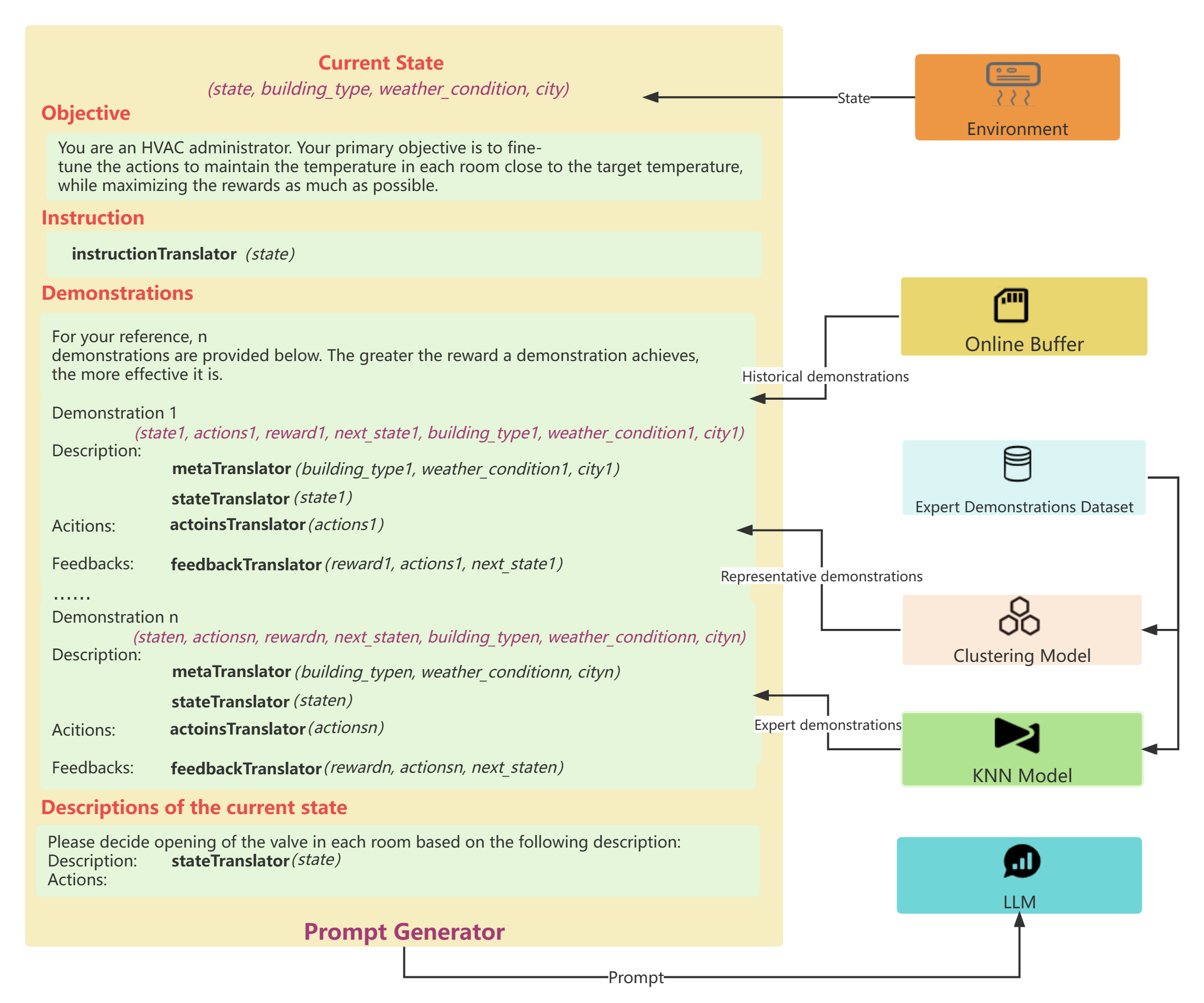
For industrial control, developing high-performance controllers with few samples and low technical debt is appealing. Foundation models, possessing rich prior knowledge obtained from pre-training with Internet-scale corpus, have the potential to be a good controller with proper prompts. In this paper, we take HVAC (Heating, Ventilation, and Air Conditioning) building control as an example to examine the ability of GPT-4 (one of the first-tier foundation models) as the controller. To control HVAC, we wrap the task as a language game by providing text including a short description for the task, several selected demonstrations, and the current observation to GPT-4 on each step and execute the actions responded by GPT-4. We conduct series of experiments to answer the following questions: 1)~How well can GPT-4 control HVAC? 2)~How well can GPT-4 generalize to different scenarios for HVAC control? 3) How different parts of the text context affect the performance? In general, we found GPT-4 achieves the performance comparable to RL methods with few samples and low technical debt, indicating the potential of directly applying foundation models to industrial control tasks.
Motivation & Objective
- Motivate low-sample, low-debt control for industrial tasks using foundation models.
- Show that a pre-trained LLM can control HVAC across heterogeneous buildings and weather with few demonstrations.
- Design demonstrations selection, translator, and prompt generation mechanisms to enable in-context control.
- Analyze how demonstration types and quantity affect GPT-4's control performance.
- Provide ablations to guide future low-debt industrial control using LLMs.
Proposed method
- Use GPT-4 as a decision-maker to control HVAC in the BEAR environment.
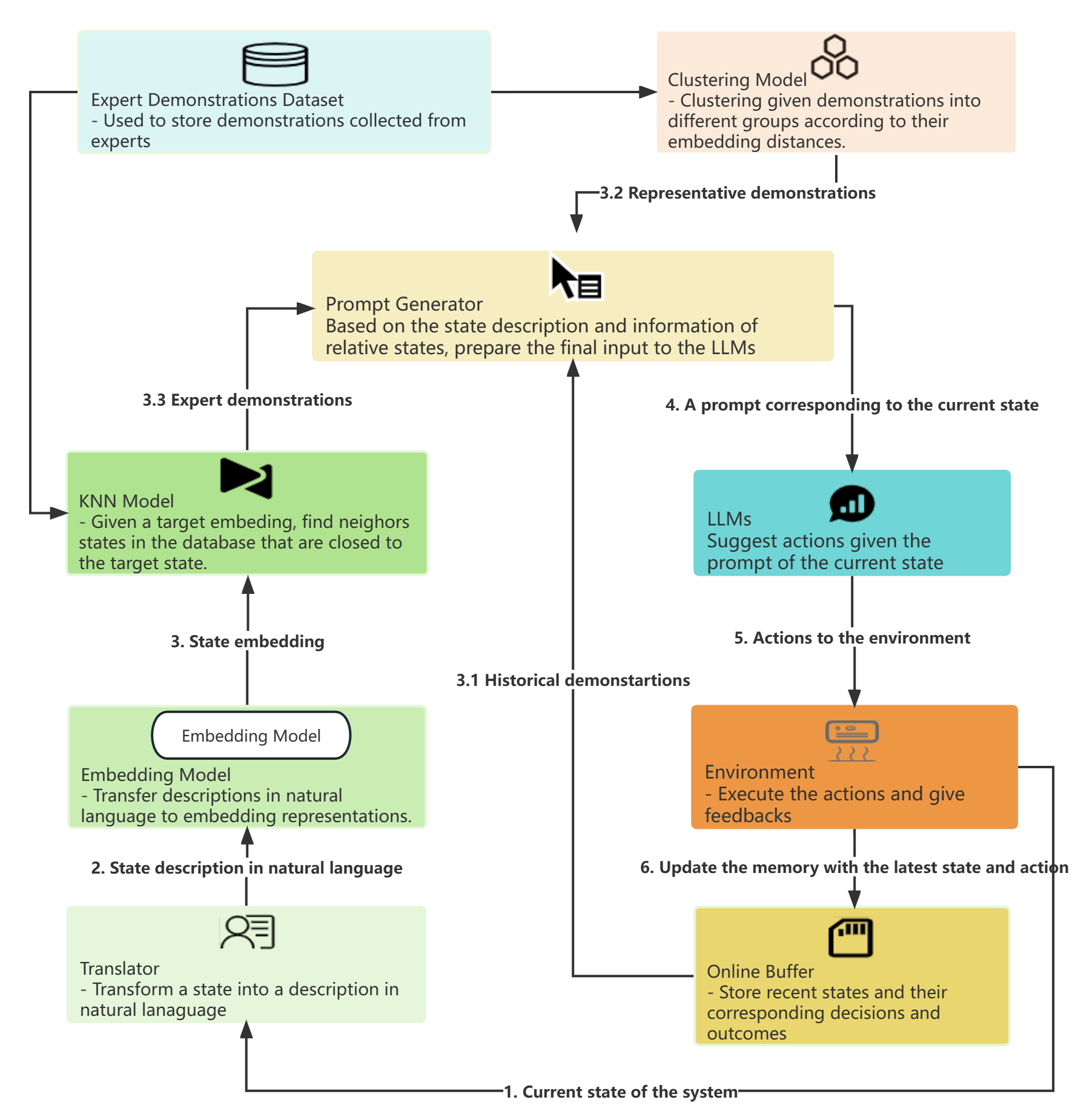
- Introduce a translator stack to convert numerical states/actions into natural language for the LLM.
- Implement online demonstration buffer and a prompt generator to craft prompts from demonstrations and current state.
- Leverage expert demonstrations, historical interactions, and clustering to select representative prompts.
- Compare GPT-4 against MPC and PPO baselines and conduct ablations on demonstration types and prompt design.
Experimental results
Research questions
- RQ1Can GPT-4 control HVAC comparably to traditional RL methods with few demonstrations?
- RQ2How well does GPT-4 generalize across buildings and weather conditions for HVAC control?
- RQ3What is the impact of demonstration type and prompt design on GPT-4’s control performance?
- RQ4How does the training-free, prompt-based approach compare to MPC and PPO in terms of sample efficiency and debt?
Key findings
- GPT-4 achieves comparable or better rewards than PPO and substantially outperforms random policies across tested scenarios.
- Performance improves when demonstrations include same-building or same-weather conditions, indicating beneficial generalization with relevant priors.
- Using demonstrations from diverse buildings and weathers can still enable strong control, with better results when target-relevant demonstrations are available.
- GPT-4 with prompt-based control can achieve best results even without expert demonstrations, relying on its online interactions.
- Across multiple groups, GPT-based policies approach or exceed traditional baselines in reward, with relatively low sample needs and technical debt.
Read this paper
Open the full text in the Nubint reader and ask about any passage as you read.
Read this paper on NubintThis review was generated by AI from the original paper. Please check the paper before citing it.