
[Paper Review] Predicting Battery Lifetime Under Varying Usage Conditions from Early Aging Data
This paper proposes a machine learning framework that predicts lithium-ion battery lifetime using early-life capacity-voltage data from low-rate full cycles under diverse usage conditions. By extracting degradation-sensitive features from the first 15% of cycling data and applying hierarchical Bayesian modeling, the method achieves 15.1% mean absolute percentage error (MAPE) for in-distribution cells and 21.8% MAPE for out-of-distribution cells, demonstrating robustness to varying stress conditions through domain-informed feature engineering.
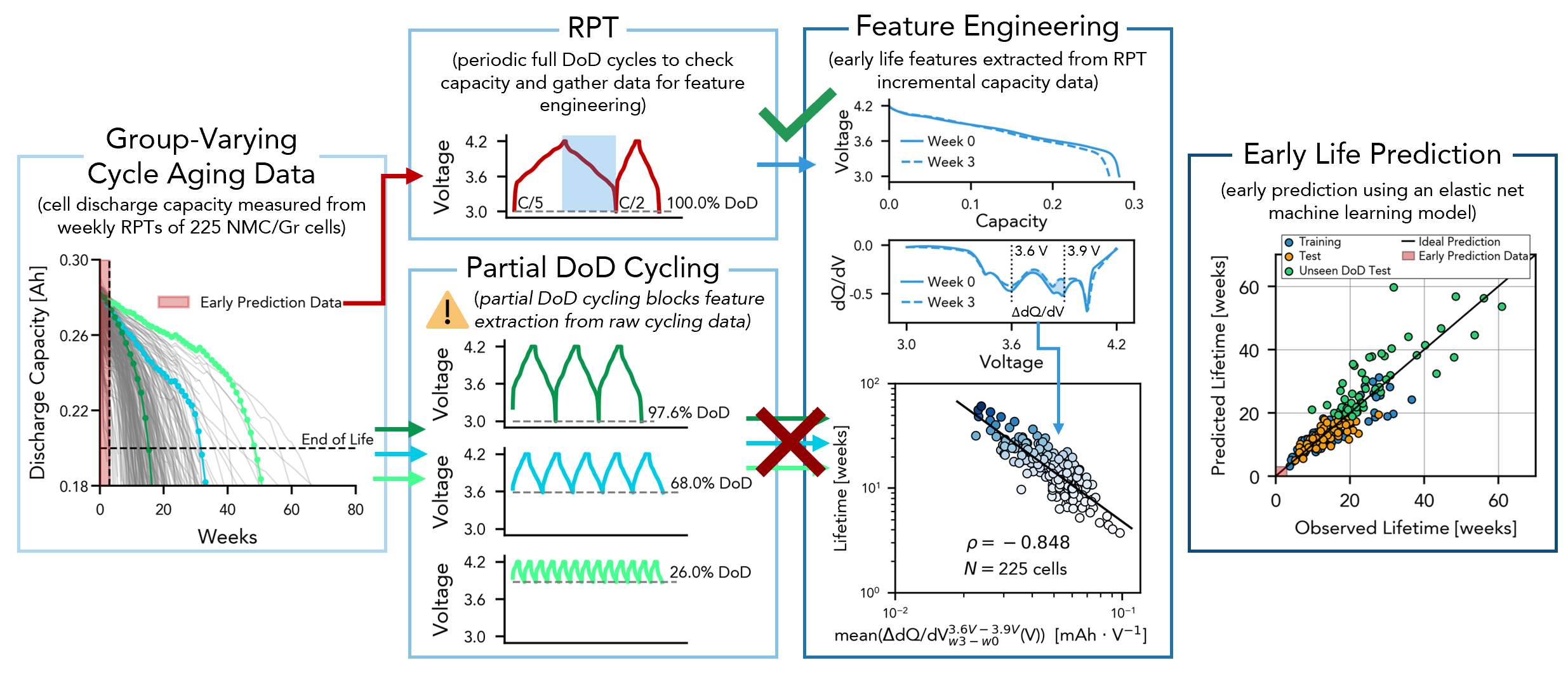
Accurate battery lifetime prediction is important for preventative maintenance, warranties, and improved cell design and manufacturing. However, manufacturing variability and usage-dependent degradation make life prediction challenging. Here, we investigate new features derived from capacity-voltage data in early life to predict the lifetime of cells cycled under widely varying charge rates, discharge rates, and depths of discharge. Features were extracted from regularly scheduled reference performance tests (i.e., low rate full cycles) during cycling. The early-life features capture a cell's state of health and the rate of change of component-level degradation modes, some of which correlate strongly with cell lifetime. Using a newly generated dataset from 225 nickel-manganese-cobalt/graphite Li-ion cells aged under a wide range of conditions, we demonstrate a lifetime prediction of in-distribution cells with 15.1% mean absolute percentage error using no more than the first 15% of data, for most cells. Further testing using a hierarchical Bayesian regression model shows improved performance on extrapolation, achieving 21.8% mean absolute percentage error for out-of-distribution cells. Our approach highlights the importance of using domain knowledge of lithium-ion battery degradation modes to inform feature engineering. Further, we provide the community with a new publicly available battery aging dataset with cells cycled beyond 80% of their rated capacity.
Motivation & Objective
- To enable rapid, accurate prediction of lithium-ion battery lifetime without waiting for end-of-life testing.
- To address the challenge of high variability in battery degradation due to manufacturing differences and usage conditions.
- To develop a method that uses only early-life data (first 15% of cycling) to predict full cell lifetime across diverse charge rates, discharge rates, and depths of discharge.
- To improve generalization to out-of-distribution conditions through hierarchical Bayesian modeling.
- To provide a publicly available dataset of 225 NiMnCo/graphite cells aged beyond 80% of rated capacity for community use.
Proposed method
- Extracted features from regularly scheduled low-rate full cycles (capacity-voltage curves) during early cycling, focusing on derivative-based metrics like ΔdQ/dV to capture degradation modes.
- Defined cell-level features such as mean(ΔdQ/dV) in the 3.60–3.90 V window, which correlate with degradation rates and lifetime.
- Applied hierarchical Bayesian regression (HBR) to model cell-level parameters (intercept, slope, noise) with cluster-level priors based on average cycling stress (Stress_avg), enabling transfer learning across stress conditions.
- Used a two-level hierarchical structure: level-1 models individual cell lifetime prediction with uncertain parameters, while level-2 models the distribution of these parameters across stress clusters.
- Calibrated uncertainty in predictions by propagating both regression coefficient uncertainty and measurement noise through posterior predictive distributions.
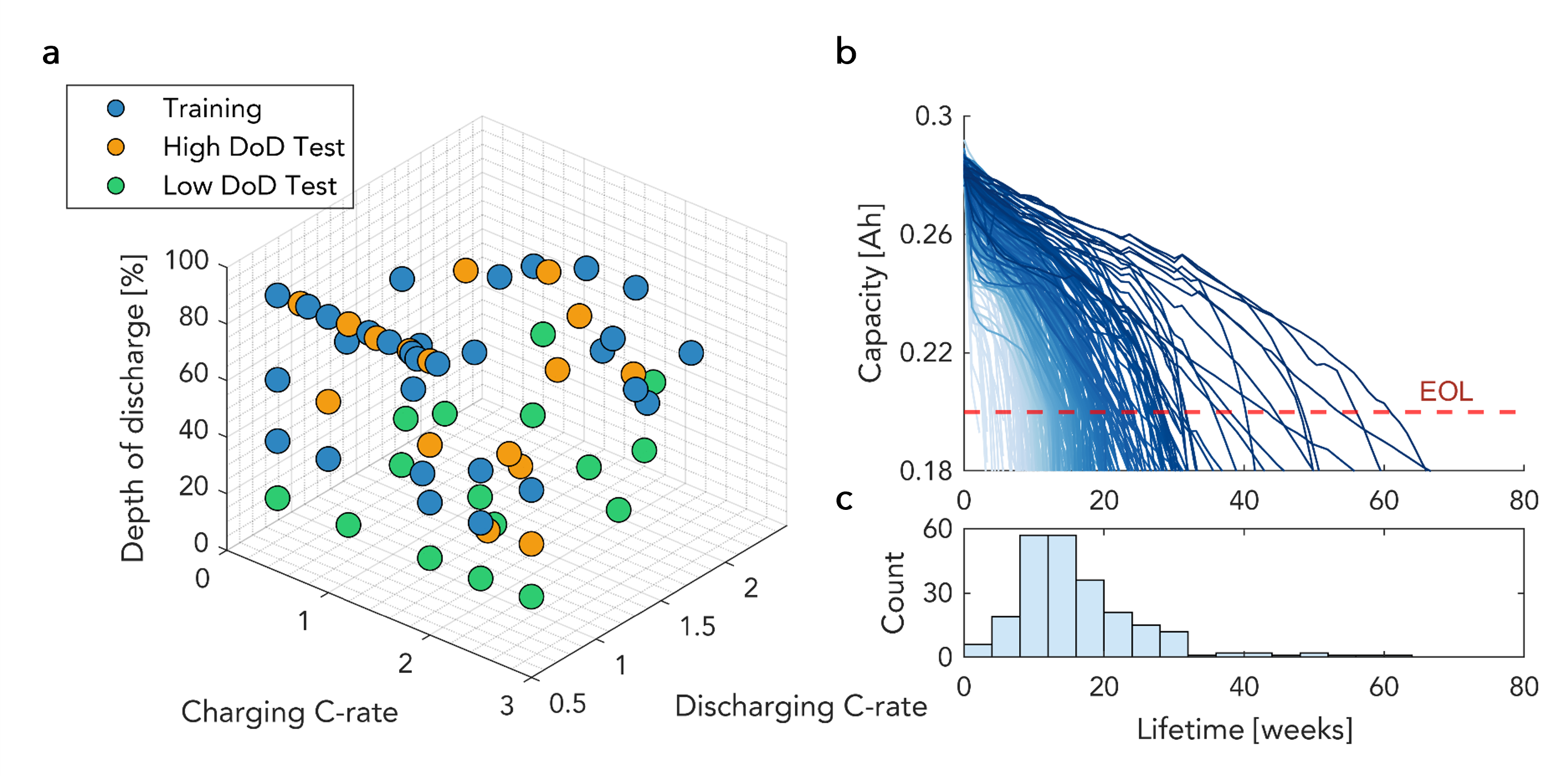
- Validated the model using a newly generated dataset of 225 cells cycled under 120 unique combinations of charge rate, discharge rate, and depth of discharge, with data collected up to 80% capacity retention.
Experimental results
Research questions
- RQ1Can early-life capacity-voltage data be used to predict battery lifetime under widely varying usage conditions with high accuracy?
- RQ2How do degradation-sensitive features extracted from early cycling data correlate with actual cell lifetime across diverse stress profiles?
- RQ3Can hierarchical Bayesian modeling improve prediction performance on out-of-distribution cells by leveraging shared structure across stress clusters?
- RQ4To what extent does domain knowledge of lithium-ion degradation mechanisms enhance feature engineering for lifetime prediction?
- RQ5Can a model trained on early data (first 15% of cycling) generalize to cells with different aging profiles without requiring full-life data for each new condition?
Key findings
- The model achieved a mean absolute percentage error (MAPE) of 15.1% in predicting lifetime for in-distribution cells using only the first 15% of cycling data.
- For out-of-distribution cells, the hierarchical Bayesian model achieved a MAPE of 21.8%, demonstrating improved generalization compared to standard models.
- The feature mean(ΔdQ/dV) in the 3.60–3.90 V window showed strong correlation with lifetime, especially when stratified by average cycling stress (Stress_avg).
- Clustering based on Stress_avg revealed two sources of lifetime variability: cross-cluster differences due to usage conditions and in-cluster differences due to manufacturing and tester variability.
- Hierarchical Bayesian modeling successfully captured uncertainty in predictions, with wider posterior distributions for cluster 3—indicating higher uncertainty due to limited training data in that stress regime.
- The posterior predictive distribution enabled robust uncertainty quantification, with prediction errors well-estimated by error bars that reflect both model and measurement uncertainty.
Read this paper
Open the full text in the Nubint reader and ask about any passage as you read.
Read this paper on NubintThis review was generated by AI from the original paper. Please check the paper before citing it.