
[Paper Review] Predicting Drivers' Route Trajectories in Last-Mile Delivery Using A Pair-wise Attention-based Pointer Neural Network
This paper proposes a pair-wise attention-based pointer neural network to predict real-world last-mile delivery route trajectories using historical driver data. By integrating local pair-wise stop relationships and an iterative route generation algorithm, the model improves prediction accuracy of the first four stops by 31.2% and reduces route disparity by 15% compared to benchmarks.
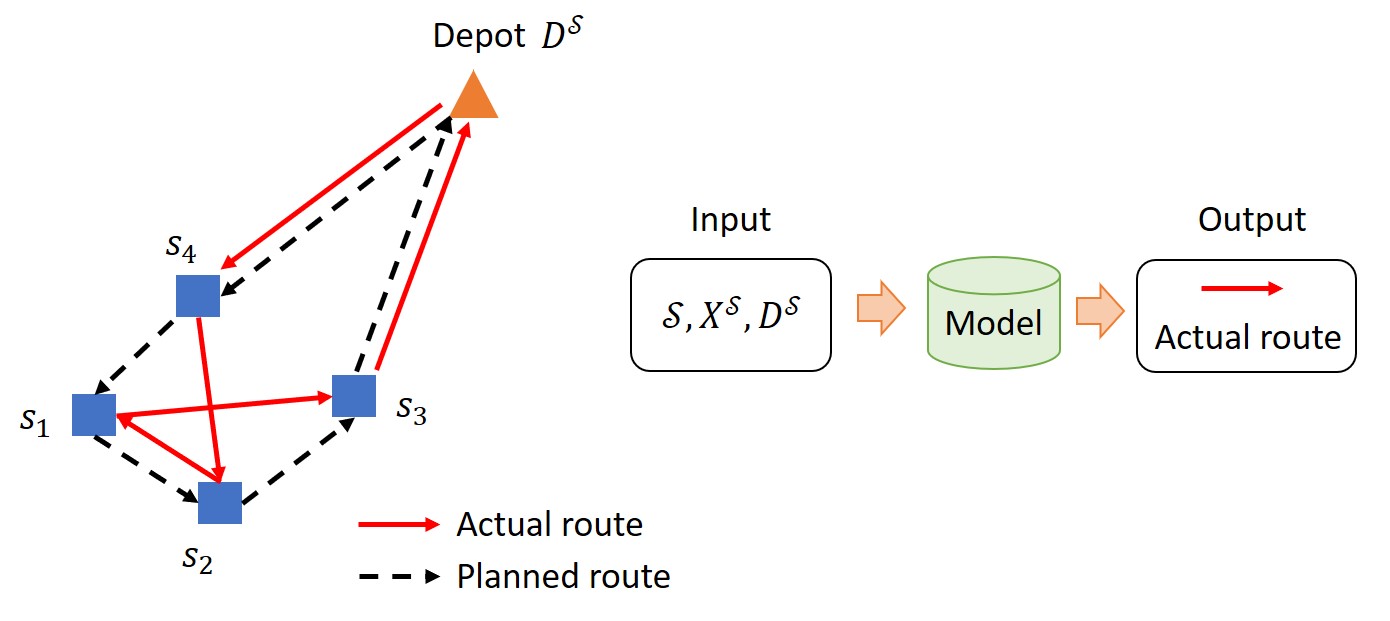
In last-mile delivery, drivers frequently deviate from planned delivery routes because of their tacit knowledge of the road and curbside infrastructure, customer availability, and other characteristics of the respective service areas. Hence, the actual stop sequences chosen by an experienced human driver may be potentially preferable to the theoretical shortest-distance routing under real-life operational conditions. Thus, being able to predict the actual stop sequence that a human driver would follow can help to improve route planning in last-mile delivery. This paper proposes a pair-wise attention-based pointer neural network for this prediction task using drivers' historical delivery trajectory data. In addition to the commonly used encoder-decoder architecture for sequence-to-sequence prediction, we propose a new attention mechanism based on an alternative specific neural network to capture the local pair-wise information for each pair of stops. To further capture the global efficiency of the route, we propose a new iterative sequence generation algorithm that is used after model training to identify the first stop of a route that yields the lowest operational cost. Results from an extensive case study on real operational data from Amazon's last-mile delivery operations in the US show that our proposed method can significantly outperform traditional optimization-based approaches and other machine learning methods (such as the Long Short-Term Memory encoder-decoder and the original pointer network) in finding stop sequences that are closer to high-quality routes executed by experienced drivers in the field. Compared to benchmark models, the proposed model can increase the average prediction accuracy of the first four stops from around 0.229 to 0.312, and reduce the disparity between the predicted route and the actual route by around 15%.
Motivation & Objective
- To predict actual driver route trajectories in last-mile delivery that reflect tacit knowledge not captured by traditional optimization.
- To model local stop dependencies using a pair-wise attention mechanism for improved sequence prediction.
- To develop an iterative generation algorithm that minimizes operational cost by selecting optimal route starts.
- To outperform traditional TSP/VRP solvers and standard deep learning models in predicting high-quality, human-executed delivery sequences.
Proposed method
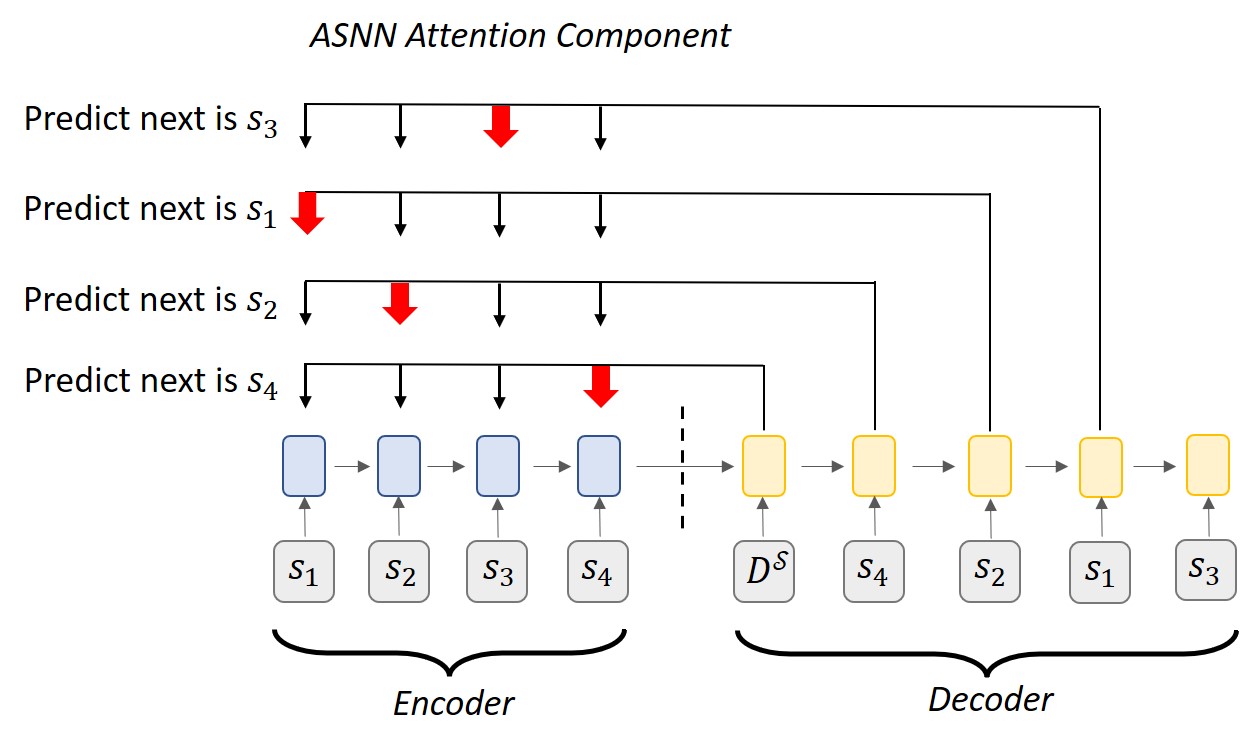
- A sequence-to-sequence model with encoder-decoder architecture processes delivery stop sequences using historical trajectory data.
- A novel pair-wise attention mechanism captures local dependencies between stop pairs, enhancing modeling of sequential choices.
- An alternative specific neural network (ASNN) computes attention scores based on stop pair features, improving local route decision accuracy.
- An iterative route generation algorithm selects the first stop that minimizes total travel cost, ensuring global route efficiency.
- The model generates complete stop sequences by solving path and tour TSP problems within zones, using nearest stops as entry/exit candidates.
- Zone sequences are converted to full stop sequences by solving TSP subproblems between candidate first and last stops in each zone.
Experimental results
Research questions
- RQ1Can a deep learning model trained on historical driver trajectories predict actual stop sequences more accurately than traditional optimization methods?
- RQ2How does incorporating pair-wise attention between stops improve trajectory prediction compared to standard pointer networks?
- RQ3To what extent can an iterative generation strategy based on operational cost minimize route deviation from experienced driver behavior?
- RQ4How does the model’s performance compare to LSTM-encoder-decoder and standard pointer networks in predicting the first four stops of a delivery route?
Key findings
- The proposed model increases the average prediction accuracy of the first four stops from approximately 0.2 to 0.312, a significant improvement over baseline models.
- The model reduces the disparity between predicted and actual delivery routes by around 15% compared to benchmark approaches.
- The pair-wise attention mechanism effectively captures local stop dependencies, contributing to better sequence modeling than standard attention mechanisms.
- The iterative route generation algorithm successfully identifies low-cost starting stops, enhancing the global efficiency of predicted routes.
- The model outperforms both traditional optimization-based methods and deep learning baselines (e.g., LSTM-encoder-decoder and original pointer network) in real-world last-mile delivery scenarios.
- The integration of zone-level routing with within-zone TSP optimization enables scalable and accurate full route reconstruction from predicted sequences.
Read this paper
Open the full text in the Nubint reader and ask about any passage as you read.
Read this paper on NubintThis review was generated by AI from the original paper. Please check the paper before citing it.