
[Paper Review] Predicting the Initial Conditions of the Universe using a Deterministic Neural Network
This paper introduces a deterministic convolutional neural network (V-Net) that accurately predicts the initial linear displacement field of cosmological N-body simulations from their final nonlinear state at z=0, achieving less than 1–2% error up to k ≈ 0.8–0.9 Mpc⁻¹h, despite the inverse problem's inherent one-to-many mapping due to nonlinear gravitational collapse. The method outperforms complex generative models by leveraging the deterministic nature of cosmological simulations and generalizes well to out-of-distribution cosmological parameters.
Finding the initial conditions that led to the current state of the universe is challenging because it involves searching over an intractable input space of initial conditions, along with modeling their evolution via tools such as N-body simulations which are computationally expensive. Recently, deep learning has emerged as a surrogate for N-body simulations by directly learning the mapping between the linear input of an N-body simulation and the final nonlinear output from the simulation, significantly accelerating the forward modeling. However, this still does not reduce the search space for initial conditions. In this work, we pioneer the use of a deterministic convolutional neural network for learning the reverse mapping and show that it accurately recovers the initial linear displacement field over a wide range of scales ($<1$-$2\%$ error up to nearly $k\simeq0.8$-$0.9 ext{ Mpc}^{-1}h$), despite the one-to-many mapping of the inverse problem (due to the divergent backward trajectories at smaller scales). Specifically, we train a V-Net architecture, which outputs the linear displacement of an N-body simulation, given the nonlinear displacement at redshift $z=0$ and the cosmological parameters. The results of our method suggest that a simple deterministic neural network is sufficient for accurately approximating the initial linear states, potentially obviating the need for the more complex and computationally demanding backward modeling methods that were recently proposed.
Motivation & Objective
- To address the inverse problem of reconstructing initial conditions of the universe from observed nonlinear structures at z=0, which is computationally prohibitive due to high-dimensional, intractable search spaces.
- To overcome the limitations of sampling-based methods like Hamiltonian Monte Carlo, which require thousands of CPU hours per posterior sample.
- To investigate whether a simple deterministic neural network can approximate the inverse mapping of N-body simulations, bypassing the need for complex generative models such as diffusion networks.
- To evaluate generalization performance of the model on out-of-distribution cosmological parameters from the Quijote simulation suite.
- To demonstrate that a deterministic neural network can serve as an efficient, reliable black-box prior for subsequent high-precision sampling-based inverse modeling.
Proposed method
- A V-Net architecture is trained to map the nonlinear displacement field at z=0 and cosmological parameters to the corresponding linear Zel’dovich approximation (ZA) displacement field.
- The model is trained on a large-scale dataset of N-body simulations generated via a neural network emulator, with inputs being nonlinear displacements and outputs being linear displacements.
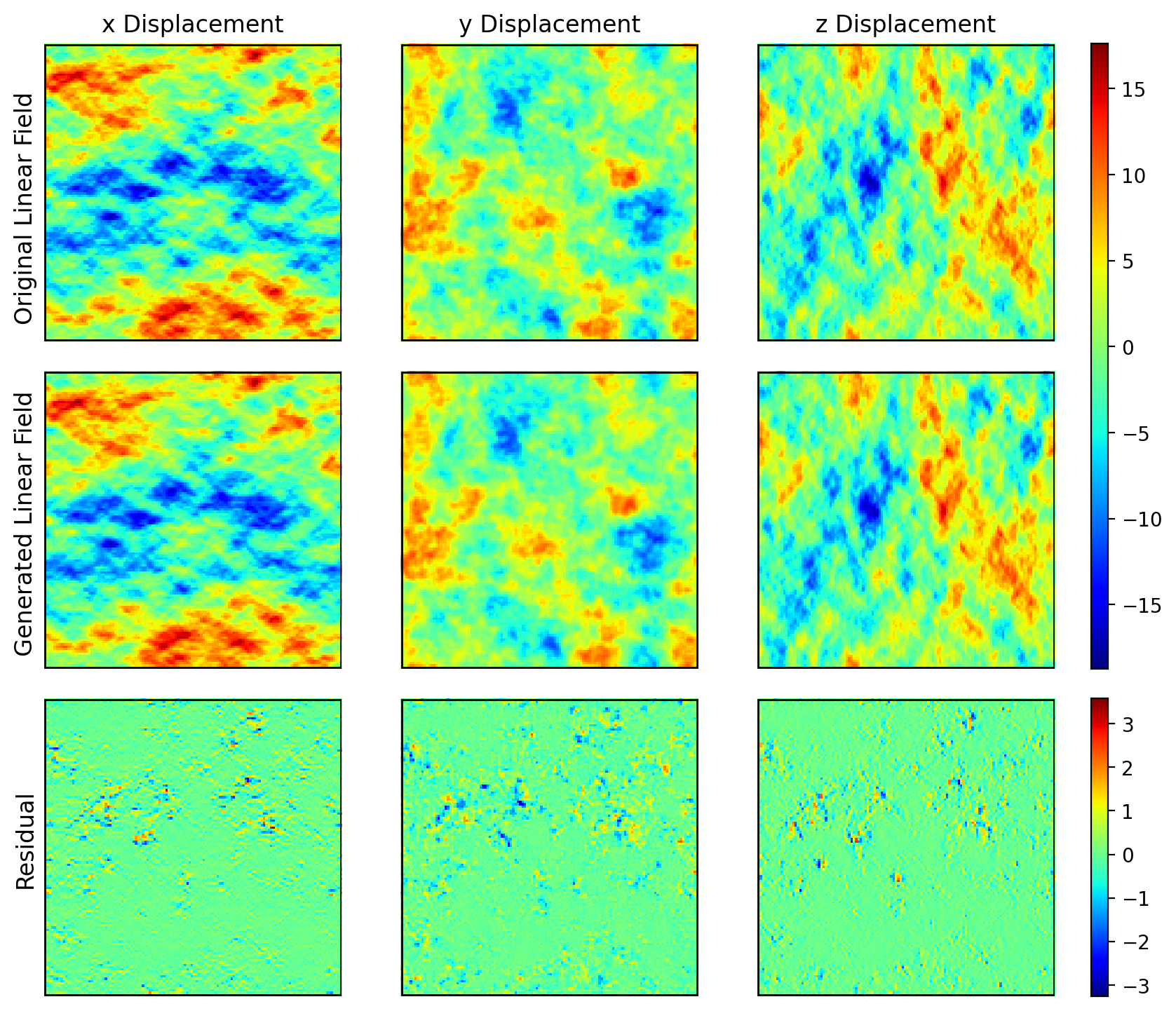
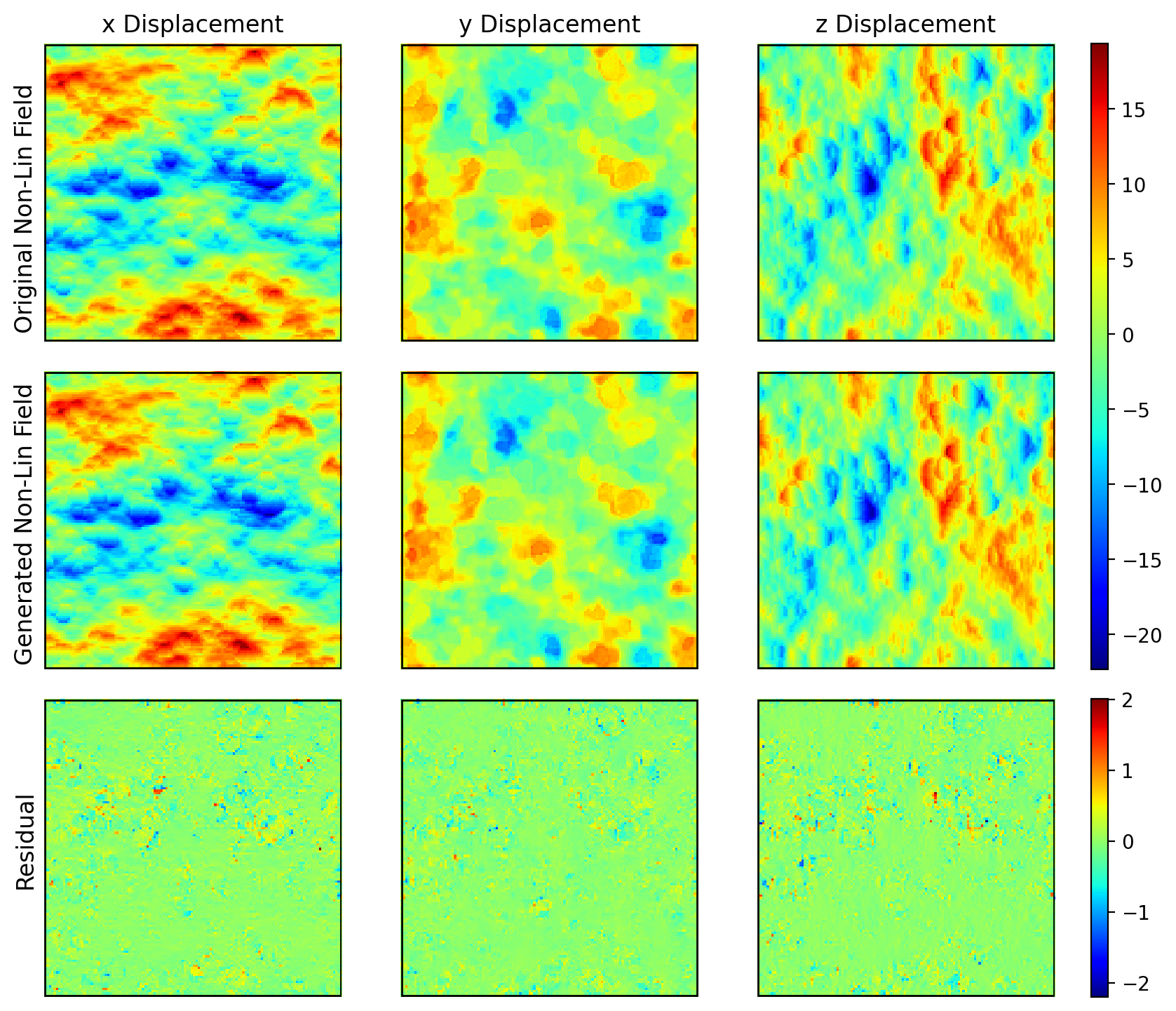
- The forward process is validated by regenerating the nonlinear field from the predicted linear field using the same emulator, ensuring consistency between predicted and actual nonlinear outputs.
- Model generalization is evaluated on the Quijote simulation suite by ranking simulations based on cosmological parameter dissimilarity (Ωₘ, σ₈) and assessing performance across percentiles from 0th to 100th.
- Performance is quantified using power spectra comparisons, two-point correlation functions, and one-point statistics of displacement fields across scales.
- Uncertainty quantification is considered as a future extension, with potential methods including Gaussian negative log-likelihood loss, Bayesian neural networks, or conformal predictions.
Experimental results
Research questions
- RQ1Can a deterministic convolutional neural network accurately recover the initial linear displacement field from the final nonlinear state of an N-body simulation?
- RQ2How well does the model generalize to cosmological parameters outside the training distribution, particularly in the Quijote simulation suite?
- RQ3Does the model maintain high accuracy even at small scales (k > 0.1 Mpc⁻¹h) where nonlinear gravitational dynamics dominate?
- RQ4Can the predicted initial conditions serve as effective priors for subsequent high-precision sampling-based inverse modeling methods?
- RQ5Is a simple deterministic network sufficient for this inverse problem, or is a more complex generative model like a diffusion model necessary?
Key findings
- The model achieves less than 1–2% error in predicting the linear displacement field across a wide range of scales, with accuracy maintained up to k ≈ 0.8–0.9 Mpc⁻¹h.
- The model generalizes effectively to out-of-distribution cosmological parameters, with performance degrading gradually across the Quijote simulation percentile ranking from 0th to 100th.
- Power spectra and two-point correlation functions of predicted and actual fields show strong agreement, especially at large and medium scales (k < 0.5 Mpc⁻¹h).
- The regenerated nonlinear field from the predicted linear field closely matches the true nonlinear field, confirming the model’s consistency and reliability in the forward direction.
- The model outperforms complex sampling-based methods like BORG in terms of speed and computational cost while maintaining competitive accuracy.
- The results suggest that deterministic neural networks are sufficient for initial condition reconstruction, potentially eliminating the need for expensive generative models in this context.
Read this paper
Open the full text in the Nubint reader and ask about any passage as you read.
Read this paper on NubintThis review was generated by AI from the original paper. Please check the paper before citing it.