
[Paper Review] Predicting the Silent Majority on Graphs: Knowledge Transferable Graph Neural Network
This paper proposes Knowledge Transferable Graph Neural Network (KTGNN) to address silent node classification on VS-Graphs—graphs with vocal nodes (abundant features/labels) and silent nodes (incomplete features, rare labels). KTGN uses domain-adapted feature completion and message passing with KL-divergence-based knowledge transfer, achieving state-of-the-art performance on real-world financial risk and political election datasets.
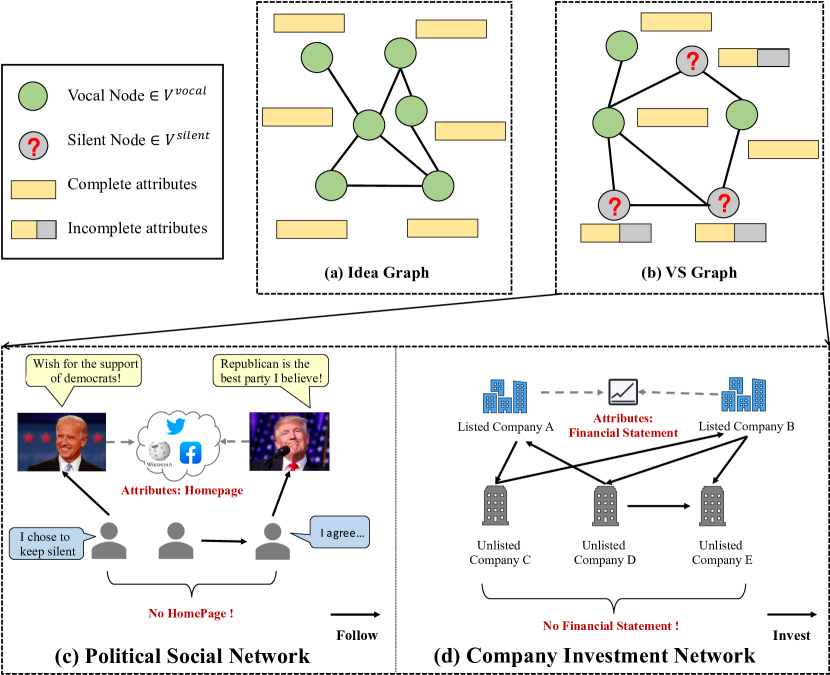
Graphs consisting of vocal nodes ("the vocal minority") and silent nodes ("the silent majority"), namely VS-Graph, are ubiquitous in the real world. The vocal nodes tend to have abundant features and labels. In contrast, silent nodes only have incomplete features and rare labels, e.g., the description and political tendency of politicians (vocal) are abundant while not for ordinary people (silent) on the twitter's social network. Predicting the silent majority remains a crucial yet challenging problem. However, most existing message-passing based GNNs assume that all nodes belong to the same domain, without considering the missing features and distribution-shift between domains, leading to poor ability to deal with VS-Graph. To combat the above challenges, we propose Knowledge Transferable Graph Neural Network (KT-GNN), which models distribution shifts during message passing and representation learning by transferring knowledge from vocal nodes to silent nodes. Specifically, we design the domain-adapted "feature completion and message passing mechanism" for node representation learning while preserving domain difference. And a knowledge transferable classifier based on KL-divergence is followed. Comprehensive experiments on real-world scenarios (i.e., company financial risk assessment and political elections) demonstrate the superior performance of our method. Our source code has been open sourced.
Motivation & Objective
- Address the challenge of classifying silent nodes in real-world graphs where they suffer from feature incompleteness and label scarcity.
- Overcome the distribution-shift problem between vocal nodes (well-observed) and silent nodes (under-observed) in graph-structured data.
- Develop a GNN framework that adaptively transfers knowledge from vocal nodes to silent nodes while preserving domain-specific differences.
- Improve node classification performance on silent nodes without relying on heuristic feature imputation or treating silent nodes as noise.
Proposed method
- Proposes a domain-adapted feature completion and message passing mechanism that learns representations while accounting for distribution shifts between vocal and silent nodes.
- Introduces a knowledge transferable classifier based on KL-divergence to align predictions across domains, enabling effective transfer from vocal to silent nodes.
- Employs a two-stage training process: first, learn node representations via message passing with domain-aware aggregation; second, apply knowledge distillation using KL divergence to refine predictions.
- Uses a K-hop neighborhood strategy (K=2) to ensure sufficient coverage of silent nodes by vocal node influence, optimizing receptive field for representation learning.
- Leverages a contrastive learning objective to enhance feature distinguishability between classes in both vocal and silent node representations.
- Employs T-SNE visualization to demonstrate that KTGNN preserves domain differences while improving inter-class separation in learned representations.
Experimental results
Research questions
- RQ1How can graph neural networks effectively classify silent nodes when they lack complete features and labels compared to vocal nodes?
- RQ2To what extent can knowledge from well-annotated vocal nodes be transferred to improve the representation and classification of silent nodes?
- RQ3Can domain adaptation techniques during message passing mitigate performance degradation caused by distribution shifts between vocal and silent nodes?
- RQ4How does the use of KL-divergence-based knowledge distillation improve generalization on silent nodes compared to standard GNNs?
- RQ5What is the optimal receptive field (e.g., K-hop neighborhood) for effective knowledge transfer in VS-Graphs?
Key findings
- KTGNN achieves state-of-the-art performance on both the company financial risk assessment and political election prediction datasets, outperforming existing GNNs and OOD detection baselines.
- The model achieves optimal performance when K=2 in the K-hop message passing, indicating that 2-hop neighbors of vocal nodes sufficiently cover silent nodes in the graph structure.
- Setting λ=1.0 in the KL-divergence loss yields the best performance, confirming the effectiveness of knowledge distillation in aligning predictions across domains.
- T-SNE visualization shows that KTGNN preserves domain differences between vocal and silent nodes while enhancing inter-class separability in the representation space.
- The proposed method significantly improves silent node classification accuracy, even under extreme data-hungry conditions with missing features and scarce labels.
- Ablation studies confirm that both the domain-adapted message passing and KL-based knowledge transfer are essential components for performance gains.
Read this paper
Open the full text in the Nubint reader and ask about any passage as you read.
Read this paper on NubintThis review was generated by AI from the original paper. Please check the paper before citing it.