
[Paper Review] Pretrained Deep 2.5D Models for Efficient Predictive Modeling from Retinal OCT
This paper proposes pretrained 2.5D deep learning models combining 2D CNNs with BiLSTM or Transformer architectures for efficient prediction of wet age-related macular degeneration (AMD) progression from retinal OCT scans. By leveraging in-domain self-supervised pretraining via TINC, the method achieves superior performance over ImageNet pretraining and larger 3D models, with the CNN+BiLSTM architecture outperforming CNN+Transformer in both AUROC and PRAUC on two longitudinal OCT datasets.
In the field of medical imaging, 3D deep learning models play a crucial role in building powerful predictive models of disease progression. However, the size of these models presents significant challenges, both in terms of computational resources and data requirements. Moreover, achieving high-quality pretraining of 3D models proves to be even more challenging. To address these issues, hybrid 2.5D approaches provide an effective solution for utilizing 3D volumetric data efficiently using 2D models. Combining 2D and 3D techniques offers a promising avenue for optimizing performance while minimizing memory requirements. In this paper, we explore 2.5D architectures based on a combination of convolutional neural networks (CNNs), long short-term memory (LSTM), and Transformers. In addition, leveraging the benefits of recent non-contrastive pretraining approaches in 2D, we enhanced the performance and data efficiency of 2.5D techniques even further. We demonstrate the effectiveness of architectures and associated pretraining on a task of predicting progression to wet age-related macular degeneration (AMD) within a six-month period on two large longitudinal OCT datasets.
Motivation & Objective
- To address the challenge of limited labeled 3D medical imaging data in predicting AMD progression from retinal OCT scans.
- To develop a computationally efficient and memory-light alternative to 3D deep learning models for volumetric OCT analysis.
- To evaluate the impact of different 2.5D architectures—specifically CNN+BiLSTM and CNN+Transformer—on predictive performance.
- To compare the effectiveness of in-domain self-supervised pretraining (TINC) versus ImageNet pretraining in low-data regimes.
- To assess the generalization performance of models across datasets with domain shifts, such as PINNACLE.
Proposed method
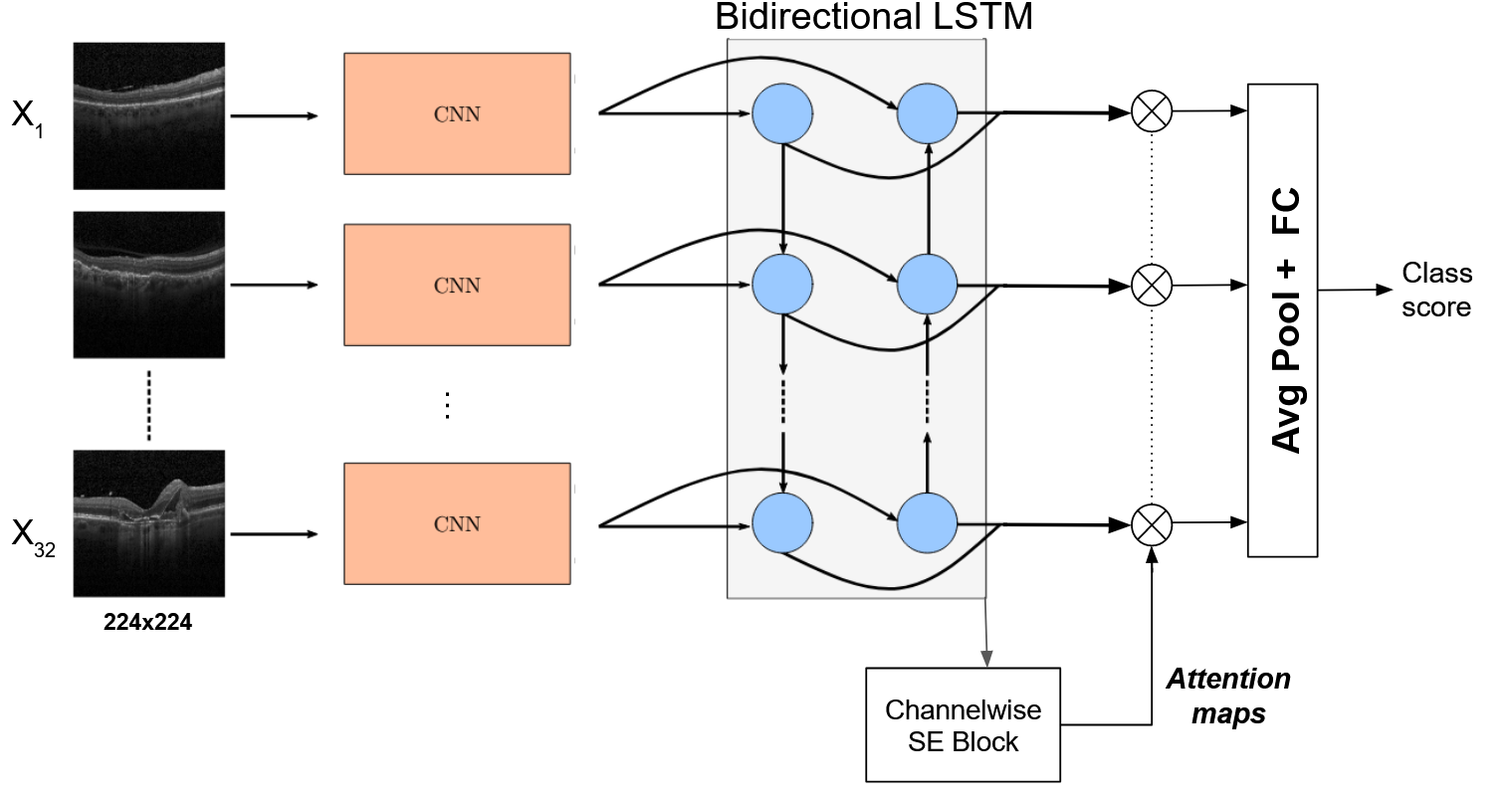
- Employed a 2.5D architecture that applies a 2D CNN to each B-scan slice of a 3D OCT volume, followed by sequence modeling using BiLSTM or Transformer to aggregate slice-level features.
- Utilized a non-contrastive self-supervised pretraining method (TINC) on an unlabeled in-domain OCT dataset to initialize 2D CNN weights, improving data efficiency.
- Fine-tuned the 2.5D models on two large longitudinal OCT datasets: HARBOR and PINNACLE, for binary classification of 6-month wet AMD progression.
- Compared models initialized with ImageNet weights, TINC weights, and, for ViViT, DukeAMD pretraining to evaluate domain-specific pretraining benefits.
- Applied average pooling and attention mechanisms to integrate features across slices, with attention scores enhancing model interpretability.
- Used AUROC and PRAUC as primary evaluation metrics, with ablation studies on model size, FLOPs, and parameter count.
Experimental results
Research questions
- RQ1Does in-domain self-supervised pretraining (TINC) improve 2.5D model performance on low-resource 3D OCT classification tasks compared to ImageNet pretraining?
- RQ2Can hybrid 2.5D architectures with 2D CNNs and sequence models (BiLSTM or Transformer) outperform full 3D models in predicting AMD progression?
- RQ3How do different 2.5D architectures (CNN+BiLSTM vs. CNN+Transformer) compare in terms of performance, parameter efficiency, and robustness under data scarcity and domain shift?
- RQ4To what extent does domain shift (e.g., scanner differences in PINNACLE) affect model generalization, and can in-domain pretraining mitigate this?
- RQ5Is the attention mechanism in the 2.5D Transformer model useful for interpretability and performance in this clinical prediction task?
Key findings
- The CNN+BiLSTM model achieved the highest AUROC (0.766±0.012) and PRAUC (0.646±0.019) on the HARBOR dataset when pretrained with TINC, outperforming both ImageNet and ViViT baselines.
- TINC pretraining consistently outperformed ImageNet pretraining across all architectures and datasets, with the largest gains observed on the domain-shifted PINNACLE dataset.
- Despite having 3x fewer parameters (34M vs. 108M), the CNN+BiLSTM model achieved better or comparable performance than the larger CNN+Transformer model in both AUROC and PRAUC on HARBOR and PINNACLE.
- The 2.5D models outperformed the 3D I3D and ViViT FSA models in all metrics, demonstrating the advantage of explicit modeling of slice relationships over simultaneous 3D processing.
- On the PINNACLE dataset, TINC pretraining maintained strong performance despite a significant drop in AUROC compared to HARBOR, indicating robustness to domain shift.
- The attention mechanism in the CNN+Transformer model provided interpretable attention scores, but did not translate into better performance than the simpler BiLSTM-based architecture.

Read this paper
Open the full text in the Nubint reader and ask about any passage as you read.
Read this paper on NubintThis review was generated by AI from the original paper. Please check the paper before citing it.