
[Paper Review] Prime Match: A Privacy-Preserving Inventory Matching System
Prime Match introduces a privacy-preserving inventory matching system for financial trading that enables clients to privately match buy and sell orders with a bank without revealing sensitive order details. Using a novel two-round secure linear comparison protocol with malicious security, the system ensures no information is leaked unless a match occurs, and it is the first SMC solution deployed in production at scale within traditional finance, currently running at J.P. Morgan.
Inventory matching is a standard mechanism/auction for trading financial stocks by which buyers and sellers can be paired. In the financial world, banks often undertake the task of finding such matches between their clients. The related stocks can be traded without adversely impacting the market price for either client. If matches between clients are found, the bank can offer the trade at advantageous rates. If no match is found, the parties have to buy or sell the stock in the public market, which introduces additional costs. A problem with the process as it is presently conducted is that the involved parties must share their order to buy or sell a particular stock, along with the intended quantity (number of shares), to the bank. Clients worry that if this information were to leak somehow, then other market participants would become aware of their intentions and thus cause the price to move adversely against them before their transaction finalizes. We provide a solution, Prime Match, that enables clients to match their orders efficiently with reduced market impact while maintaining privacy. In the case where there are no matches, no information is revealed. Our main cryptographic innovation is a two-round secure linear comparison protocol for computing the minimum between two quantities without preprocessing and with malicious security, which can be of independent interest. We report benchmarks of our Prime Match system, which runs in production and is adopted by J.P. Morgan. The system is designed utilizing a star topology network, which provides clients with a centralized node (the bank) as an alternative to the idealized assumption of point-to-point connections, which would be impractical and undesired for the clients to implement in reality. Prime Match is the first secure multiparty computation solution running live in the traditional financial world.
Motivation & Objective
- To address the privacy leakage in traditional inventory matching where clients' order details are exposed to banks and potentially to other market participants.
- To enable secure, private matching between clients and banks without revealing order quantities or symbols unless a match is found.
- To design a practical, production-ready system that supports both bank-to-client and client-to-client matching under real-world network constraints.
- To develop a two-round secure comparison protocol with malicious security that enables efficient, private computation of minimum quantities in a financial context.
- To deploy a fully operational system in a real financial institution, demonstrating feasibility and performance of secure multiparty computation in production.
Proposed method
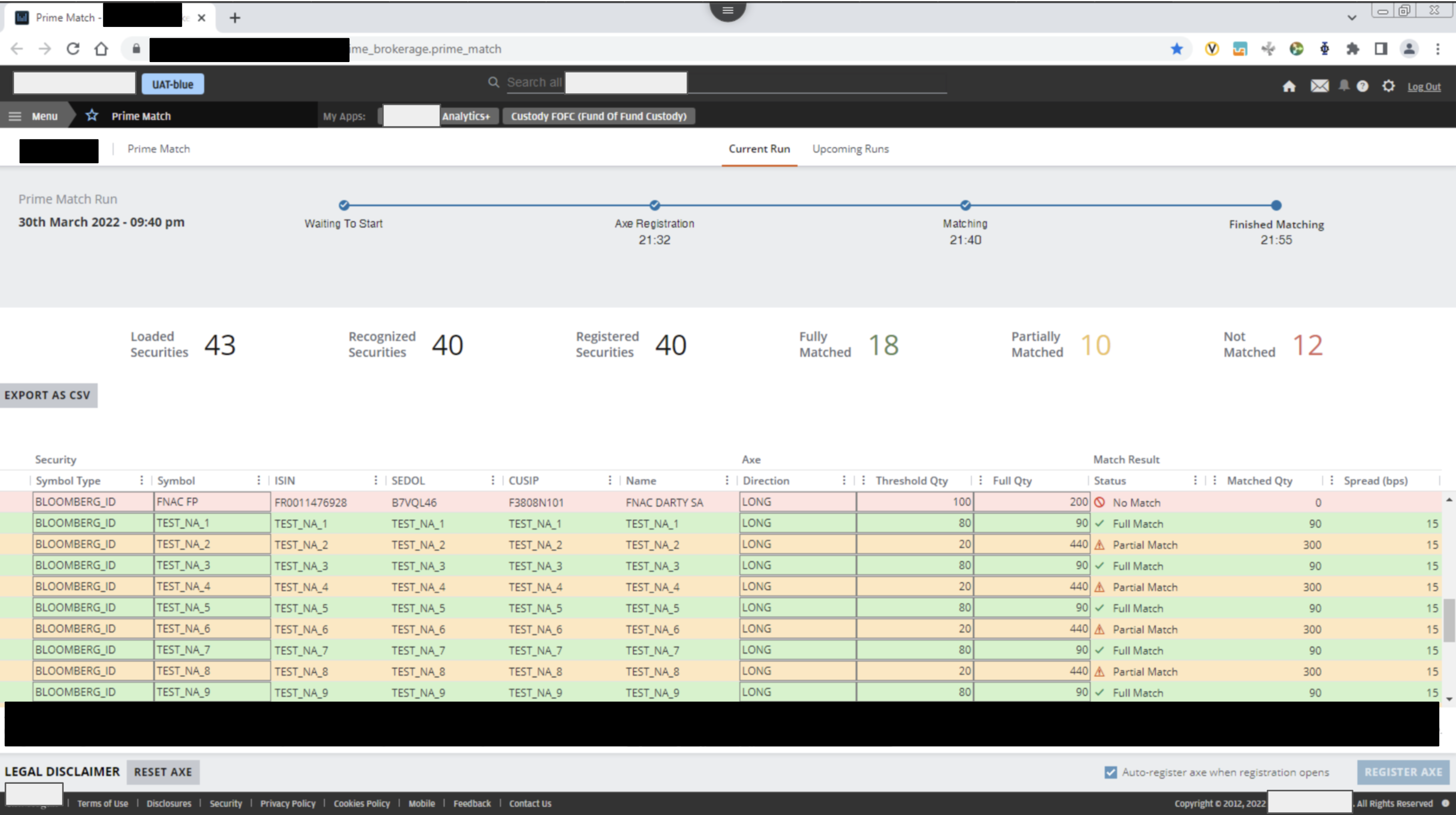
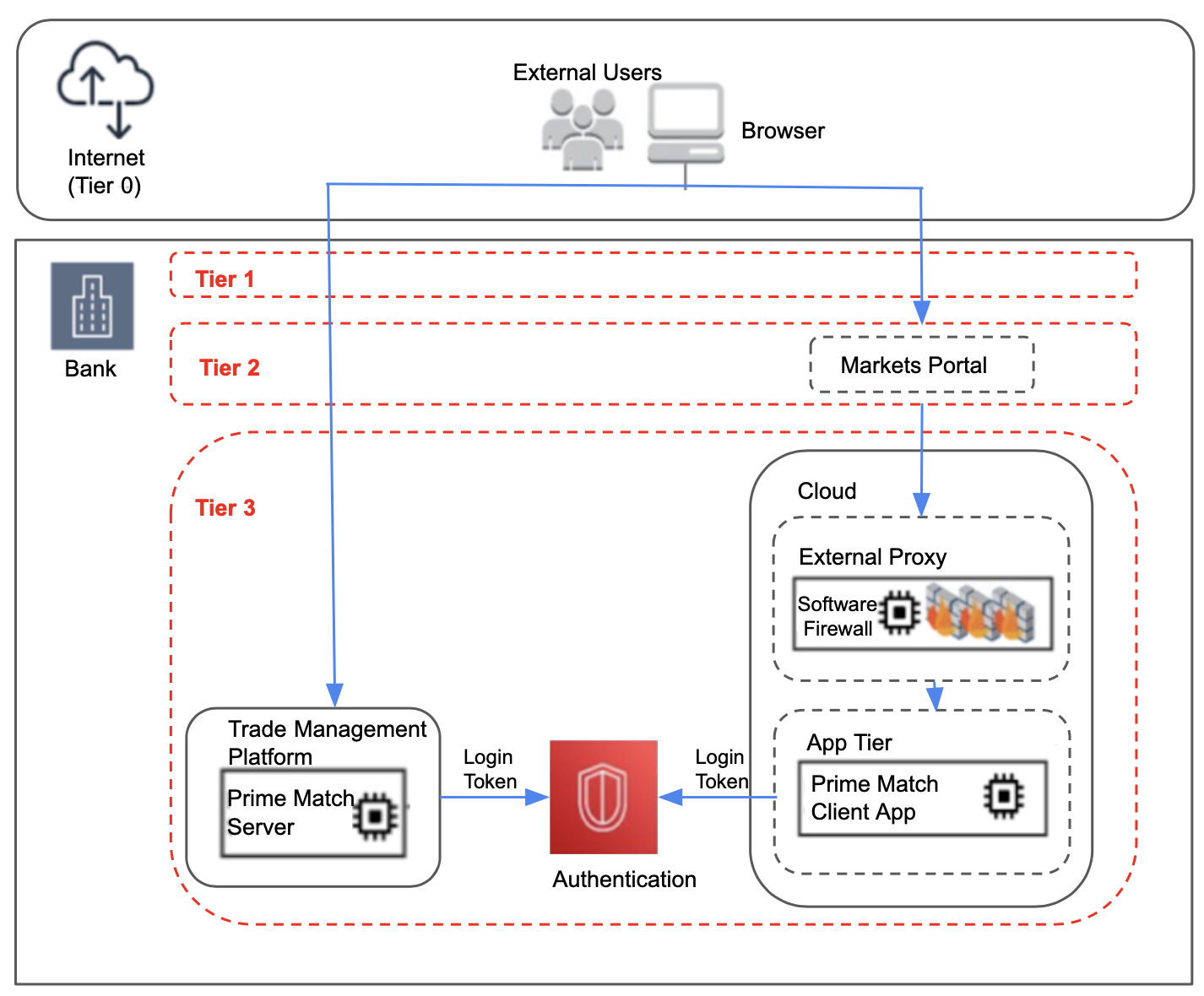
- The system uses a star-topology network with a central bank as coordinator, enabling practical deployment without requiring direct peer-to-peer connections between clients.
- Private order registration is performed client-side in the browser, where orders (symbol, direction, quantity) are encrypted before upload, ensuring data never leaves the client’s device.
- A two-round secure linear comparison protocol computes the minimum of two private quantities without preprocessing, providing malicious security and enabling efficient matching.
- The protocol reveals only the matched quantities and fixed spreads; all other data remains private, even in the absence of a match.
- The system processes orders in two phases: first, threshold quantities are evaluated to detect potential matches; only if a match is found are full quantities revealed.
- The application runs every 30 minutes on a production platform with 32 vCPUs, supporting up to 5000 symbols and 10–60 clients per auction.
Experimental results
Research questions
- RQ1Can a secure multiparty computation protocol be designed to privately match buy and sell orders in financial markets while ensuring no leakage of private data?
- RQ2How can a two-round secure comparison protocol be constructed to compute the minimum of two private values with malicious security and without preprocessing?
- RQ3What architectural and cryptographic trade-offs are required to deploy a secure multiparty computation system in a real-world, high-frequency financial environment?
- RQ4How can private order registration and matching be achieved in a browser-based, client-side computation model to ensure data never leaves the client’s device?
- RQ5What performance and scalability characteristics are achievable in a production deployment of such a system in a major financial institution?
Key findings
- Prime Match is the first secure multiparty computation system deployed in production within the traditional financial industry, currently running at J.P. Morgan since September 2021.
- The system achieves secure matching with no information leakage in the absence of a match, and only reveals matched quantities and fixed spreads when a match occurs.
- The two-round secure linear comparison protocol with malicious security is efficient and practical, enabling real-time matching every 30 minutes with sub-55 second completion times.
- Performance benchmarks show the system handles up to 5000 symbols and 10–60 clients per auction, with full quantities only revealed upon successful matching.
- The system is deployed using a browser-based, client-side computation model, ensuring all private data remains on the client’s device and is never transmitted to the server.
- The implementation successfully addresses real-world challenges such as network topology, latency, and integration with existing banking infrastructure, demonstrating feasibility of SMC in production finance.
Read this paper
Open the full text in the Nubint reader and ask about any passage as you read.
Read this paper on NubintThis review was generated by AI from the original paper. Please check the paper before citing it.