
[Paper Review] Priming bias versus post-treatment bias in experimental designs
This paper addresses the trade-off between priming bias (from pre-treatment covariate measurement) and post-treatment bias (from conditioning on treatment-affected moderators) in survey experiments. It proposes nonparametric bounds and sensitivity analyses to assess the robustness of interaction estimates under different measurement timing designs, demonstrating that even small post-treatment bias can severely widen confidence intervals in empirical applications.
Conditioning on variables affected by treatment can induce post-treatment bias when estimating causal effects. Although this suggests that researchers should measure potential moderators before administering the treatment in an experiment, doing so may also bias causal effect estimation if the covariate measurement primes respondents to react differently to the treatment. This paper formally analyzes this trade-off between post-treatment and priming biases in three experimental designs that vary when moderators are measured: pre-treatment, post-treatment, or a randomized choice between the two. We derive nonparametric bounds for interactions between the treatment and the moderator under each design and show how to use substantive assumptions to narrow these bounds. These bounds allow researchers to assess the sensitivity of their empirical findings to priming and post-treatment bias. We then apply the proposed methodology to a survey experiment on electoral messaging.
Motivation & Objective
- To formally analyze the trade-off between priming bias (from pre-treatment moderator measurement) and post-treatment bias (from conditioning on treatment-affected moderators) in experimental designs.
- To derive nonparametric bounds for treatment-by-moderator interactions under three designs: pre-treatment, post-treatment, and randomized timing of moderator measurement.
- To show how substantive assumptions—monotonicity of post-treatment effects and stability of the moderator under control—can narrow these bounds and improve inference.
- To develop a sensitivity analysis procedure that varies the proportion of respondents affected by post-treatment measurement bias to assess the credibility of empirical findings.
- To apply the framework to a survey experiment on land-based political appeals in Kenya, evaluating the robustness of estimated interaction effects on electoral support.
Proposed method
- Derives nonparametric bounds for the interaction between treatment and moderator under pre-treatment, post-treatment, and randomized moderator measurement designs.
- Imposes two substantive assumptions: (1) monotonicity of post-treatment effect (moderator values can only shift in one direction after treatment), and (2) stability of moderator under control (timing of measurement does not affect control group values).
- Proposes a sensitivity analysis that varies the maximum proportion of respondents, γ, whose moderator value changes due to post-test measurement, and assesses how bounds shift with γ.
- Uses the observed pre- and post-test distributions of the moderator (land insecurity) to set a lower bound on γ, which is then used as a starting point for sensitivity analysis.
- Applies the bounds and sensitivity analysis to a real survey experiment on land-based appeals in Kenya, using 95% confidence intervals around the bounds for inference.
- Employs a randomization-based approach to estimate bounds under the randomized timing design, allowing for comparison across designs.
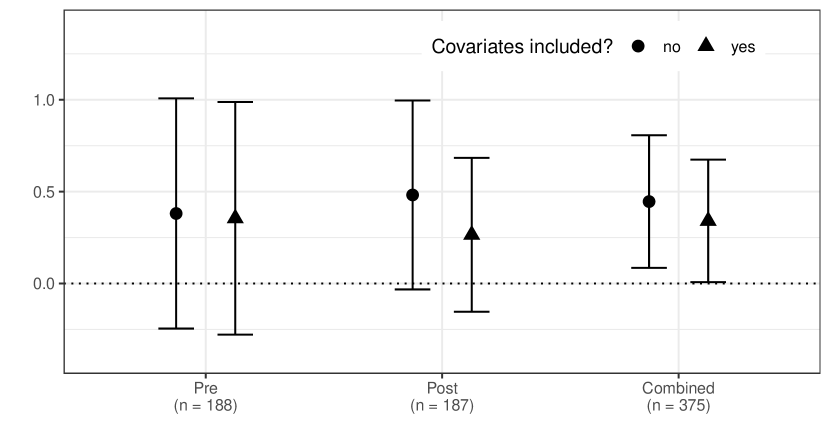
Experimental results
Research questions
- RQ1How do nonparametric bounds for treatment-by-moderator interactions differ across pre-treatment, post-treatment, and randomized moderator measurement designs?
- RQ2To what extent can substantive assumptions—monotonicity of post-treatment effects and stability of the moderator under control—narrow the nonparametric bounds for interaction effects?
- RQ3How sensitive are the bounds to plausible levels of post-treatment bias, measured by the proportion γ of respondents whose moderator value changes due to post-test measurement?
- RQ4What is the impact of priming bias on causal effect estimates when moderators are measured before treatment, and how can this be assessed via sensitivity analysis?
- RQ5How can researchers use sensitivity analysis to evaluate the credibility of interaction estimates in the presence of post-treatment or priming bias?
Key findings
- The nonparametric bounds for the interaction between land-based appeals and land insecurity are highly sensitive to post-treatment bias, with the lower bound crossing zero when γ ≤ 0.07.
- Even with the minimum feasible γ (0.02), the 95% confidence interval around the bounds includes zero, indicating that the estimated interaction effect is not statistically significant under plausible assumptions.
- When γ is at its minimum (0.02), the bounds are [0.38, 0.64]; when γ increases to 0.12 (based on a plausible subset of respondents affected by conflict), the bounds widen to [-1.02, 1.14], an eightfold increase in width.
- The sensitivity analysis shows that bounds stabilize beyond γ = 0.5, but the most critical changes occur at low values of γ, highlighting the importance of plausible assumptions about bias magnitude.
- The bounds under the post-test design are substantially wider than the naïve OLS estimate, which reports a positive interaction effect near statistical significance (p ≈ 0.05).
- Substantive knowledge suggests that only about 12% of respondents (those with prior ethnic conflict exposure and moderate initial land insecurity) are likely to be affected by post-test measurement, but this small group still causes substantial uncertainty in inference.
Read this paper
Open the full text in the Nubint reader and ask about any passage as you read.
Read this paper on NubintThis review was generated by AI from the original paper. Please check the paper before citing it.