
[Paper Review] Primordial black holes and stochastic inflation beyond slow roll: I -- noise matrix elements
This paper extends the stochastic inflation framework beyond slow-roll conditions to study primordial black hole (PBH) formation, focusing on noise matrix elements in an inflaton potential with a feature inducing ultra-slow-roll behavior. It finds that momentum-induced noise dominates during the transition, significantly altering quantum diffusion and the primordial curvature perturbation PDF, which critically impacts PBH mass fraction predictions.
Primordial Black Holes (PBHs) may form in the early Universe, from the gravitational collapse of large density perturbations, generated by large quantum fluctuations during inflation. Since PBHs form from rare over-densities, their abundance is sensitive to the tail of the primordial probability distribution function (PDF) of the perturbations. It is therefore important to calculate the full PDF of the perturbations, which can be done non-perturbatively using the 'stochastic inflation' framework. In single field inflation models generating large enough perturbations to produce an interesting abundance of PBHs requires violation of slow roll. It is therefore necessary to extend the stochastic inflation formalism beyond slow roll. A crucial ingredient for this are the stochastic noise matrix elements of the inflaton potential. We carry out analytical and numerical calculations of these matrix elements for a potential with a feature which violates slow roll and produces large, potentially PBH generating, perturbations. We find that the transition to an ultra slow-roll phase results in the momentum induced noise terms becoming larger than the field noise whilst each of them falls exponentially for a few e-folds. The noise terms then start rising with their original order restored, before approaching constant values which depend on the nature of the slow roll parameters in the post transition epoch. This will significantly impact the quantum diffusion of the coarse-grained inflaton field, and hence the PDF of the perturbations and the PBH mass fraction.
Motivation & Objective
- To extend the stochastic inflation formalism beyond slow-roll conditions, as required for models generating large primordial perturbations that may form PBHs.
- To calculate the stochastic noise matrix elements of the inflaton potential in a model with a feature causing ultra-slow-roll behavior.
- To assess how non-slow-roll dynamics—particularly the transition to ultra-slow-roll—affect quantum diffusion and the full probability distribution function (PDF) of curvature perturbations.
- To determine the impact of modified noise terms on the tail of the PDF, which governs the rare, large-amplitude fluctuations leading to PBH formation.
- To provide a non-perturbative framework for computing PBH mass fractions in inflationary models with non-trivial potential features.
Proposed method
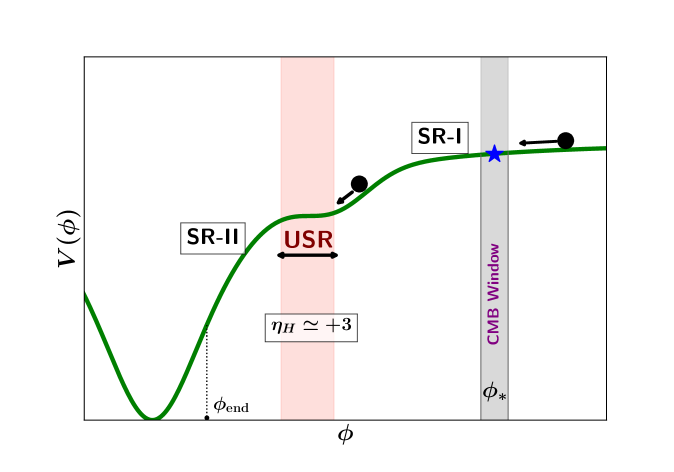
- Analytically and numerically compute the noise matrix elements for a single-field inflation model with a potential feature inducing a transient ultra-slow-roll (USR) phase.
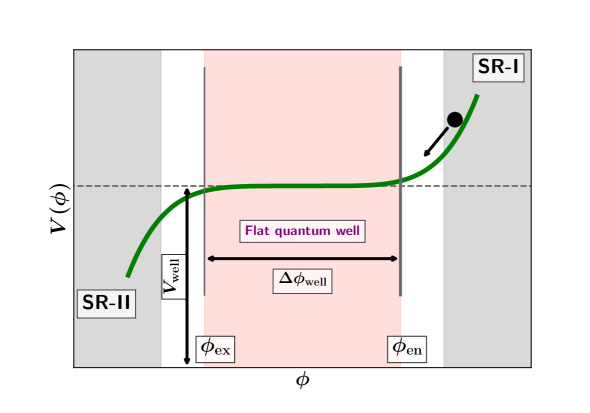
- Model the time evolution of the inflaton's slow-roll parameters using a piecewise potential with three distinct phases: initial slow roll (SR-I), ultra-slow roll (USR), and final slow roll (SR-II).
- Use the stochastic inflation formalism to derive the Fokker-Planck equation for the coarse-grained inflaton field, with noise terms derived from the inflaton potential's curvature and its time derivatives.
- Solve the mode functions for scalar perturbations in the three phases using Bessel functions and apply Israel junction conditions at transition points to match solutions across regions.
- Compute the noise matrix elements via the mode function derivatives and the power spectrum of curvature perturbations, incorporating delta-function impulses at transitions due to abrupt changes in slow-roll parameters.
- Analyze the time evolution of noise terms (field noise and momentum noise) across the USR transition, tracking their relative magnitudes and asymptotic behavior.
Experimental results
Research questions
- RQ1How do the stochastic noise matrix elements—specifically field noise and momentum-induced noise—evolve during a transition from slow roll to ultra-slow roll in an inflationary potential?
- RQ2What is the relative dominance of momentum-induced noise versus field noise during the ultra-slow-roll phase, and how does this affect quantum diffusion of the coarse-grained inflaton field?
- RQ3How do the noise terms behave after the ultra-slow-roll phase ends, and do they approach constant values dependent on the post-transition slow-roll parameters?
- RQ4To what extent does the transient ultra-slow-roll phase alter the full probability distribution function (PDF) of primordial curvature perturbations, particularly in its tail?
- RQ5How does the non-perturbative stochastic inflation framework, extended beyond slow roll, improve the accuracy of PBH mass fraction predictions compared to perturbative power-spectrum methods?
Key findings
- During the transition to ultra-slow-roll, momentum-induced noise terms become larger than field noise terms, indicating a significant shift in the dominant quantum diffusion mechanism.
- The noise terms initially fall exponentially over a few e-folds after the transition, before recovering their original order and eventually approaching constant values determined by the slow-roll parameters in the post-transition phase.
- The field noise and momentum noise terms are both modified by delta-function impulses at transition times due to abrupt changes in the slow-roll parameter η_H, which are incorporated via Israel junction conditions.
- The late-time behavior of the noise matrix elements depends on the nature of the slow-roll parameters after the ultra-slow-roll phase, with the system approaching a steady-state regime governed by the post-transition dynamics.
- The non-monotonic evolution of noise terms—initial suppression followed by recovery—implies a transient but significant impact on the quantum diffusion of the inflaton field, which directly affects the shape of the primordial PDF.
- These results imply that the full non-Gaussian tail of the PDF, critical for PBH formation, cannot be captured by perturbative methods and requires the extended stochastic inflation framework presented here.
Read this paper
Open the full text in the Nubint reader and ask about any passage as you read.
Read this paper on NubintThis review was generated by AI from the original paper. Please check the paper before citing it.