
[Paper Review] Principled Weight Initialization for Hypernetworks
The paper introduces hyperfan initialization for hypernetworks, providing principled variance-based schemes (hyperfan-in and hyperfan-out) to preserve mainnet activation/gradient scales, improving stability and convergence over ad-hoc initializations.
Hypernetworks are meta neural networks that generate weights for a main neural network in an end-to-end differentiable manner. Despite extensive applications ranging from multi-task learning to Bayesian deep learning, the problem of optimizing hypernetworks has not been studied to date. We observe that classical weight initialization methods like Glorot & Bengio (2010) and He et al. (2015), when applied directly on a hypernet, fail to produce weights for the mainnet in the correct scale. We develop principled techniques for weight initialization in hypernets, and show that they lead to more stable mainnet weights, lower training loss, and faster convergence.
Motivation & Objective
- Identify why classical weight initializations fail for hypernetworks generating mainnet weights.
- Develop principled variance-based initialization rules tailored to hypernetworks.
- Theoretically and empirically show that hyperfan initializations stabilize activations/gradients and improve convergence.
Proposed method
- Use variance analysis to derive hyperfan-in and hyperfan-out initializations for hypernetworks.
- Model the hypernet as generator of mainnet weights and analyze forward/backward variance propagation.
- Propose specific variance formulas for H, h, G, g layers to preserve mainnet activation/gradient variance.
- Differentiate cases where the hypernet outputs only weights or both weights and biases.
- Provide initialization schemes that align hypernet weight variance with classical fan-in/fan-out init semantics.
Experimental results
Research questions
- RQ1Why do classical initialization schemes fail when applied to hypernetworks generating mainnet weights?
- RQ2How can we initialize hypernetworks so that mainnet activations and gradients retain stable variance across depth?
- RQ3Do hyperfan-in and hyperfan-out initializations enable stable training across different mainnet architectures and tasks?
Key findings
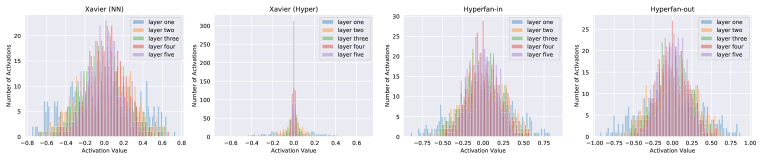
- Classical initializations on hypernets lead to exploding activations in the mainnet.
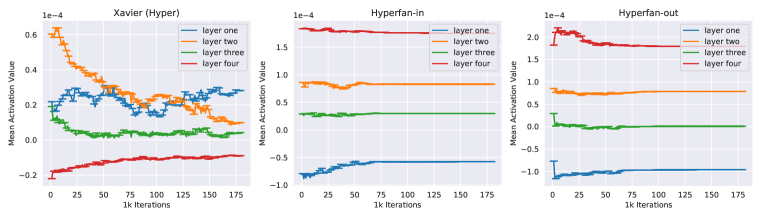
- Hyperfan-in and hyperfan-out initializations preserve mainnet variance and enable stable training.
- Hyperfan methods produce lower initial losses and faster convergence in MNIST feedforward experiments.
- Hyperfan initializations enable training when Xavier/Kaiming on hypernet fails (e.g., CIFAR-10, ImageNet Bayesian setup).
- Both hyperfan-in and hyperfan-out work with SGD across tasks, with no strong preference in practice.
Better researchstarts right now
From reading papers to final review, dramatically reduce your research time.
No credit card · Free plan available
This review was created by AI and reviewed by human editors.