
[Paper Review] PRIOR: Prototype Representation Joint Learning from Medical Images and Reports
This paper proposes PRIOR, a prototype representation learning framework that jointly learns global and local alignments between medical images and reports using a sentence-wise prototype memory bank and cross-modality conditional reconstruction. By modeling fine-grained visual and linguistic features through prototype categorization and non-auto-regressive generation, PRIOR achieves state-of-the-art performance across five downstream tasks on multiple datasets, including a 22.20% mAP on RSNA object detection under 100% training data.
Contrastive learning based vision-language joint pre-training has emerged as a successful representation learning strategy. In this paper, we present a prototype representation learning framework incorporating both global and local alignment between medical images and reports. In contrast to standard global multi-modality alignment methods, we employ a local alignment module for fine-grained representation. Furthermore, a cross-modality conditional reconstruction module is designed to interchange information across modalities in the training phase by reconstructing masked images and reports. For reconstructing long reports, a sentence-wise prototype memory bank is constructed, enabling the network to focus on low-level localized visual and high-level clinical linguistic features. Additionally, a non-auto-regressive generation paradigm is proposed for reconstructing non-sequential reports. Experimental results on five downstream tasks, including supervised classification, zero-shot classification, image-to-text retrieval, semantic segmentation, and object detection, show the proposed method outperforms other state-of-the-art methods across multiple datasets and under different dataset size settings. The code is available at https://github.com/QtacierP/PRIOR.
Motivation & Objective
- To address the limitations of existing vision-language pre-training methods in capturing fine-grained, locality-aware representations in medical imaging.
- To improve low-level feature learning—such as lesion boundaries and symptom descriptions—by leveraging structured clinical report semantics.
- To enable effective cross-modality information exchange through conditional reconstruction of masked images and sentence prototypes.
- To develop a non-auto-regressive, parallel decoding strategy for reconstructing non-sequential medical reports.
- To demonstrate the effectiveness of prototype-based representation learning in enhancing downstream medical image analysis tasks.
Proposed method
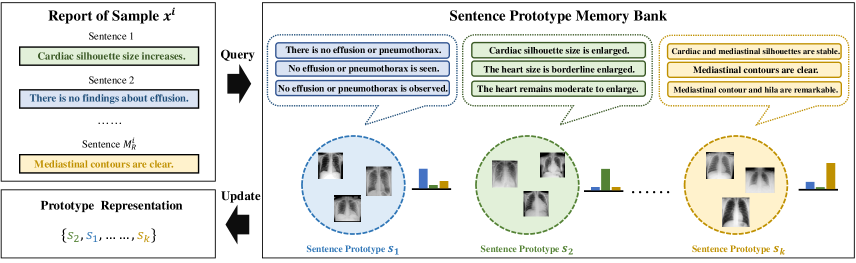
- A sentence-wise prototype memory bank is constructed to discretize sentence representations into categorical prototypes, enabling clustering of semantically similar clinical descriptions.
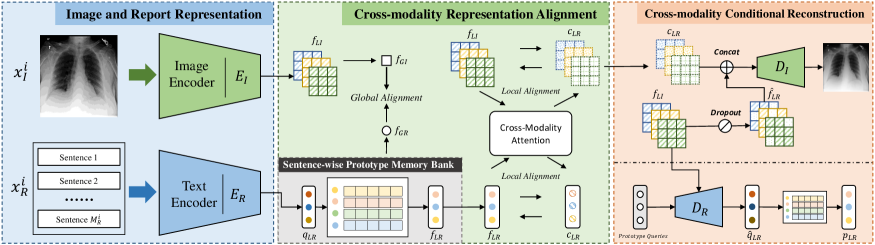
- A cross-modality conditional reconstruction module reconstructs masked images using report features and vice versa, maximizing conditional mutual information between modalities.
- A non-auto-regressive generation paradigm uses bipartite matching to reconstruct sentence prototypes in parallel, avoiding sequential autoregressive generation.
- Local alignment is enforced via a contrastive loss between image sub-regions and report sentences, with a modified sampling strategy to avoid spatially adjacent negative samples.
- Global representation is obtained via attention pooling over localized features, while local features are refined through prototype-based clustering.
- The framework integrates global alignment, local alignment, cross-modality reconstruction, and prototype memory bank in an end-to-end training scheme.
Experimental results
Research questions
- RQ1Can prototype-based representation learning improve the modeling of fine-grained, clinically relevant features in medical reports and images?
- RQ2How does cross-modality conditional reconstruction enhance low-level feature learning for locality-aware tasks such as segmentation and object detection?
- RQ3Does a non-auto-regressive, parallel decoding strategy outperform autoregressive generation for reconstructing non-sequential medical reports?
- RQ4To what extent does the sentence-wise prototype memory bank improve representation clustering and downstream task generalization?
- RQ5How do the individual components of the framework—local alignment, reconstruction, and prototype memory—contribute to overall performance?
Key findings
- PRIOR achieves 87.27% accuracy on 1% SIIM classification, outperforming the next best method by 2.42 percentage points.
- On 1% SIIM segmentation, PRIOR reaches 20.43% Dice score, a 2.55-point improvement over the baseline with all components.
- In RSNA object detection, PRIOR achieves 22.20% mAP(0.5:0.95) with 100% training data, surpassing the previous state-of-the-art by 0.55 points.
- Ablation studies confirm that all components—local alignment, cross-modality reconstruction, and the sentence prototype memory bank—are essential, with the full model outperforming variants by up to 4.5% on key tasks.
- t-SNE visualization shows that PRIOR produces more distinct, cluster-like representations compared to other methods, indicating better semantic separation.
- Cross-modality attention maps demonstrate that the model correctly localizes relevant image regions corresponding to specific report sentences, validating interpretability and alignment quality.
Read this paper
Open the full text in the Nubint reader and ask about any passage as you read.
Read this paper on NubintThis review was generated by AI from the original paper. Please check the paper before citing it.