
[Paper Review] Prismatic VLMs: Investigating the Design Space of Visually-Conditioned Language Models
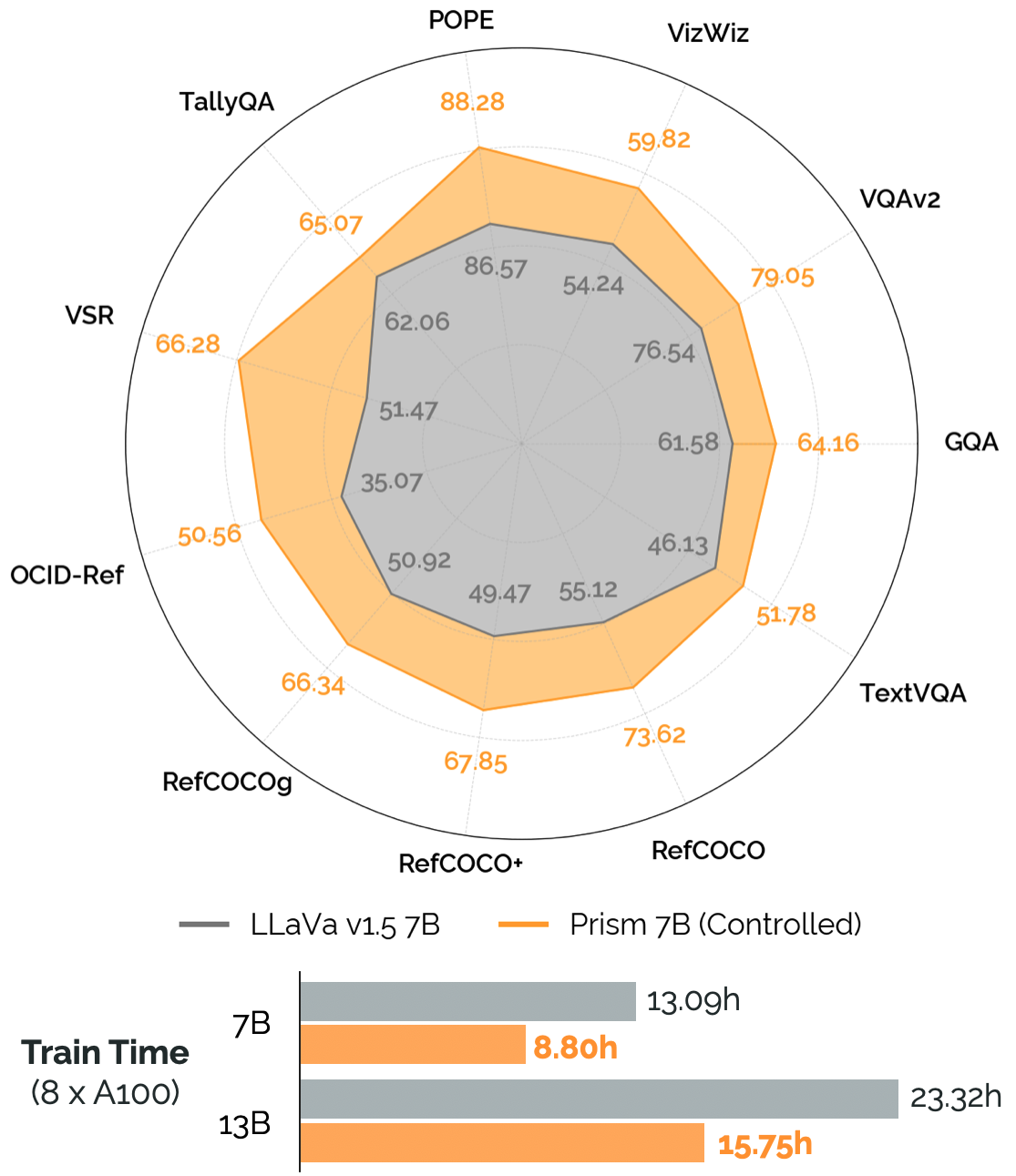
The paper probes design choices for visually-conditioned language models (VLMs) via a standardized evaluation suite and a modular training framework, introducing Prism s that outperform open baselines at 7B/13B scales.
Visually-conditioned language models (VLMs) have seen growing adoption in applications such as visual dialogue, scene understanding, and robotic task planning; adoption that has fueled a wealth of new models such as LLaVa, InstructBLIP, and PaLI-3. Despite the volume of new releases, key design decisions around image preprocessing, architecture, and optimization are under-explored, making it challenging to understand what factors account for model performance $-$ a challenge further complicated by the lack of objective, consistent evaluations. To address these gaps, we first compile a suite of standardized evaluations spanning visual question answering, object localization, and challenge sets that probe properties such as hallucination; evaluations that provide fine-grained insight VLM capabilities. Second, we rigorously investigate VLMs along key design axes, including pretrained visual representations and training from base vs. instruct-tuned language models, amongst others. We couple our analysis with three resource contributions: (1) a unified framework for evaluating VLMs, (2) optimized, flexible training code, and (3) checkpoints for all models, including a family of VLMs at the 7-13B scale that strictly outperform InstructBLIP and LLaVa v1.5, the state-of-the-art in open VLMs.
Motivation & Objective
- Provide a standardized, fine-grained evaluation suite for VLMs spanning VQA, localization, and challenge tasks.
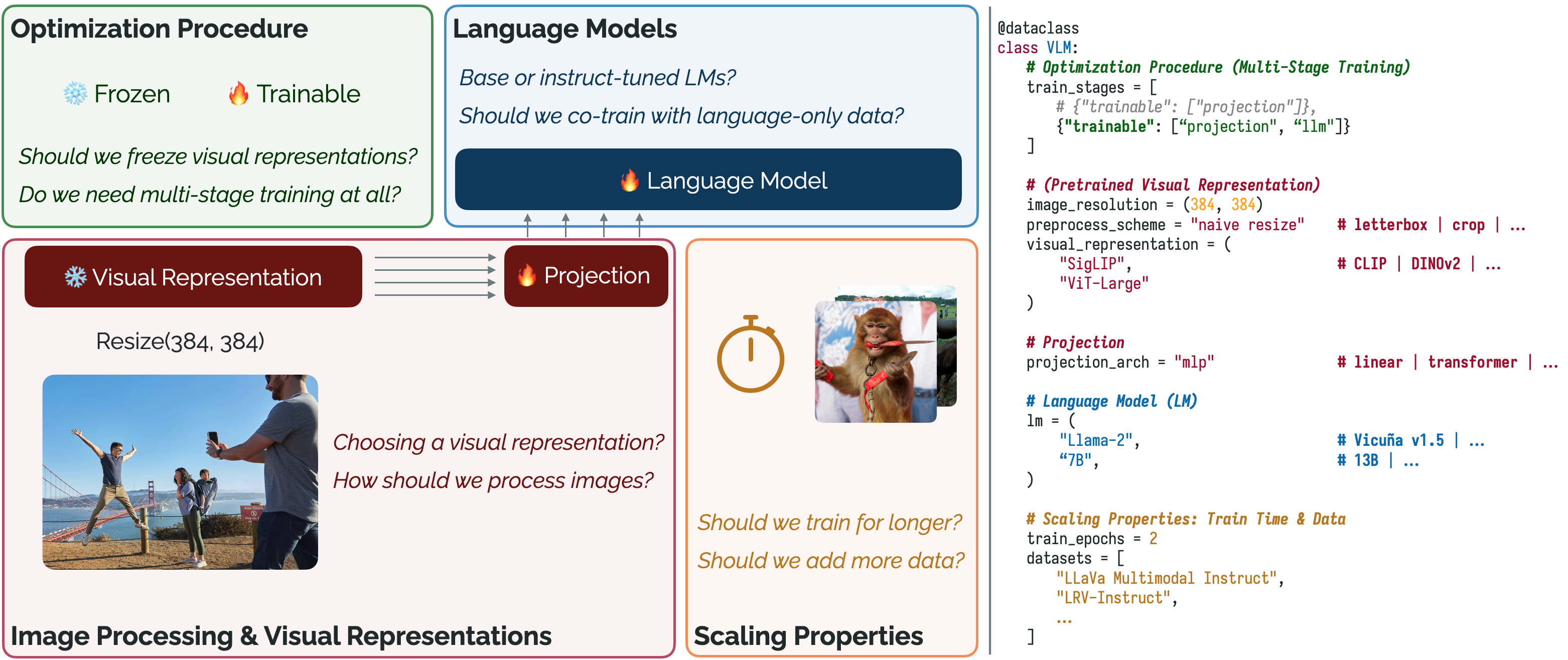
- Systematically analyze key design axes of VLMs including optimization, image processing, visual representations, and language models.
- Offer an optimized, flexible VLM training codebase and checkpoints to enable reproducibility and future research.
Proposed method
- Adopt a simple patch-as-token VLM architecture with a pretrained visual backbone, vision-language projector, and language model.
- Use a fully open pretraining data mixture (LLaVa v1.5 components) and single-stage training to contrast with multi-stage pipelines.
- Develop and release an optimized training framework using PyTorch with Fully Sharded Data Parallel (FSDP) and BF16 mixed precision.
- Construct an open evaluation suite with eleven benchmarks across VQA, localization, and challenge sets to probe capabilities and hallucination risks.
- Experiment across four design axes: optimization procedure, image processing/visual representations, language models, and scaling properties.
Experimental results
Research questions
- RQ1What design choices in image processing, visual representations, and language models most strongly affect VLM performance?
- RQ2Is multi-stage training necessary, or can single-stage training achieve comparable or better results more efficiently?
- RQ3Do fused visual backbones and ensembling improve VLM capabilities across tasks?
- RQ4How do base vs. instruct-tuned LMs compare in VLMs, and what safety effects arise from language-only data?
- RQ5How do training time and diverse data sources influence downstream performance?
Key findings
- Single-stage training maintains or improves performance while reducing compute cost by 20-25%.
- Finetuning the vision backbone beyond initial training degrades performance, especially on localization tasks.
- Fusing DINOv2 and SigLIP visual representations improves performance, with DINOv2 + SigLIP often being most effective.
- Base LMs (e.g., Llama-2) match or exceed instruct-tuned LMs in VLMs and exhibit fewer hallucinations; language-only safety data aids safeguards.
- Increasing image resolution to 336px or 384px significantly boosts performance, though with higher compute costs.
- Ensembling DINOv2 with SigLIP or CLIP/SigLIP features yields notable gains in localization and challenge tasks; naive image resizing can outperform letterbox padding in some setups.
- Adding diverse data sources (LVIS-Instruct-4V, LRV-Instruct) yields performance gains, with LRV-Instruct offering substantial improvements.
Read this paper
Open the full text in the Nubint reader and ask about any passage as you read.
Read this paper on NubintThis review was generated by AI from the original paper. Please check the paper before citing it.