
[Paper Review] Privacy Issues in Large Language Models: A Survey
A comprehensive survey of privacy risks in LLMs, covering memorization, privacy attacks, privacy-preserving training, unlearning, and copyright considerations.
This is the first survey of the active area of AI research that focuses on privacy issues in Large Language Models (LLMs). Specifically, we focus on work that red-teams models to highlight privacy risks, attempts to build privacy into the training or inference process, enables efficient data deletion from trained models to comply with existing privacy regulations, and tries to mitigate copyright issues. Our focus is on summarizing technical research that develops algorithms, proves theorems, and runs empirical evaluations. While there is an extensive body of legal and policy work addressing these challenges from a different angle, that is not the focus of our survey. Nevertheless, these works, along with recent legal developments do inform how these technical problems are formalized, and so we discuss them briefly in Section 1. While we have made our best effort to include all the relevant work, due to the fast moving nature of this research we may have missed some recent work. If we have missed some of your work please contact us, as we will attempt to keep this survey relatively up to date. We are maintaining a repository with the list of papers covered in this survey and any relevant code that was publicly available at https://github.com/safr-ml-lab/survey-llm.
Motivation & Objective
- Motivate privacy concerns in the deployment and training of large language models (LLMs).
- Summarize formal definitions and measurements of memorization and privacy risks in LLMs.
- Review privacy attacks against language models and mitigation techniques.
- Survey privacy-preserving learning methods and unlearning approaches relevant to LLMs.
- Discuss legal and copyright considerations related to training data and generated content.
Proposed method
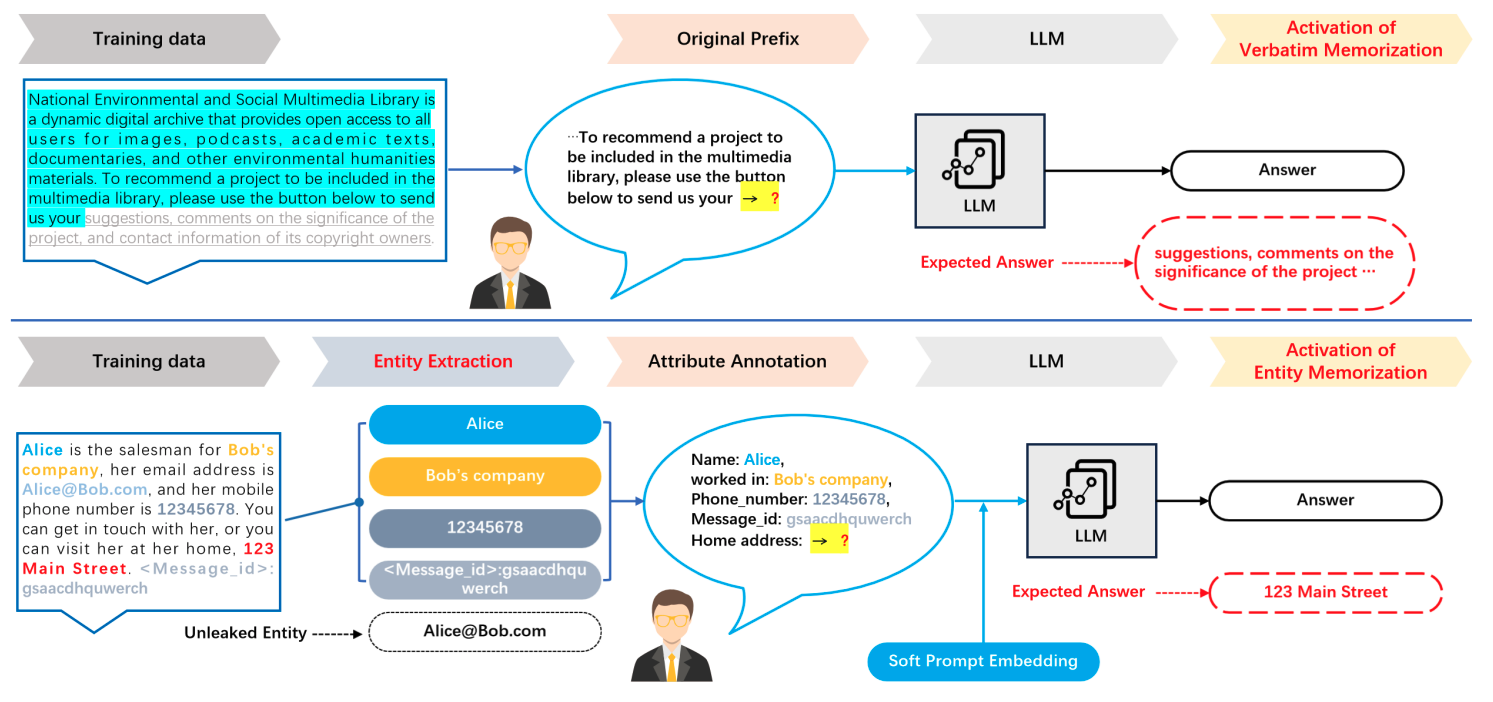
- Surveyed and organized existing technical research on LLM privacy, memorization measures, privacy attacks, and defenses.
- Defined core memorization concepts (eidetic, exposure, counterfactual) and related metrics (extractability, canaries, exposure).
- Reviewed model-size, data-duplication, and dataset-size as risk factors for memorization.
- Summarized rights-based and regulatory contexts (GDPR, DP, PETs) and legislative discussions impacting privacy.
- Outlined privacy-preserving training methods (DP, federated learning) and unlearning approaches in LLMs.
Experimental results
Research questions
- RQ1What are the formal definitions and measurements of memorization in LLMs and how do they relate to privacy risk?
- RQ2What factors (model size, dataset size, data duplication) influence memorization and privacy risk in LLMs?
- RQ3What privacy attacks threaten LLMs, and how can they be mitigated through training-time and post-training techniques?
- RQ4What privacy-preserving learning paradigms and unlearning methods are applicable to LLMs, and what are their limitations?
- RQ5How do copyright and data-rights considerations intersect with LLM privacy and mitigation strategies?
Key findings
- LLMs memorize training data, and memorization increases with model size and training capacity.
- Data duplication in training data substantially amplifies memorization, with deduplication reducing memorized outputs.
- Different memorization definitions (extractability, exposure, counterfactual memorization) capture varied privacy risks and have distinct practical trade-offs.
- Privacy attacks such as membership inference, data extraction, and attribute inference threaten LLM privacy, prompting DP and federated learning as mitigation strategies.
- Unlearning and memory-erasure techniques are active research areas motivated by regulatory rights like GDPR’s right to erasure, with evolving technical approaches.
- Copyright considerations around training data and generated content drive both legal and technical governance in LLM privacy.

Read this paper
Open the full text in the Nubint reader and ask about any passage as you read.
Read this paper on NubintThis review was generated by AI from the original paper. Please check the paper before citing it.