
[Paper Review] Privacy-Preserving Language Model Inference with Instance Obfuscation
This paper introduces Instance-Obfuscated Inference (IoI), a novel method to protect decision privacy in black-box Language Model as a Service (LMaaS) by obfuscating input instances before inference, ensuring that model outputs remain confidential while preserving task performance. IoI enables users to recover true decisions without exposing sensitive information, marking the first approach to address decision privacy in PLM inference under black-box constraints.
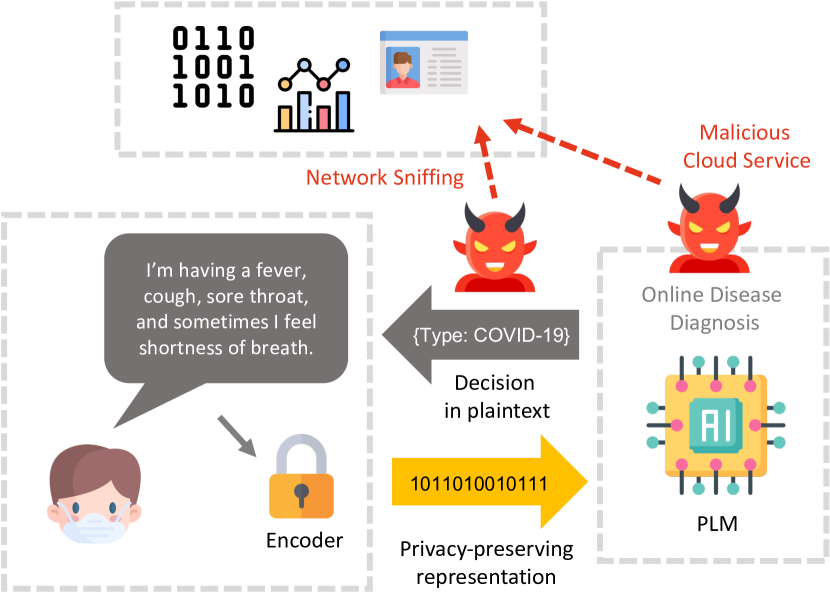
Language Models as a Service (LMaaS) offers convenient access for developers and researchers to perform inference using pre-trained language models. Nonetheless, the input data and the inference results containing private information are exposed as plaintext during the service call, leading to privacy issues. Recent studies have started tackling the privacy issue by transforming input data into privacy-preserving representation from the user-end with the techniques such as noise addition and content perturbation, while the exploration of inference result protection, namely decision privacy, is still a blank page. In order to maintain the black-box manner of LMaaS, conducting data privacy protection, especially for the decision, is a challenging task because the process has to be seamless to the models and accompanied by limited communication and computation overhead. We thus propose Instance-Obfuscated Inference (IOI) method, which focuses on addressing the decision privacy issue of natural language understanding tasks in their complete life-cycle. Besides, we conduct comprehensive experiments to evaluate the performance as well as the privacy-protection strength of the proposed method on various benchmarking tasks.
Motivation & Objective
- To address the critical gap in protecting decision privacy—i.e., the confidentiality of model inference outputs—in Language Model as a Service (LMaaS) systems.
- To design a black-box compatible solution that does not require model modification or access to internal parameters, preserving the intellectual property of service providers.
- To enable users to obfuscate input instances in a way that hides raw decision distributions while retaining the ability to reconstruct accurate predictions.
- To define and evaluate new metrics for decision privacy, ensuring rigorous assessment of privacy strength and task performance.
- To demonstrate feasibility and effectiveness of instance obfuscation for text classification tasks under real-world LMaaS constraints.
Proposed method
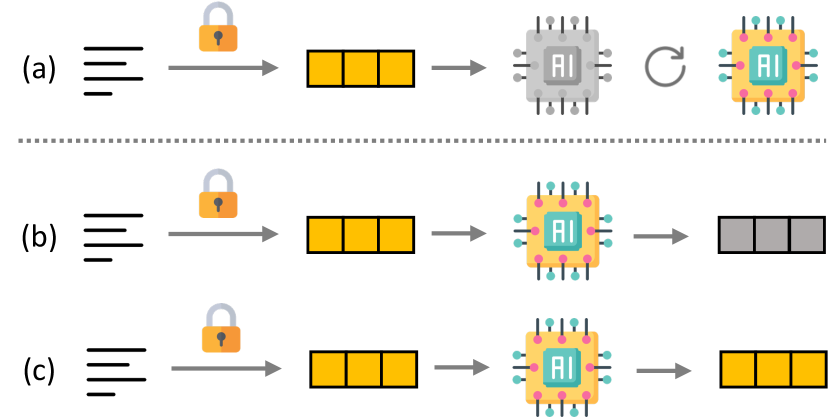
- IoI introduces a technique that intentionally obfuscates input instances before sending them to the cloud-based language model, using strategies such as balancing and randomization to hide the true instance.
- The method relies on instance-level obfuscation via representation mixup-like techniques, where the target instance is combined with obfuscators to mask its decision distribution.
- Obfuscation is applied at inference time, ensuring that the model never sees the original input or output in plaintext, thus protecting both input and decision privacy.
- A recovery mechanism allows the user to reconstruct the true decision from multiple obfuscated inferences, preserving model accuracy despite obfuscation.
- The approach is designed to be compatible with existing input privacy techniques, enabling layered protection without requiring changes to the model or infrastructure.
- The method is evaluated under a black-box setting, maintaining model compatibility and minimizing communication and computational overhead.
Experimental results
Research questions
- RQ1Can decision privacy be effectively protected in a black-box LMaaS setting without modifying the model or exposing internal parameters?
- RQ2How can instance obfuscation be designed to hide sensitive decision distributions while preserving model performance?
- RQ3What evaluation metrics are suitable for measuring decision privacy strength in NLP inference?
- RQ4How does IoI compare to existing input-only privacy techniques in terms of privacy protection and task accuracy?
- RQ5What is the trade-off between privacy strength and inference cost in the proposed obfuscation framework?
Key findings
- IoI successfully protects decision privacy in text classification tasks under a black-box LMaaS setting, marking the first such approach to address this gap.
- The method maintains high task performance, with minimal degradation in accuracy compared to baseline models, even under strong obfuscation.
- Evaluation metrics for decision privacy demonstrate that IoI effectively hides sensitive information in model outputs, reducing the risk of inference leakage.
- The approach incurs only moderate additional inference cost due to multiple obfuscated requests, which is significantly lower than alternatives requiring model fine-tuning or full model sharing.
- IoI is compatible with existing input privacy techniques, enabling layered privacy protection without compromising system usability or model integrity.
- The method is not directly applicable to generative tasks due to challenges in handling variable-length outputs and token-level mixup, indicating a need for future adaptation.
Read this paper
Open the full text in the Nubint reader and ask about any passage as you read.
Read this paper on NubintThis review was generated by AI from the original paper. Please check the paper before citing it.