
[Paper Review] Proactive Detection of Voice Cloning with Localized Watermarking
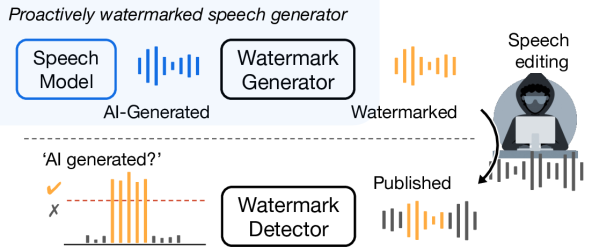
AudioSeal is a proactive, localized audio watermarking system that detects, localizes to sample level, and attributes AI-generated speech with a fast single-pass detector, outperforming prior watermarking methods.
In the rapidly evolving field of speech generative models, there is a pressing need to ensure audio authenticity against the risks of voice cloning. We present AudioSeal, the first audio watermarking technique designed specifically for localized detection of AI-generated speech. AudioSeal employs a generator/detector architecture trained jointly with a localization loss to enable localized watermark detection up to the sample level, and a novel perceptual loss inspired by auditory masking, that enables AudioSeal to achieve better imperceptibility. AudioSeal achieves state-of-the-art performance in terms of robustness to real life audio manipulations and imperceptibility based on automatic and human evaluation metrics. Additionally, AudioSeal is designed with a fast, single-pass detector, that significantly surpasses existing models in speed - achieving detection up to two orders of magnitude faster, making it ideal for large-scale and real-time applications.
Motivation & Objective
- Motivate the need for authenticating speech against voice cloning and misuses of generative models.
- Propose a localized watermarking approach (AudioSeal) to enable detection, localization, and attribution of AI-generated speech.
- Jointly train a generator and detector to embed imperceptible watermarks and detect them at high precision.
- Incorporate novel perceptual and localization losses to improve imperceptibility and sample-level localization.
- Evaluate robustness, localization accuracy, and computational efficiency against real-world audio edits.
Proposed method
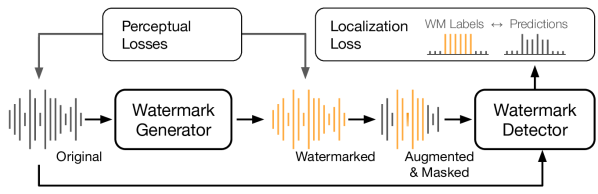
- Joint generator-detector architecture where the generator adds an additive watermark to audio.
- Detector outputs sample-level detection logits indicating watermark presence.
- Training uses a masked localization strategy to enable precise sample-level localization.
- Novel TF-Loudness perceptual loss inspired by auditory masking to improve imperceptibility.
- Four-stage training with watermark masking augmentations and robust audio-editing augmentations.
- Optional multi-bit watermarking to attribute audio to a model/version.
Experimental results
Research questions
- RQ1Can localized watermarking enable sample-level detection of AI-generated speech within longer audio?
- RQ2How robust is the proposed AudioSeal approach to common real-life audio manipulations and edits?
- RQ3Does the detector support fast, real-time detection without brute-force synchronization?
- RQ4Can multi-bit messages enable attribution to specific model versions without compromising detection?
- RQ5What is the impact of watermarking on perceptual speech quality compared to prior methods?
Key findings
- AudioSeal achieves state-of-the-art robustness to a wide range of audio edits and near-perfect detection rates.
- The detector runs in a single pass, yielding logits at every time step for real-time detection.
- Localization accuracy is high, achieving sample-level localization (1/16k seconds) and IoU near 0.99 for short watermarked segments.
- AudioSeal is up to two orders of magnitude faster in detection than prior methods like WavMark; generation is also faster by ~14x.
- Multi-bit watermarking enables attribution to a model/version with high accuracy; detection remains robust under edits.
- Empirical analysis shows keeping detector weights private is important to resist adversarial watermark removal.
Read this paper
Open the full text in the Nubint reader and ask about any passage as you read.
Read this paper on NubintThis review was generated by AI from the original paper. Please check the paper before citing it.