
[Paper Review] Probabilistically Correct Language-based Multi-Robot Planning using Conformal Prediction
This paper proposes a decentralized, LLM-based multi-robot planner that uses conformal prediction to quantify uncertainty and ensure user-specified mission success rates. By enabling robots to make decisions when confident and request help when uncertain, the method achieves 96.57% success rate at 95% confidence while minimizing help requests, outperforming prior centralized and decentralized LLM planners in complex scenarios.
This paper addresses task planning problems for language-instructed robot teams. Tasks are expressed in natural language (NL), requiring the robots to apply their capabilities at various locations and semantic objects. Several recent works have addressed similar planning problems by leveraging pre-trained Large Language Models (LLMs) to design effective multi-robot plans. However, these approaches lack performance guarantees. To address this challenge, we introduce a new distributed LLM-based planner, called S-ATLAS for Safe plAnning for Teams of Language-instructed AgentS, that is capable of achieving user-defined mission success rates. This is accomplished by leveraging conformal prediction (CP), a distribution-free uncertainty quantification tool in black-box models. CP allows the proposed multi-robot planner to reason about its inherent uncertainty in a distributed fashion, enabling robots to make individual decisions when they are sufficiently certain and seek help otherwise. We show, both theoretically and empirically, that the proposed planner can achieve user-specified task success rates, assuming successful plan execution, while minimizing the overall number of help requests. We provide comparative experiments against related works showing that our method is significantly more computational efficient and achieves lower help rates. The advantage of our algorithm over baselines becomes more pronounced with increasing robot team size.
Motivation & Objective
- To address the lack of safety and performance guarantees in existing LLM-based multi-robot planners, which often hallucinate or fail under uncertainty.
- To enable decentralized, language-instructed multi-robot planning with provable mission success rates using uncertainty quantification.
- To minimize reliance on human intervention by allowing robots to autonomously request help only when their confidence is low.
- To design a planner that maintains high planning accuracy even as mission complexity and robot team size increase.
- To integrate conformal prediction with LLMs in a multi-agent setting to produce reliable, valid action prediction sets.
Proposed method
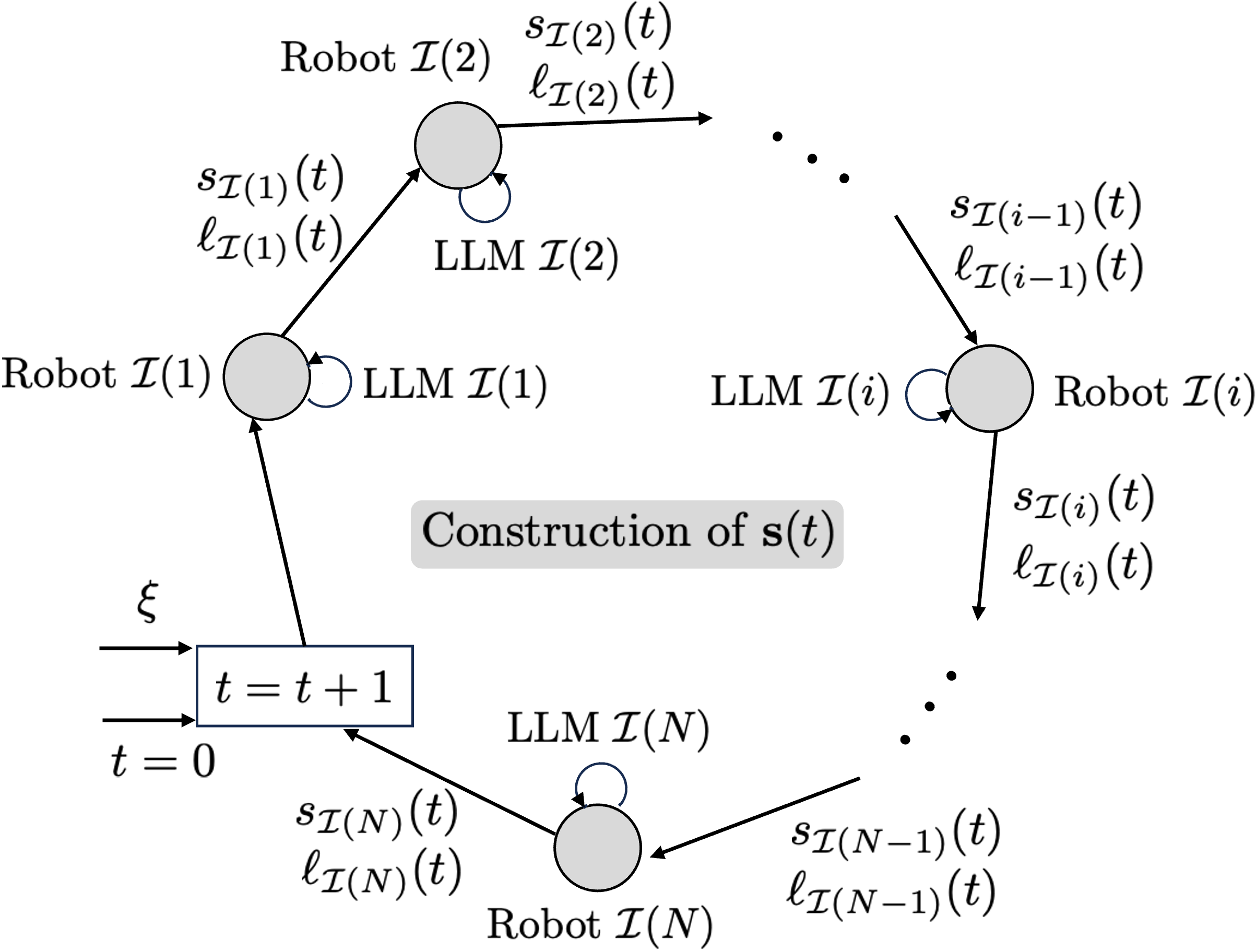
- Each robot is assigned a pre-trained LLM agent that selects actions via a multiple-choice question-answering (MCQA) framework, restricting choices to valid actions and reducing hallucination.
- Conformal prediction is applied to the LLM’s output to generate prediction sets for each robot’s next action, quantifying uncertainty in a distribution-free manner.
- The planner uses a coordinate-descent approach, where robots sequentially select actions based on the history of decisions from others, ensuring coordination.
- When a prediction set is non-singleton, the robot may request help; the system re-computes the plan using different robot ordering sets (I) to potentially reduce uncertainty.
- If no ordering yields a singleton set within W attempts, the system requests help from a human user, ensuring correctness.
- The method is theoretically grounded in conformal prediction, guaranteeing that the true action lies in the prediction set with probability at least 1−α.

Experimental results
Research questions
- RQ1Can a decentralized LLM-based planner achieve user-specified mission success rates without relying on centralized supervision?
- RQ2How can conformal prediction be effectively integrated into multi-robot planning to quantify uncertainty in a decentralized, black-box LLM setting?
- RQ3Does the proposed method reduce help requests compared to baseline LLM planners while maintaining or improving planning accuracy?
- RQ4How does the performance of the planner scale with increasing mission complexity and robot team size?
- RQ5Can reordering the robot selection sequence (I) lead to smaller prediction sets and thus reduce the need for human intervention?
Key findings
- The proposed planner achieved a mission success rate of 87.9% without help requests, validating its baseline performance.
- When targeting a 90% success rate (1−α=0.90), the method achieved 94.59% success rate by allowing help requests, confirming theoretical guarantees.
- For a 95% success rate (1−α=0.95), the planner achieved 96.57% success rate, demonstrating strong empirical alignment with theoretical bounds.
- At 90% and 95% confidence levels, help was requested in 4.44% and 8.1% of decisions, respectively, showing low intervention overhead.
- Reordering the robot selection set (I) successfully reduced non-singleton prediction sets to singletons in two out of five tested scenarios, reducing reliance on human help.
- The proposed method outperformed recent centralized and decentralized LLM-based planners in planning accuracy, especially as mission complexity and team size increased.
Read this paper
Open the full text in the Nubint reader and ask about any passage as you read.
Read this paper on NubintThis review was generated by AI from the original paper. Please check the paper before citing it.