
[Paper Review] Probing Leptogenesis through Gravitational Waves
This paper proposes that gravitational waves (GWs) emitted during the out-of-equilibrium decay of heavy right-handed neutrinos (RHNs) in leptogenesis can serve as a detectable probe of baryon asymmetry generation. The mechanism arises from graviton bremsstrahlung in RHN decays, with GW spectra sensitive to RHN mass and decay dynamics, enabling future detection via resonant cavity experiments for RHN masses near 10^15 GeV.
We propose that a gravitational wave can be generated during leptogenesis in the early Universe which occurs when a heavy right handed neutrino decays out of equilibrium. Such a gravitational wave, as remnant of leptogenesis, is shown to be associated with distinguishing signatures that act as a powerful probe to leptogenesis and its requirements, which otherwise remains difficult to validate despite its success in explaining the baryon asymmetry of the Universe bearing connection to neutrino physics.
Motivation & Objective
- To establish a novel observational probe for leptogenesis, a leading mechanism for baryon asymmetry, using gravitational waves (GWs) from heavy right-handed neutrino (RHN) decays.
- To address the challenge that RHNs required for leptogenesis are too heavy for terrestrial collider detection, by proposing GW emission as an alternative probe.
- To demonstrate that GWs from RHN decay can carry signatures of the CP-asymmetry and mass scale of the RHNs, enabling indirect testing of leptogenesis.
- To extend the applicability of GW detection to non-thermal and phase transition-induced leptogenesis scenarios involving RHNs.
- To evaluate the detectability of such GWs with current and future GW detectors, particularly resonant cavity experiments.
Proposed method
- Derive the effective interaction Lagrangian for graviton emission via the minimal coupling of the stress-energy tensor of SM fields (leptons, Higgs) to the graviton, using the Einstein-Hilbert action and weak-field approximation.
- Model the three-body decay process $N_i \to \ell_L + H + h_{\mu\nu}$ (RHN to lepton, Higgs, and graviton) as a bremsstrahlung process, with the graviton coupling to the stress-energy tensor $T^{\mu\nu}_X$.
- Calculate the gravitational wave energy density spectrum $\Omega_{\text{GW}} h^2$ from RHN decays using the decay width and phase space, incorporating the RHN's mass, temperature, and CP-asymmetry.
- Apply the formalism to both thermal and non-thermal leptogenesis scenarios, including cases where RHNs acquire mass via a phase transition (first or second order), with sudden mass generation at $T_*$.
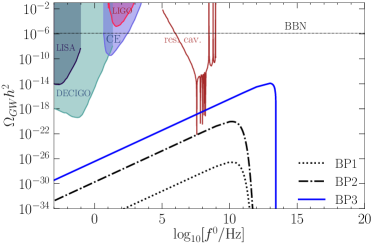
- Assess detectability by comparing the predicted GW spectrum with the sensitivity curves of proposed GW detectors, particularly resonant cavity experiments.
- Use the type-I seesaw Lagrangian with two RHNs to compute the CP asymmetry $\varepsilon^i_\ell$ and ensure the observed baryon asymmetry is reproduced while GWs are emitted.
Experimental results
Research questions
- RQ1Can gravitational waves be generated during the out-of-equilibrium decay of heavy right-handed neutrinos in the early Universe?
- RQ2What is the spectral signature of gravitational waves produced via graviton bremsstrahlung in RHN decays, and how does it encode information about the RHN mass and CP asymmetry?
- RQ3Can such gravitational waves be detectable with current or proposed GW detectors, particularly for RHN masses beyond the reach of colliders?
- RQ4How does the GW spectrum differ in scenarios where RHNs gain mass via a phase transition compared to thermal leptogenesis?
- RQ5Can this GW signal distinguish between different leptogenesis mechanisms, such as thermal vs. non-thermal, or type-I vs. type-II seesaw?
Key findings
- Gravitational waves are produced via the bremsstrahlung process $N_i \to \ell_L + H + h_{\mu\nu}$, with the graviton coupling to the stress-energy tensor of SM fields, providing a direct link to leptogenesis dynamics.
- For a heavy right-handed neutrino with mass $M_1 = 10^{15}$ GeV and $M_2 = 5M_1$, the resulting GW spectrum falls within the sensitivity range of proposed resonant cavity experiments, as shown by the blue solid line in Fig. 3.
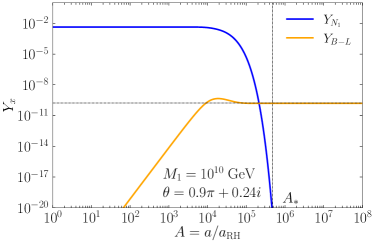
- The phase transition scenario, where RHNs become massive at $T_* = 10^{12}$ GeV, avoids the $\Delta L=2$ process erasure of asymmetry (valid up to $M_{\text{max}} \lesssim 10^{13}$ GeV), allowing for successful leptogenesis and detectable GW emission.
- The model remains perturbative up to $M_1 \lesssim 10^{16}$ GeV, beyond which neutrino Yukawa couplings exceed perturbative limits, setting an upper bound on detectable RHN masses.
- The GW signal is robust across different leptogenesis scenarios, including non-thermal and phase transition-induced RHN mass generation, indicating broad applicability.
- Future high-frequency GW detectors with enhanced sensitivity could extend the probe to lighter seesaw states, including those below the electroweak scale, if their mass evolves with temperature in the early Universe.
Read this paper
Open the full text in the Nubint reader and ask about any passage as you read.
Read this paper on NubintThis review was generated by AI from the original paper. Please check the paper before citing it.